Do Weighted Hula Hoops Actually Work for Core Training?
Weighted hula hoops do provide a genuine, if modest, core and oblique workout by forcing the torso muscles to continuously stabilize against a heavier, more momentum-driven hoop, and the added weight makes the movement noticeably more demanding than a lightweight toy hoop, but it is a light-to-moderate cardio and stabilization activity rather than a substitute for targeted strength training.
What is actually working during hooping
Keeping a weighted hoop spinning around the waist requires continuous small contractions in the obliques, deep core stabilizers, and hip muscles to match the hoop’s rotational momentum, which is a real, repeated muscular demand even though it looks like a simple circular motion from the outside.
Why weight changes the effort level
A heavier hoop carries more momentum once spinning, which means the core has to generate and absorb more rotational force with each pass, similar to how a heavier medicine ball demands more core engagement than a light one during a twisting exercise, making weighted hoops a noticeably harder workout than a lightweight hoop.
What the research actually shows
Studies on hooping have found measurable reductions in waist circumference and modest improvements in core endurance over several weeks of regular use, generally in people who were not already doing targeted ab training, though the effect size is modest compared to dedicated strength training programs.
Where it falls short as a core workout
Hooping mainly trains rotational endurance and stabilization at a continuous, moderate intensity rather than building raw strength the way weighted exercises like planks with added load, cable rotations, or hanging leg raises do, so it works best as a complement to strength training rather than a replacement for it.
Cardio benefit alongside the core work
Sustained hooping sessions also raise heart rate meaningfully, giving it a real light cardio component, which is part of why some studies measure waist and general fitness improvements together rather than core strength changes alone. A thirty minute session at a steady pace can realistically burn a meaningful number of calories for someone who sticks with it regularly, which adds a genuine cardiovascular argument alongside the core stabilization work itself.
Who tends to see the most benefit
People newer to structured exercise or those looking for a low-impact, repetitive activity they will actually stick with tend to see the clearest gains, since consistency matters more than the specific exercise, while already well-trained lifters typically see smaller added benefit to their existing core strength.
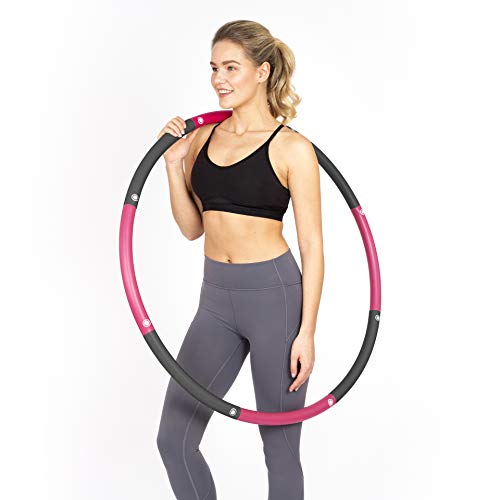
Lifeline Weighted Fitness Hoop
A segmented weighted hoop designed for adult fitness use, offering a heavier resistance level than standard toy hoops.

Sunny Health & Fitness Weighted Hula Hoop
A padded weighted hoop marketed for home core workouts, assembled from connecting segments for storage convenience.
Good to know
How heavy should a weighted hula hoop be for beginners?
Most beginners do well starting somewhere around one and a half to two and a half pounds, since a hoop that heavy is manageable to keep spinning while still providing more resistance than a lightweight toy hoop.
Can hooping actually reduce belly fat specifically?
Hooping burns calories and can contribute to overall fat loss alongside a broader calorie deficit, but it cannot specifically target belly fat any more than any other exercise can, since localized fat loss from one exercise is not how the body actually works.
Is weighted hooping safe for people with back problems?
People with existing back issues should check with a doctor or physical therapist first, since the repeated rotational movement, while generally low impact, may not suit every back condition, particularly disc-related issues.
How long should a hooping session last to see benefits?
Most studies showing measurable benefit used sessions in the range of ten to thirty minutes, several times a week, over at least several weeks, rather than a single short session.
Does hooping work the same muscles as crunches?
Not entirely, crunches primarily target the rectus abdominis through flexion, while hooping emphasizes the oblique muscles and deep stabilizers through continuous rotational control, so the two exercises complement rather than duplicate each other.
Can hooping bruise your waist or hips?
Mild bruising on the hips or waist is common for beginners as the body adjusts to the repeated contact, and it typically fades as technique improves and the skin and underlying tissue adapt over the first couple of weeks.
Is a weighted hoop better than a regular hula hoop for fitness?
For fitness purposes specifically, yes, the added resistance from a weighted hoop makes the core work harder than a lightweight hoop designed mainly for tricks or play.
Do you need any prior skill to use a weighted hoop effectively?
A basic hooping motion is learnable within a session or two for most people, and a heavier weighted hoop is actually often easier for beginners to keep spinning than a very light hoop, since momentum helps maintain the motion.
How soon can someone expect to notice a difference from hooping?
Some people notice improved core endurance and better hoop control within two to three weeks of regular practice, while visible changes in waist measurement typically take longer and depend heavily on overall diet and activity level.
Can hooping help with posture?
Indirectly, since stronger core and hip stabilizers support better upright posture generally, though hooping alone is not a targeted posture-correction exercise the way specific postural strengthening routines are.
Is hooping a good option for someone who cannot do traditional ab exercises?
It can be a reasonable lower-impact option for people who find floor-based ab exercises uncomfortable, though anyone with specific medical restrictions should still confirm it is appropriate for their situation first.
Does hoop size matter as much as hoop weight?
Both matter, a hoop that is too small in diameter for a person’s height is harder to keep spinning regardless of its weight, so proper sizing to the user’s waist and height affects usability as much as the added resistance does.
Can hooping be combined with other core exercises?
Yes, many people use hooping as a cardio and core warm-up or finisher alongside planks, rotational exercises, or general strength training rather than as a standalone complete program.
Is it normal to feel sore after a first hooping session?
Yes, mild soreness in the obliques and hip area after a first session is normal as those muscles adapt to a movement pattern most people are not used to using regularly.
Do weighted hoops come with injury risks heavier hoops do not have?
The main added risk with heavier hoops is bruising or minor skin irritation from repeated contact, rather than any joint or structural risk, assuming a reasonable weight is chosen for the user’s experience level.
Can hooping improve balance along with core strength?
Yes, the continuous balance and coordination required to keep a hoop spinning around the body does carry over to general balance and proprioception, alongside the core strength component.
Is there an upper limit to how much a weighted hoop should weigh?
Most fitness-oriented weighted hoops top out in the three to five pound range, since heavier hoops become difficult to control safely and the added weight beyond that point adds more injury risk than additional training benefit.
Does hooping technique affect how much the core actually gets worked?
Yes, a smoother, more controlled rotation that relies on hip and core timing rather than exaggerated upper body movement tends to recruit the target muscles more effectively, while beginners who compensate with their arms or shoulders to keep the hoop up often get less genuine core benefit out of the same amount of time spent hooping.
Final word
Weighted hula hoops are a genuine, low-impact way to challenge the core and get a light cardio session in, especially for people who find traditional ab exercises boring or uncomfortable. They are not a shortcut past real strength training, but as one piece of a broader routine, the resistance from the added weight makes the time spent worthwhile.
Derek Holt
Derek has a background coaching recreational and amateur athletes and has worked the sales floor at specialty fitness retailers. He focuses on equipment durability, ergonomics and realistic use cases rather than marketing claims.


