Do Solar Fountain Pumps Work Without a Battery?
Yes, a direct-solar fountain pump runs straight off the solar panel with no battery involved at all, but it only works while the panel is getting strong, direct sunlight. The moment a cloud passes over or shade falls on the panel, the pump slows or stops instantly, and it will not run after dark, since there’s nothing stored to draw on once the sun is gone.
How a no-battery solar pump actually operates
A direct-solar fountain pump is wired straight from the solar panel to the pump motor with no storage component in between, so the pump’s speed and output track the panel’s power output in real time. In strong, direct sun the pump runs at or near full speed, and as the panel’s output drops, the pump visibly slows along with it.
What actually happens when the sun dims
This is the part that surprises people who haven’t used one before: a passing cloud, a tree’s shadow moving across the panel through the day, or even the sun’s lower angle in early morning and late afternoon can cause the pump to slow down, flicker, or stop completely within seconds, then resume just as quickly once full sun returns. It’s a direct, immediate relationship rather than a smooth, steady flow.
Why some solar pumps include a battery pack instead
Adding a small battery lets the pump keep running for a period even when the panel’s output drops or the sun sets, since the battery stores extra energy collected during peak sunlight and discharges it when the panel can’t keep up on its own. This smooths out cloudy-day performance and can extend operation into the evening, at the cost of a higher price and, eventually, a battery that needs replacing.
Why matching panel size to pump wattage matters more without a battery
Without a battery buffering the power supply, an undersized panel paired with a pump that needs more wattage than the panel reliably produces will underperform even in decent sun, running the pump well below its rated flow. Getting the panel-to-pump wattage match right matters more for a no-battery setup than for a battery-backed one, which can smooth over small mismatches using stored charge.
Placement matters even more without a battery buffer
Since a no-battery pump has nothing to fall back on, the solar panel’s placement in full, unobstructed sun for as many hours of the day as possible becomes critical. A panel that’s shaded by a nearby tree or structure for even part of the afternoon will visibly reduce fountain performance during exactly that window, in a way a battery-backed system would mostly smooth over.
When skipping the battery is fine, and when it’s worth the extra cost
For a decorative fountain where an intermittent, sun-dependent flow is perfectly acceptable, like a small garden feature only meant to run during daylight hours, a no-battery pump is simpler, cheaper and has one less component that can eventually fail. For a bird bath or pond aerator that benefits from continuous circulation regardless of passing clouds, the battery-backed version is the more reliable choice.
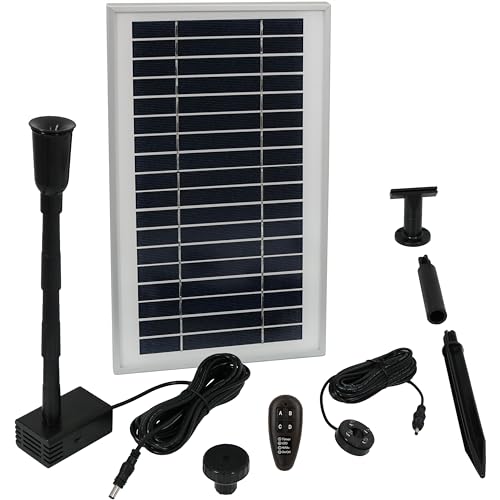
Sunnydaze Decor Solar Pump and Panel Kit with Battery Pack
A solar fountain pump kit that includes a battery backup option, letting the pump keep running through brief cloud cover or a short period after direct sun fades.

AISITIN 3.5W Solar Fountain Pump
A direct-solar fountain pump with no battery, running speed tracking the panel’s real-time sun exposure, suited to small decorative fountains and bird baths.
Good to know
Will a solar fountain pump run at night without a battery?
No, a direct-solar pump has nothing stored to draw on after dark, so it stops running as soon as the panel stops generating usable power.
How much sun does a solar fountain pump actually need to run well?
Most direct-solar pumps need several hours of strong, direct sunlight to run near their rated output; partial shade or hazy conditions noticeably reduce performance.
Does a battery pack make a solar fountain pump run continuously all day?
Not necessarily all day, but it extends runtime through brief cloud cover and sometimes into early evening, depending on the battery’s capacity and how much charge it built up earlier in the day.
Can I add a battery to a solar pump that didn’t originally include one?
Some models support an add-on battery pack sold separately, but many basic direct-solar pumps aren’t designed to accept one, so checking the specific model’s compatibility matters before buying an add-on.
Why does my solar fountain flicker on and off throughout the day?
That’s normal behavior for a no-battery pump reacting in real time to small changes in sunlight intensity, like passing clouds or a shadow moving across the panel.
Is a bigger solar panel always better for a fountain pump without a battery?
A panel sized to match or slightly exceed the pump’s wattage requirement generally gives the most consistent performance; an undersized panel is the more common problem than an oversized one.
Do solar fountain pumps work on cloudy or overcast days?
A direct-solar pump will run at reduced speed on an overcast day since some light still reaches the panel, but output drops noticeably compared to full sun.
How long do solar fountain pump batteries typically last before replacement?
Battery packs on solar fountain pumps commonly need replacing after a couple of seasons of regular outdoor use, depending on battery quality and how consistently they’re recharged.
Can a solar fountain pump be used indoors near a window?
Generally not well, since window glass filters out some usable light and most indoor locations don’t get the hours of strong direct sun a solar panel needs to run a pump effectively.
Does panel angle affect how well a no-battery solar pump performs?
Yes, angling the panel to more directly face the sun’s path through the day improves how much usable power it collects, which matters even more without a battery to smooth over a poor angle.
Is it worth cleaning a solar panel regularly for fountain pump performance?
Yes, dust, pollen and debris on the panel surface reduce how much sunlight it converts, and this becomes more noticeable on a no-battery pump since there’s no buffer to compensate.
Can a solar fountain pump be submerged fully in a bird bath or pond?
Most solar fountain pumps are designed to be fully submersible, with just the solar panel and its cable sitting outside the water, though checking the specific model’s submersion rating is still worth doing.
Does a solar fountain pump without a battery wear out faster than one with a battery?
Not necessarily; the lack of a battery removes one component that can degrade over time, though the pump motor itself wears at a similar rate in either version under comparable use.
Can I run a solar fountain pump on an extension cord from a wall outlet instead?
Some solar pump kits include that option as a backup power source, but many are built to run only from the included solar panel, so checking the product’s specifications is necessary before assuming that flexibility exists.
Is a battery-backed solar pump noticeably more expensive than a basic one?
Yes, typically, since the added battery, charge controller and sometimes a larger panel to charge it all add cost compared to a simple direct-solar setup.
Does winter reduce solar fountain pump performance even in sunny climates?
Yes, shorter days and a lower sun angle in winter reduce total daily sun exposure even in a climate that stays sunny, which lowers both direct-solar and battery-backed pump performance somewhat.
Can two solar panels be connected together to run one larger fountain pump?
Some kits support linking panels to increase total power output, which is one way to run a larger pump without a battery, though checking the specific pump’s wiring compatibility is necessary before combining panels.
The bottom line
A no-battery solar pump genuinely works, it just works on the sun’s schedule rather than yours, speeding up, slowing down and stopping with every change in light. That’s a fair tradeoff for a simple decorative fountain, but anyone wanting steadier output through passing clouds should budget for the battery-backed version instead.
Sierra Daniels
Sierra's background is in landscape design and nursery retail. She focuses on lawn and garden equipment, outdoor furniture and gear durability, weighing published specs against how materials actually hold up outside.