Do Mandoline Slicers Need Specific Blade Care?
Yes, mandoline blades need different care than a kitchen knife because the blade sits exposed and fixed in a frame rather than held by a handle. They should be hand washed immediately after use, dried completely before storage, and kept covered with the guard, since a dishwasher cycle, a scouring pad, or leftover moisture can dull the edge or corrode it faster than normal knife wear.
Why the blade behaves differently than a knife
A chef’s knife gets support from your grip and a handle, so you control the angle and pressure on every cut. A mandoline blade is fixed at a set angle inside the frame and stays exposed the entire time you are slicing, which means it both dulls differently under repeated contact and poses a real cut risk during cleaning if you forget it is there.
Washing rules that actually matter
Hand wash the blade right after use with warm water and mild dish soap, using a soft sponge rather than an abrasive scrubber that can leave micro scratches along the edge. Skip the dishwasher entirely. The heat cycle and the jostling against other items can loosen the blade mounting on plastic frames and dull thin stainless steel faster than normal use would.
Drying and rust prevention
Moisture left sitting on a blade, especially one with any carbon content, is the fastest way to get surface rust spots. Dry the blade fully with a towel before putting the guard back on or returning it to a drawer, and avoid letting it soak in a sink full of other dishes where it is both a hazard and exposed to standing water longer than necessary.
Sharpening realities most buyers do not expect
Most consumer mandolines use a fixed, thin stainless blade that is not designed to be touched up with a standard knife steel or whetstone the way a chef’s knife is. Once it dulls, the usual fix is a replacement blade cassette or insert rather than home sharpening, and premium Japanese style mandolines are more likely to offer that swappable insert than cheaper fixed frame models.
Storage habits that extend blade life
Always store the blade with its guard attached, and keep it away from other utensils in a drawer where it could get nicked against metal or knocked loose. A blade that gets jostled around loose in a drawer is more likely to develop small chips at the edge than one that stays guarded in a dedicated slot or case.
Signs the blade is telling you it needs attention
If slicing suddenly takes noticeably more downward pressure, if the cut edges start looking ragged or torn instead of clean, or if the hand guard no longer glides smoothly along the frame, that is the blade signaling it has dulled or the mounting has shifted, not something to push through by pressing harder.

OXO Good Grips V-Blade Mandoline Slicer
A widely used mandoline with an adjustable stainless steel blade and a hand guard built into the design, aimed at home cooks who want easy hand-wash cleanup.
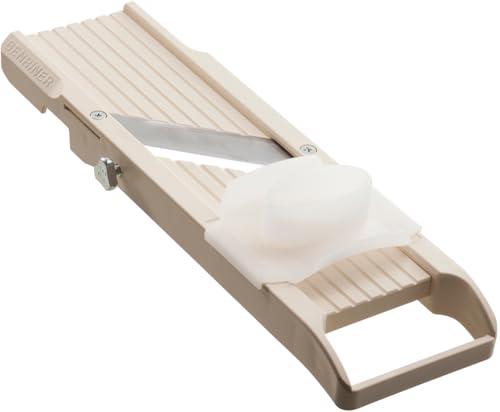
Benriner Mandoline Slicer
A classic Japanese-style mandoline with a simple fixed frame and a swappable blade insert, long favored for how easily the blade can be replaced once it dulls.
Common questions
Can you put a mandoline blade in the dishwasher?
It is better not to. The heat and movement in a dishwasher cycle can dull the edge faster than hand washing and can loosen the blade mounting on plastic-framed models over repeated cycles.
Why does my mandoline blade feel duller after only a few months?
Frequent use on dense vegetables, washing with an abrasive pad, or storing it unguarded against other utensils are the most common reasons a blade dulls faster than expected.
Is it safe to sharpen a mandoline blade at home?
Most fixed stainless mandoline blades are not designed for home sharpening with a steel or stone. Replacing the blade cassette or insert is the usual fix once it dulls.
Does rust on a mandoline blade mean it is ruined?
Light surface rust can sometimes be removed carefully, but it is a sign the blade was left wet too long, and once pitting sets in under the rust, replacement is usually the safer choice.
How often should the blade guard be used?
Every time the blade is not actively in use, including during washing, drying and storage, since the exposed blade poses a real cut risk even when the mandoline looks idle.
Why do manufacturers warn against soaking the blade in water?
Standing water speeds up rust on any carbon content in the steel and can also loosen glue or plastic seams around the blade mount over time.
Do starchy vegetables wear down the blade faster than others?
Starchy, fibrous vegetables like potatoes and squash put more resistance against the edge than soft produce like tomatoes, which can accelerate dulling with heavy repeated use.
Can a chipped mandoline blade still be used safely?
A visibly chipped edge should not be used, since it tends to tear food instead of cutting cleanly and increases the chance of a piece catching and pulling your hand forward.
Is stainless steel better than carbon steel for a mandoline blade?
Stainless resists rust better and needs less maintenance, which is why most consumer mandolines use it, while carbon steel can hold a slightly sharper edge but needs more diligent drying.
Do all mandolines use the same blade size and shape?
No, blade width, angle and mounting style vary by brand, so replacement blades are usually specific to that model rather than universally interchangeable.
Why does the cutting quality get worse even if the blade looks fine?
A blade can look intact while the actual cutting edge has microscopically rounded over from repeated use, which is not always visible just by looking at it.
Should the blade be oiled like a knife sometimes is?
Stainless mandoline blades generally do not need oiling, but a very light wipe of food-safe mineral oil on a carbon steel blade before storage can help prevent rust.
How long does a typical mandoline blade last with regular home use?
With proper hand washing and dry storage, a quality blade commonly lasts a few years of regular home use before cutting quality noticeably drops.
Is a wire brush safe for cleaning stuck food off the blade?
A soft sponge or brush is safer. A stiff wire brush can scratch the cutting edge and create tiny nicks that make future cuts less clean.
Does the cutting board material affect blade wear?
The mandoline blade does not usually contact a cutting board directly during use, so board material has little effect on the blade compared to how it is washed and stored.
Are replacement blades easy to find for most mandolines?
For popular, long-running models like swappable-insert Japanese style mandolines, replacement blades are generally easy to source, while off-brand mandolines may be harder to find exact parts for.
When should a mandoline be retired instead of just replacing the blade?
If the frame itself is cracked, the adjustment mechanism no longer holds a thickness setting, or the hand guard no longer fits securely, those point to replacing the whole unit rather than just the blade.
Does blade angle adjustment affect how fast the edge wears?
Steeper slicing settings put more resistance against the blade on every pass, which can dull the edge a little faster than regularly using thinner, lower-resistance settings.
Is a dishwasher-safe frame still a benefit if the blade needs hand washing anyway?
Yes, a dishwasher-safe frame still simplifies cleaning the housing itself, even though the blade portion should always be hand washed and dried separately regardless of the frame’s rating.
Can you tell a blade is dull just by looking at it?
Not always. A blade can look fully intact while the actual cutting edge has microscopically rounded from repeated use, so how it performs during slicing is a more reliable test than appearance alone.
Where this leaves you
A mandoline blade rewards simple, consistent habits more than any special product: hand wash it right away, dry it fully, and keep the guard on whenever it is not slicing. Most of the dulling and rust complaints people run into trace back to skipping one of those three steps, not a flaw in the mandoline itself.
Dana Whitfield
Dana spent eight years buying and merchandising for a regional kitchenware retailer before moving into editorial work. She has handled thousands of SKUs across cookware, small appliances and kitchen organization, and focuses on the practical differences that matter once a product is actually in daily use.
You might also need

Zafit 4-Pocket Bedside Caddy: A $7.99 Fix for Nightstand Clutter?

Great Bay Home Reversible Recliner Cover: One Cover, Two Looks for $21.00?

Haute Decor 16-Inch Green Twist Ties (6-Pack): Worth It Over Plain Wire?