Do Inflatable Paddle Boards Actually Perform as Well as Hard Boards?
Modern inflatable paddle boards, inflated to the recommended pressure, typically 12 to 17 PSI depending on the model, perform close to a hard board for most recreational paddling, flatwater touring, and yoga use, with the gap showing up mainly in top end speed, glide efficiency, and stiffness on longer boards, where a hard board’s rigid construction still edges ahead.
Why the performance gap has narrowed so much
Modern inflatables use drop stitch construction, thousands of internal threads connecting the top and bottom layers directly, which lets the board hold a rigid, flat shape under high air pressure rather than ballooning the way older, softer inflatables used to.
Where inflatables still fall slightly short
At the same length, a hard epoxy or composite board is generally stiffer and glides with slightly less flex related energy loss, which matters most for racing, long distance touring, and larger or heavier paddlers who flex the inflatable deck more under load.
Where inflatables actually win over hard boards
Storage in a small space, airline travel without oversized baggage fees, surviving a hard landing on rocks or a dock far better than fiberglass, and far simpler transport without needing roof racks are all areas where inflatables clearly come out ahead.
PSI matters more than people realize
An underinflated board flexes noticeably underfoot, slows down, and feels less stable, so most complaints about inflatable performance actually trace back to paddlers not inflating to the manufacturer’s recommended pressure, not a flaw in the inflatable concept itself.
Board thickness changes the comparison
Thicker inflatables, commonly five to six inches, trade a bit of stiffness and add weight in exchange for higher weight capacity, while thinner touring style inflatables sacrifice a bit more rigidity for speed, so comparing inflatable against hard boards without specifying the board type oversimplifies the real tradeoffs.
Who actually notices the difference in practice
Casual paddlers, yoga users, and recreational flatwater paddlers rarely notice a meaningful performance gap, while competitive racers, wave surfers, and very long distance tourers are the group most likely to still prefer a hard board.
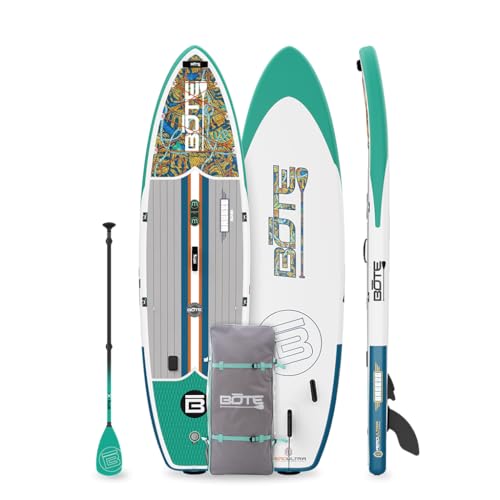
BOTE Breeze Aero Inflatable SUP
A drop stitch inflatable board aimed at recreational flatwater paddling and all around casual use.

iROCKER CRUISER Inflatable Paddle Board
A touring oriented inflatable board built for longer flatwater sessions with a focus on tracking and glide.
Questions worth asking
How much PSI does an inflatable paddle board actually need?
Most recreational inflatable boards perform best somewhere between 12 and 17 PSI, with the exact recommended figure printed on the board or pump and varying slightly by model.
Can an underinflated board actually pop or just perform worse?
Underinflation does not cause popping, it simply lets the board flex more, reducing stiffness, speed, and stability rather than creating a safety risk on its own.
Do inflatable paddle boards work well for ocean waves?
They can handle mild waves and recreational surf, but serious wave riding generally favors a hard board’s sharper rails and more responsive turning for performance surfing.
Is drop-stitch construction the reason inflatables got so much stiffer?
Yes, the dense internal threading connecting the top and bottom layers is the key technology that lets modern inflatables hold a rigid shape under pressure, unlike older, softer designs.
Does board thickness affect stability more than the inflatable vs hard question?
In many cases yes, a thicker inflatable can feel more stable underfoot than a thinner hard board of the same width, since thickness and width influence stability as much as construction type does.
How long does it take to inflate a paddle board before each use?
With a standard hand or electric pump, most boards take roughly five to fifteen minutes to reach full recommended pressure, depending on pump type and board size.
Are inflatable boards heavier or lighter than hard boards of the same size?
This varies by model, but many inflatables are comparable in weight or slightly heavier once fully inflated, while being far lighter and more compact to carry when deflated and rolled up.
Can an inflatable paddle board get punctured easily on rocks?
The outer PVC material used on quality inflatables resists most rock and dock impacts well, often better than a hard board’s gel coat, though sharp objects can still cause damage with enough force.
Do inflatables lose air pressure significantly during a normal session?
A quality inflatable with no leaks typically loses only a small, gradual amount of pressure during a normal session, which is usually not enough to noticeably affect performance.
Is an inflatable board a good choice for a heavier paddler?
Yes, as long as the board’s weight capacity is matched appropriately and it is inflated to the recommended pressure, since underinflation is the main factor that makes an inflatable feel unstable under more weight.
Do inflatable paddle boards need special care in cold weather?
Extreme cold can make the PVC material slightly stiffer and air pressure drop a bit more than usual, so checking pressure before each cold weather session is a good habit.
Can inflatable boards be repaired if they get a small puncture?
Yes, most inflatable paddle boards come with a basic repair kit for small punctures, and the PVC material is generally straightforward to patch compared to repairing a hard board’s shell.
Is a hard board still better for racing or competitive paddling?
Generally yes, the marginal stiffness and glide advantage of a hard board still matters at a competitive level, even though recreational paddlers rarely notice the difference.
How much storage space does an inflatable board actually save compared to a hard board?
Deflated and rolled, most inflatable boards fit into a duffel bag roughly the size of a large suitcase, compared to a hard board that typically needs a full length storage space or wall rack.
Does water temperature affect inflatable board performance?
Water temperature itself does not change board performance, though very cold conditions can make the PVC material slightly stiffer, which has a minor effect on how the board flexes under paddling.
Can two paddlers use the same inflatable board at once safely?
Many boards rated for tandem use can safely carry two paddlers within their listed weight capacity, though stability and maneuverability both decrease compared to solo paddling on the same board.
Is a single fin or multi-fin setup different in performance between inflatable and hard boards?
The fin principles are the same for both, with a single large fin favoring straight line tracking and multi-fin setups favoring maneuverability, regardless of whether the board itself is inflatable or hard.
Do inflatable boards need to be fully dried before storage to avoid mold?
Yes, storing a damp inflatable board rolled up for extended periods can encourage mold or mildew growth on the material, so drying it fully before packing away is an important habit.
Can UV exposure over time degrade an inflatable board’s material?
Yes, prolonged sun exposure can gradually degrade PVC material and seams over years of heavy use, which is why many owners rinse and store boards out of direct sun when not in use.
Is paddle choice more important than board type for overall performance?
Paddle length, material, and blade shape genuinely affect efficiency and fatigue over a session, so for most recreational paddlers, paddle choice matters as much as or more than the inflatable versus hard board decision.
Do inflatable boards come with a weight capacity rating like hard boards?
Yes, nearly all inflatable boards list a maximum weight capacity, which should account for the paddler plus any gear, pets, or passengers brought along for the session.
Can an inflatable board be left inflated between uses without damage?
Most quality inflatables can stay inflated for days or weeks without issue, though manufacturers generally recommend deflating for long term storage to reduce stress on the seams over extended periods.
Our take
The old idea that inflatables are a compromise toy has not held up well against modern drop stitch construction. For nearly everyone outside of racing and serious wave riding, a properly inflated board performs close enough to a hard board that the storage and travel advantages make the decision easy.
Sierra Daniels
Sierra's background is in landscape design and nursery retail. She focuses on lawn and garden equipment, outdoor furniture and gear durability, weighing published specs against how materials actually hold up outside.