Do Ankle Braces Limit Mobility Too Much?
Ankle braces do restrict mobility to some degree, but the amount varies widely by type. A rigid stirrup brace can cut inversion and eversion by half or more, while a soft sleeve or lace-up brace limits motion only slightly. For most people, the restriction is a deliberate tradeoff for stability during healing or high-risk activity, not a permanent sentence to stiff ankles.
What mobility actually means for an ankle brace
Mobility in this context usually refers to four motions: dorsiflexion (toes up), plantarflexion (toes down), inversion (sole inward), and eversion (sole outward). A brace is designed to limit the last two, especially inversion, because that is the motion most ankle sprains happen in. Dorsiflexion and plantarflexion are limited much less, which is why you can still walk, run, and jump in most braces, even if the side-to-side play is reduced.
How much motion each brace type takes away
Soft neoprene sleeves offer compression and proprioceptive feedback but barely restrict range of motion. Lace-up braces with side stays limit inversion and eversion moderately while allowing near-full forward and backward motion. Rigid stirrup braces, the kind with hard plastic shells and Velcro straps, restrict inversion and eversion the most, often by 50 percent or more, and can also reduce dorsiflexion slightly depending on how tight you strap them. The stiffer the brace, the more stability it provides and the more mobility it costs.
When restriction is the point
During acute recovery from a sprain, limiting inversion is exactly what you want, because it prevents the ankle from rolling into the position that re-injures the ligaments. The same logic applies to high-risk sports like basketball or volleyball, where a brace is worn to stop the ankle from going past its safe range under load. In those cases, a loss of side-to-side motion is not a side effect, it is the mechanism of protection.
When restriction becomes a problem
A brace that is too bulky or too rigid can alter your gait, fatigue your calf and shin muscles, and even cause compensations at the knee or hip if worn all day. It can also reduce proprioceptive training, meaning your ankle never learns to stabilize itself without the brace. That is why many clinicians recommend weaning off a rigid brace as healing progresses and using it mainly for sport or risky terrain rather than constantly.
Fit and strap tension matter as much as brace type
A rigid brace strapped as tight as possible will restrict more than the same brace worn at a functional tension. Over-tightening can also cut off circulation and make the brace uncomfortable enough that you stop wearing it. The goal is a snug fit that prevents the ankle from rolling but still lets you move through a normal walking stride without pinching or pressure points.
What the evidence says about performance
Studies on lace-up and stirrup braces generally show minimal impact on vertical jump and sprint speed in athletes who are used to wearing them, though some users report a feeling of restriction. The perceived loss of mobility is often larger than the measured loss. For most recreational athletes, the protective benefit against re-injury outweighs the small performance cost, especially in sports with a high ankle sprain rate.

ASO Ankle Stabilizer
A lace-up brace with side stays that limits inversion and eversion while allowing near-normal forward and backward motion.
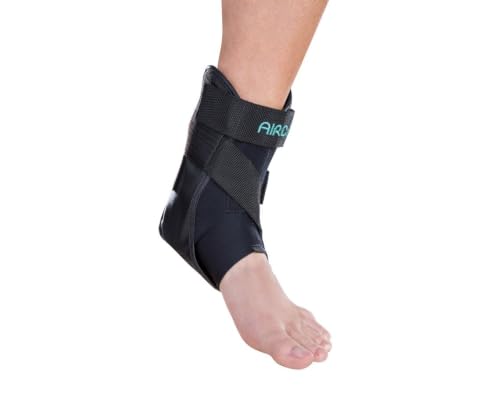
Aircast AirSport Ankle Support Brace
A rigid stirrup brace with air cells that provides strong side-to-side stability, often used during recovery and high-risk sports.
Questions worth asking
Do ankle braces weaken your ankle over time?
Not directly, but relying on a brace constantly can reduce the ankle’s own stabilizing response. That is why braces are usually paired with strengthening and balance work, and why rigid braces are often phased out as healing progresses.
Can you run in an ankle brace?
Yes, many runners train and race in lace-up or stirrup braces, especially after a sprain. The brace may feel restrictive at first, but most runners adapt within a few sessions. A rigid brace is bulkier for running but still usable.
How much does a rigid ankle brace limit inversion?
Rigid stirrup braces can reduce inversion by roughly half compared to an unbraced ankle, depending on strap tension and shell design. That is a significant restriction, but it is also what makes them effective at preventing re-injury.
Will an ankle brace make my calf muscle weaker?
Only if you wear it constantly and stop using the ankle through its full range. If you wear it for sport or risky activity and continue normal training without it, muscle strength is generally maintained.
Is a soft ankle sleeve enough for a sprained ankle?
A soft sleeve provides compression and mild feedback but does little to mechanically stop inversion. For a moderate sprain, a lace-up or stirrup brace is usually more protective during the early weeks.
Can I wear an ankle brace all day?
You can, but it is not usually necessary. Wearing a rigid brace all day can be bulky and may reduce proprioceptive training. Many people wear it during activity and remove it for rest and sleep.
Do ankle braces affect balance?
They can improve balance by providing feedback and stability, but a very rigid brace might slightly reduce the ankle’s natural micro-adjustments. Balance training without the brace is still important.
How tight should an ankle brace be?
Snug enough to prevent the ankle from rolling but not so tight that it causes numbness, tingling, or visible marks. You should be able to walk with a normal stride without pinching.
Can an ankle brace prevent knee or hip problems?
Indirectly, yes, by stabilizing the ankle and reducing compensatory movements. But a poorly fitted or overly rigid brace can also cause compensations, so fit matters.
Do professional athletes wear ankle braces?
Many do, especially in basketball and volleyball, where ankle sprains are common. Most use lace-up or stirrup braces during games and practices to reduce re-injury risk.
Will an ankle brace help with chronic ankle instability?
Yes, braces are commonly used for chronic instability to provide external support and confidence. They are usually combined with strengthening and balance training for the best results.
Can you swim with an ankle brace?
Most braces are not designed for swimming and may degrade in chlorine or salt water. If you need support in the water, look for a waterproof brace or consult a clinician.
Does an ankle brace restrict dorsiflexion?
Only slightly in most designs. Lace-up and stirrup braces are cut to allow near-normal forward and backward motion, though a very tight strap or bulky shell can reduce it a bit.
How long should you wear an ankle brace after a sprain?
It varies by severity, but many people wear a brace for activities for several weeks to a few months, tapering off as strength and confidence return. Follow your clinician’s guidance.
Are ankle braces covered by insurance?
Sometimes, if prescribed for a medical condition. Over-the-counter braces are often not covered, but it depends on your plan and whether a doctor orders it.
Can an ankle brace cause blisters or skin irritation?
Yes, especially if it is too loose and rubs, or if you wear it over bare skin during sweaty activity. A thin sock underneath and proper fit help prevent this.
Do ankle braces expire?
They do not expire in a strict sense, but materials like elastic and Velcro degrade over time. If straps lose tension or the brace no longer fits snugly, it is time to replace it.
Is it better to wear an ankle brace or use taping?
Both work, but braces are reusable and easier to apply consistently. Taping can be more custom but loosens with sweat and requires skill. Many athletes prefer braces for convenience.
Final word
Ankle braces do limit mobility, but the restriction is usually targeted at the motions that cause sprains, not at walking or running. The key is matching the brace type to your situation: a rigid brace when you need maximum protection, a lace-up or soft brace when you need a balance of support and freedom, and a plan to strengthen the ankle so you are not dependent on either.
Derek Holt
Derek has a background coaching recreational and amateur athletes and has worked the sales floor at specialty fitness retailers. He focuses on equipment durability, ergonomics and realistic use cases rather than marketing claims.


