Zoom Lenses Worth Buying, From APS-C to Full Frame
Sony FE 24-70mm F2.8 GM II leads for full frame Sony bodies, holding f/2.8 across the range at 695 grams. Tamron 28-75mm f/2.8 Di III VXD G2 covers similar ground 155 grams lighter. Canon owners chasing extra reach should take the RF 24-105mm f/4 L IS USM.
Sony FE 24-70mm F2.8 GM II is the zoom to buy for full frame Sony bodies, since one barrel frames a whole room at 24mm and a head and shoulders portrait at 70mm without an aperture shift. Bulk is the cost: 695 grams hanging off an 82mm front thread. Photographers who walk all day usually trade a little range for a lighter f/2.8 option.
Mount, sensor size and aperture each rewrite the shortlist, which is where zoom shopping stalls. An APS-C lens darkens the corners on a full frame sensor, while a full frame telephoto frames tighter on a crop body. We compared published optical specifications, focal ranges, minimum focus distances, stabilisation ratings, filter threads and weight. Aggregated owner feedback on autofocus reliability, zoom creep and focus breathing settled the close calls.
What to look for
What to check before buying a zoom lens Mount comes first, because a Sony E lens will not sit on a Canon RF body. Sensor coverage follows: APS-C lenses vignette heavily on full frame. Focal range then defines what you can frame, and maximum aperture defines how much light arrives. Weight decides what you actually carry, which is rarely what you intended to carry. Filter thread size is a hidden cost, since 82mm polarisers and ND sets do not fit a 67mm lens. Minimum focus distance matters more than most buyers expect for food, product and vlogging frames.
Constant f/2.8 vs variable aperture zooms Constant f/2.8 means brightness never changes as you zoom. Exposure stays locked through a ceremony or an interview, and autofocus keeps more light to work with. Variable designs such as f/4 to f/5.6 open bright and dim as they extend, pushing ISO up indoors. Choose the constant aperture if you photograph people in dim rooms. Variable aperture wins outdoors, where reach per gram counts for more. Weight tells the story plainly: fast standard zooms run 540 to 805 grams, while a variable telephoto can land at 375.
Best zoom lens for travel and everyday carry Compact glass gets used; heavy glass stays home. Sigma 18-50mm f/2.8 weighs 290 grams and still holds a fast aperture, which fits crop bodies used for street and family photos. On full frame, Tamron 28-75mm G2 at 540 grams is the lightest fast standard zoom listed here. A 24-105mm f/4 makes sense when one lens has to cover an entire trip and slower glass is acceptable. Match new purchases to filter sizes you already own, or plan on a second polariser. Flying with carry on only? Weigh the kit first, since two fast zooms clear a kilogram together.
Zoom lenses for portraits, events, sports and wildlife Past 100mm the tradeoff becomes reach against weight. Paid portrait and event work rewards a 70-180mm f/2.8, which isolates a subject inside a cluttered venue. Indoor sports need that aperture too, because shutter speeds have to stay near 1/500 second under gym lighting. Daylight wildlife and youth sports flip the maths: a 55-250mm delivers 400mm equivalent framing on a crop body for 375 grams. Skip the fast telephoto if you only shoot outdoors in good light, since the extra stop will sit unused. Stabilisation earns its keep beyond 100mm, where small hand movements magnify quickly.
The best picks, ranked

Sony FE 24-70mm F2.8 GM II
Aperture stays at f/2.8 from 24mm to 70mm, so exposure holds steady while you zoom on a moving subject. Four XD linear motors drive focus quietly enough for video according to owner reports. Sony cut mass to 695 grams, a clear drop from the first GM version.
Pros
- One barrel covers wide interiors through portrait framing
- Constant f/2.8 keeps exposure locked while zooming
- Sealed barrel with a de-clickable aperture ring for video
Cons
- 82mm filters rarely transfer to smaller lenses
- Front heavy on compact bodies such as the a7C

Tamron 28-75mm f/2.8 Di III VXD G2
Trimming the wide end to 28mm lets Tamron reach 540 grams while holding f/2.8 throughout. Minimum focus of 0.18m at the wide end brings food and product frames within range. VXD linear motors track faces reliably on recent Sony bodies, according to owner feedback.
Pros
- At 540 grams, all day carry stays realistic
- 67mm thread matches other Tamron Di III zooms
- Focuses to 0.18m for tabletop and detail work
Cons
- Starting at 28mm means stepping back in tight rooms
- Sony E mount only, with no Canon or Nikon version

Canon RF 24-105mm f/4 L IS USM
Reach is what separates this from a 24-70mm, since 105mm frames a portrait from across a table. Optical stabilisation rated at 5 stops coordinates with IBIS on RF bodies for handheld video. Giving up a stop to f/4 is precisely what buys that extra 35mm.
Pros
- 105mm covers portraits without swapping lenses
- Five stop IS steadies handheld video and slow shutters
- Weather sealed L series barrel for outdoor shoots
Cons
- f/4 blurs backgrounds less than an f/2.8 zoom
- Dim interiors push ISO higher than fast glass would

Nikon NIKKOR Z 24-70mm f/2.8 S
An OLED panel on the barrel displays focal length and aperture, keeping settings readable with the camera at your waist. Published optical data shows corners holding up wide open across the range. Weight is the penalty at 805 grams, heaviest of the standard zooms here.
Pros
- Control ring assigns to aperture or exposure compensation
- OLED readout confirms settings without the viewfinder
- Fluorine coated front element sheds water and fingerprints
Cons
- 805 grams feels heavy on smaller Z bodies
- No lens stabilisation, so it leans on body IBIS

Sigma 18-50mm f/2.8 DC DN Contemporary
Crop bodies get a 27-75mm equivalent view from 290 grams of glass. Focusing down to 0.121m at 18mm suits vlogging at arm length and close product frames. Sigma builds it for Sony E, L mount, Fujifilm X and Canon RF crop cameras.
Pros
- Fits a jacket pocket at 290 grams
- Constant f/2.8 without full frame lens bulk
- Sold in four mounts, including Fujifilm X
Cons
- Image circle will not cover a full frame sensor
- Sealing stops at the mount gasket

Tamron 70-180mm f/2.8 Di III VXD G2
Subject separation arrives easily at 180mm and f/2.8, with backgrounds compressed into a soft wash. Tamron kept the 67mm thread, so filters move straight over from the 28-75mm G2. At 855 grams it undercuts most 70-200mm f/2.8 designs.
Pros
- Shares 67mm filters with the Tamron standard zoom
- f/2.8 holds up under dim reception hall lighting
- Lighter than typical 70-200mm f/2.8 telephotos
Cons
- Reach stops at 180mm rather than 200mm
- No optical stabilisation built into the barrel
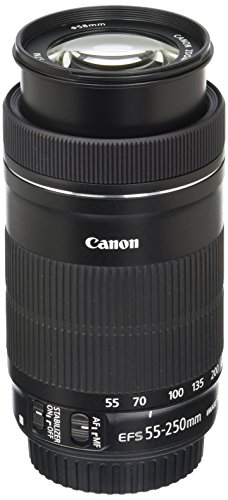
Canon EF-S 55-250mm f/4-5.6 IS STM
Long reach for very little weight explains why this became the standard second lens on Canon crop DSLRs. Stabilisation rated at 3.5 stops matters most at 250mm, where handshake shows up first. Aperture narrows to f/5.6 fully extended, so daylight or a lit field suits it best.
Pros
- Gives 400mm equivalent framing on an APS-C body
- STM motor stays quiet through recorded clips
- Only 375 grams, so it rides along unnoticed
Cons
- Variable aperture dims as you zoom in
- EF-S mount will not fit full frame EF bodies
The lineup, side by side
| # | Model | Mount | Best for | Score | Price |
|---|---|---|---|---|---|
| 1 | Sony FE 24-70mm F2.8 GM II | Sony E, full frame | Best overall | 9.4 | Check price |
| 2 | Tamron 28-75mm f/2.8 Di III VXD G2 | Sony E, full frame | Best value | 9.2 | Check price |
| 3 | Canon RF 24-105mm f/4 L IS USM | Canon RF, full frame | Best for Canon hybrid shooters | 9.0 | Check price |
| 4 | Nikon NIKKOR Z 24-70mm f/2.8 S | Nikon Z, full frame | Best for Nikon Z bodies | 8.8 | Check price |
| 5 | Sigma 18-50mm f/2.8 DC DN Contemporary | APS-C | Best for APS-C cameras | 8.6 | Check price |
| 6 | Tamron 70-180mm f/2.8 Di III VXD G2 | Sony E, full frame | Best for portraits and events | 8.4 | Check price |
| 7 | Canon EF-S 55-250mm f/4-5.6 IS STM | Canon EF-S, APS-C | Best budget telephoto | 8.0 | Check price |
Questions worth asking
What is the best all round zoom lens for beginners?
A 24-105mm f/4 on full frame, or an 18-50mm f/2.8 on crop, covers most beginner situations. Family gatherings, travel and casual portraits all fall inside that range. Pick the f/2.8 option if indoor light is your usual problem.
Is a constant f/2.8 zoom worth the extra weight?
Yes for receptions, stages and indoor portraits, where one extra stop halves your ISO. Daytime outdoor shooters rarely touch that advantage. Saving several hundred grams matters more on a long hike than a faster aperture does.
Can you use a full frame zoom lens on an APS-C camera?
Full frame lenses mount normally on crop bodies of the same system and gain roughly 1.5x apparent reach. A 24-70mm frames like a 36-105mm on APS-C. Going the other way darkens the corners, since crop lenses project a smaller image circle.
What does a 24-70mm zoom lens actually cover?
At 24mm you can fit a small room or a group of six. Near 50mm the perspective sits close to normal human vision. By 70mm you get flattering head and shoulders framing from a comfortable distance.
Which zoom lens is best for indoor sports?
Fast telephoto glass such as a 70-180mm f/2.8 handles it. Gym lighting forces shutter speeds around 1/500 second, and f/4 zooms push ISO past what most sensors handle cleanly. Reach beyond 180mm only helps in larger arenas.
Do zoom lenses need stabilisation if my camera has IBIS?
In body stabilisation covers most standard zoom work by itself. Lens stabilisation adds real benefit past 100mm, where small shakes get magnified. Canon and Nikon coordinate both systems when a stabilised lens is fitted.
How do Tamron and Sigma zooms compare with first party lenses?
Both now ship linear focus motors and weather resistant builds, and owners report dependable eye detection on recent bodies. First party optics still lead on extreme corner sharpness and firmware support. Weight and value usually favour the third party choice.
Which zoom lens works well for both video and photo?
Look for a quiet linear motor, controlled focus breathing and a de-clickable aperture ring. Sony FE 24-70mm GM II and Tamron 28-75mm G2 both fit that description. Stabilised f/4 zooms such as the Canon RF 24-105mm suit run and gun handheld filming.
Is a 24-105mm f/4 better than a 24-70mm f/2.8 for travel?
For daylight travel, yes: the extra 35mm of reach removes most lens swaps and the lens stays lighter than an 805 gram f/2.8. Night markets, museums and interiors flip the answer back to f/2.8. Consider which half of your trip happens indoors before deciding.
The verdict
Sony FE 24-70mm F2.8 GM II is the zoom to buy for full frame Sony work where one lens has to cover an entire job, from wide venue shots to portraits. Hobbyists are better off with the Tamron 28-75mm f/2.8 Di III VXD G2, which saves 155 grams and shares 67mm filters with the rest of the Tamron lineup. Crop sensor owners should stop at the Sigma 18-50mm f/2.8 and spend the difference on a fast prime.
Marcus Chen
Marcus covered consumer electronics for enthusiast tech publications for six years before joining ChoiceCrest. He specializes in translating manufacturer spec sheets into plain-language buying advice, with a focus on audio, computing accessories and smart-home gear.


