Wood Moisture Meters Ranked for Accuracy and Depth
Wagner Meters Orion 930 leads for woodworkers, reading at two depths without leaving pin holes. Mixed renovation work suits Calculated Industries AccuMASTER Duo Pro 7445, which carries pin and pinless sensors in one body. For firewood and framing checks, General Tools MMD4E settles the question.
Wagner Meters Orion 930 belongs in a shop handling finished panels or costly hardwood. Its pinless sensor reads at quarter inch and three quarter inch depths, so surface and core can be compared without marking anything. Outlay is the barrier, and casual users rarely need that resolution. Checking firewood or framing instead? General Tools MMD4E answers it with two pins.
Moisture numbers drive real decisions: mill now or wait, lay the floor or acclimate longer, burn the log or stack it another season. Density and wood temperature both shift a reading, and meters that ignore either can land several points off. We compared sensor type, stated ranges, reading depth and species correction across current listings. Owner reports covered contact quality, battery behaviour and how quickly each interface makes sense. Trade acceptance carried weight for the flooring picks.
What we recommend

Wagner Meters Orion 930 Pinless Moisture Meter
Two selectable depths let you read the surface, then the core, and see whether a board dried through or only on the outside. Nothing punctures the wood, so veneer, figured hardwood and finished panels stay clean. An on-demand calibrator ships in the box, letting accuracy be verified rather than assumed.
Pros
- Depth comparison exposes boards still wet in the core
- Finished and figured surfaces stay unmarked
- Bundled calibrator confirms the meter is still true
Cons
- Highest outlay of the seven meters here
- Needs flat contact, so rough sawn stock reads poorly

Calculated Industries AccuMASTER Duo Pro 7445
Pin and pinless sensors share one body, so a finished face can be scanned and then confirmed with pins on a hidden edge. Wood group settings adjust for species density, which matters on oak, maple and other dense hardwoods. Construction material scales widen its use during renovation work.
Pros
- Both measurement methods remove the need for a second meter
- Wood group selection corrects for species density
- Backlit display reads clearly in a dim crawlspace
Cons
- Bulkier than a single-method meter
- Pin caps go missing easily on site
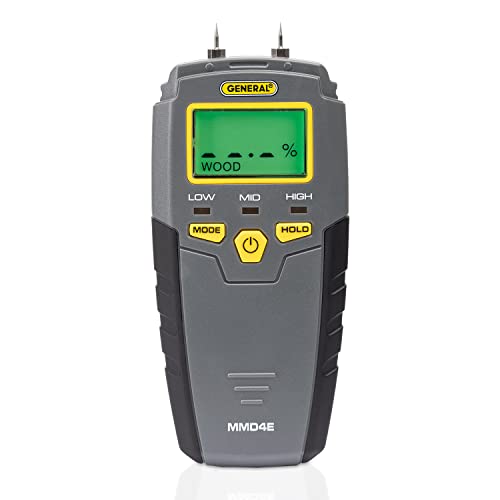
General Tools MMD4E Digital Moisture Meter
Two stainless pins and a colour LED bar answer one question quickly: dry enough or not yet. Wood readings run 5 to 50 percent, spanning green timber through seasoned firewood. A separate scale covers drywall and masonry for basic damp checks.
Pros
- Colour bar delivers a verdict without interpreting numbers
- Range stretches from green timber to seasoned firewood
- Auto power off preserves the battery between uses
Cons
- Pins leave visible holes in finished wood
- No species correction, so dense hardwoods read high

Klein Tools ET140 Pinless Moisture Meter
Sweeping a wall or floor is where this one earns its place, helped by an audible tone that climbs as moisture rises. Wood readings cover 6 to 44 percent, with a relative scale for drywall and masonry. Treat it as a leak-finding instrument rather than a woodworking tool.
Pros
- Audible tone lets you scan without watching the screen
- Painted and finished surfaces stay unmarked
- Rugged body survives life in a tool bag
Cons
- No species correction for precise woodworking
- Masonry scale is relative, not a true percentage

Delmhorst BD-2100 Pin Moisture Meter
Delmhorst has supplied hardwood flooring and restoration trades for decades, and the BD-2100 carries species and temperature correction into that workflow. Readings span 6 to 40 percent, covering subfloor checks through acclimated flooring stock. An electrode socket accepts external probes for deep readings in thick timber.
Pros
- Species and temperature correction sharpens real accuracy
- External electrodes reach deep into thick timbers
- Widely accepted across flooring and restoration trades
Cons
- Pin holes rule it out on finished surfaces
- Interface takes longer to learn than consumer meters

Lignomat Mini-Ligno E/D Moisture Meter
Two pin lengths come in the box, so a shallow reading and a deep one can be taken on the same board and compared. That gap reveals whether stock dried through or only near the surface. Body size fits a shirt pocket, which is why buyers carry it around a lumber yard.
Pros
- Two pin depths separate surface moisture from core moisture
- Small enough to carry on every yard visit
- Operation is direct with no menus to navigate
Cons
- Species correction means reading a printed chart
- Plain display with no backlight

Extech MO55 Pin and Pinless Moisture Meter
Alongside moisture content, this reports ambient temperature and relative humidity, the two factors pulling wood toward its equilibrium level. Logging those beside board readings explains why stock keeps moving in a workshop. Pin and pinless measurement both run from the same body.
Pros
- Humidity and temperature readings explain seasonal wood movement
- One body switches between pin and pinless
- Adjustable alarm flags readings above your chosen limit
Cons
- Pinless accuracy trails dedicated scanning meters
- More functions than a firewood check will ever need
Compared at a glance
| # | Model | Type | Best for | Score | Price |
|---|---|---|---|---|---|
| 1 | Wagner Meters Orion 930 Pinless Moisture Meter | Pinless, non-damaging | Best overall | 9.4 | Check price |
| 2 | Calculated Industries AccuMASTER Duo Pro 7445 | Combined pin and pinless | Best value | 9.2 | Check price |
| 3 | General Tools MMD4E Digital Moisture Meter | Pin, two stainless pins | Best budget | 9.0 | Check price |
| 4 | Klein Tools ET140 Pinless Moisture Meter | Pinless | Best for site inspections | 8.8 | Check price |
| 5 | Delmhorst BD-2100 Pin Moisture Meter | Pin, with external electrode socket | Best for flooring professionals | 8.6 | Check price |
| 6 | Lignomat Mini-Ligno E/D Moisture Meter | Pin, two selectable depths | Best for lumber buying | 8.3 | Check price |
| 7 | Extech MO55 Pin and Pinless Moisture Meter | Pin and pinless | Best for tracking drying conditions | 8.0 | Check price |
How to pick the right one
What to look for in a wood moisture meter Sensor type is the first fork. Pin meters drive electrodes into the wood and measure resistance between them, producing a reading at a known depth. Pinless models send a field through the surface and average moisture across a zone, leaving nothing behind. Check the stated range next, because meters stopping near 30 percent cannot assess green timber. Species correction is the specification buyers skip and later regret, since density alone shifts a number by several points on oak or maple.
Pin vs pinless: which suits your work Pins win on thin stock, rough sawn boards and anywhere a specific depth matters. Holes are the price, which rules them out on veneer, finished panels and a laid floor. Scanning covers large areas far faster, as the Klein ET140 shows with its rising tone during a leak hunt. Contact is the weakness: bandsawn or textured timber breaks the sensor’s grip and the number wanders. Carrying both methods, as the AccuMASTER Duo Pro does, removes the choice entirely.
Target moisture levels by job Numbers only mean something against a target. Indoor furniture and cabinetry sit at 6 to 8 percent in most heated homes. Hardwood flooring is usually laid between 6 and 9 percent, and within a couple of points of the subfloor beneath it. Framing lumber is generally accepted below 19 percent. Firewood should reach 20 percent or lower, since wetter logs waste heat boiling off water and line the flue with creosote.
How to avoid false readings Take several readings along a board instead of trusting one, because moisture shifts near the ends and around knots. Temperature skews results, with cold wood reading low and warm wood high, which is why the Delmhorst BD-2100 builds in a correction step. Metal fasteners, wire lath and foil-backed insulation all distort a pinless scan, so move away from them. Pressure-treated and salt-treated lumber reads artificially high because of the chemicals inside it. Split firewood and test the fresh inner face, since an uncut surface always flatters the result.
Good to know
What moisture content should wood be before woodworking?
Indoor furniture and cabinetry want 6 to 8 percent in a heated climate. Building with wetter stock invites gaps, cupping and failed joints as the wood keeps drying indoors. Rough lumber often needs weeks in the shop before it settles there.
Pin vs pinless moisture meter: which is more accurate?
Pins give a precise reading at a known depth and cope with rough or thin stock. Pinless sensors average across a zone and need flat contact, but they mark nothing. For finished surfaces and figured hardwood, a pinless meter like the Wagner Orion 930 is the practical answer.
How do you check if firewood is dry enough to burn?
Split a log first, then press the pins into the freshly exposed inner face. Below 20 percent is the target. Testing an uncut surface gives a misleadingly dry number, because the outside seasons long before the core does.
Do moisture meters work on all wood species?
They read every species, but density shifts the result. Dense hardwoods report higher than softwoods at the same actual moisture content. Meters carrying species or wood group settings, such as the AccuMASTER Duo Pro 7445 and the Delmhorst BD-2100, correct for that.
Can a wood moisture meter find a leak in a wall?
A pinless model scans quickly and flags wetter zones, which is exactly the Klein ET140’s job. Drywall and masonry readings are relative rather than true percentages. Use them to compare one area against another, not to state an absolute figure.
Why does my moisture meter give different readings on one board?
Moisture genuinely varies along a board, especially near the ends and around knots. Species setting, wood temperature and nearby metal fasteners all move the number too. Read several spots and work from the pattern rather than a single figure.
What moisture level is acceptable for hardwood flooring?
Most installations aim for 6 to 9 percent, with the flooring within a couple of points of the subfloor before nails go in. Acclimating boards in the finished room for several days is standard practice.
Is an expensive wood moisture meter worth it for a home shop?
It pays off when you buy rough lumber, dry your own stock or work with figured hardwood, because dual-depth pinless readings catch mistakes before glue-up. Checking firewood and framing timber needs nothing beyond the General Tools MMD4E.
How accurate are cheap wood moisture meters?
Entry-level pin meters sit close enough for pass or fail decisions like firewood and framing. Accuracy slips on dense hardwoods without species correction, and cold or warm wood adds further error. Treat a budget reading as a range, not a fixed figure.
The bottom line
Wagner Meters Orion 930 earns the buy when your stock is finished, figured or expensive, because dual-depth scanning shows what is happening inside a board without marking it. Mixed work across rough lumber and finished surfaces is better served by the AccuMASTER Duo Pro 7445 and its two sensors. Split firewood and framing checks need nothing past the General Tools MMD4E.
Dana Whitfield
Dana spent eight years buying and merchandising for a regional kitchenware retailer before moving into editorial work. She has handled thousands of SKUs across cookware, small appliances and kitchen organization, and focuses on the practical differences that matter once a product is actually in daily use.