Window AC Units Compared on BTU, Noise and Fit
Midea U-Shaped 8,000 BTU Smart Inverter finishes first, dropping to 42 dB because the sash closes through the chassis. GE Profile ClearView keeps the upper glass clear and runs near 40 dB. For rooms past 500 square feet, the Frigidaire FHWW123WBE has the capacity.
Midea U-Shaped 8,000 BTU Smart Inverter is the unit to buy for a bedroom. Its split chassis lets the sash close between the indoor and outdoor halves, putting glass and foam between you and the compressor. Fit is the catch, since a U shape needs a standard double hung frame. Casement openings, larger rooms and tight budgets each get a different pick below.
BTU tells you almost nothing about noise, running cost or whether a unit clears your sill. Inverter compressors ramp up and down rather than slamming on and off, which changes both. We compared published BTU figures, coverage areas, decibel ratings, compressor type, filter design and minimum window dimensions. Owner reports on install difficulty and frame rattle broke the ties.
The top picks, ranked

Midea U-Shaped 8,000 BTU Smart Inverter Window Air Conditioner
Splitting the chassis into a U lets the sash drop between the indoor and outdoor halves. Midea quotes 42 dB at the low setting, quiet enough to sleep beside. Compressor speed varies instead of cycling, so temperature holds steady, and Wi-Fi control reaches the app, Alexa and Google Assistant.
Pros
- Closed sash blocks compressor noise at the window
- Inverter compressor holds temperature without hard cycling
- Window still opens with the unit in place
Cons
- Only fits a standard double hung window
- Install is heavier and fiddlier than a box unit
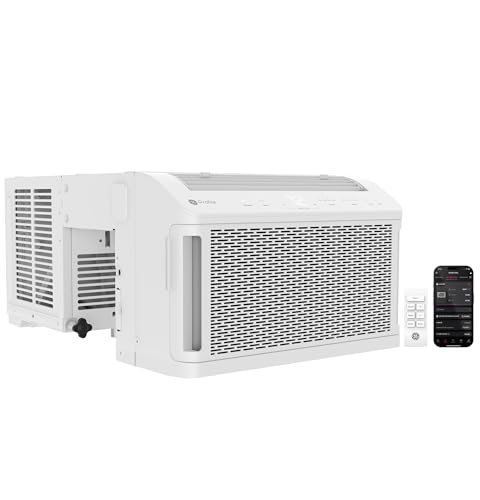
GE Profile ClearView Window Air Conditioner
Mechanical parts sit in a low housing along the base, leaving the upper panel clear to see through. Around 40 dB on low puts it among the quietest units here. Less of the opening disappears, which matters in a room with a single window.
Pros
- Clear upper panel preserves most of the view
- Quietest low setting in this comparison
- Inverter operation smooths temperature swings
Cons
- Chassis weight makes solo installation awkward
- Fits a narrower range of window sizes
LG LW8017ERSM 8,000 BTU Smart Window Air Conditioner
Conventional box shape, executed carefully, with LG ThinQ app control and scheduling built in. Coverage reaches about 340 square feet, enough for a bedroom or a small living room. Its washable mesh filter slides out from the front, so upkeep needs no tools and no replacement cartridges.
Pros
- ThinQ scheduling on a mainstream chassis
- Front filter rinses clean without tools
- Standard shape fits most double hung windows
Cons
- Fixed speed compressor cycles audibly
- Occupies the full window opening

Windmill AC 8,300 BTU Window Air Conditioner
Side panels arrive pre attached, and a foam kit seals the gaps most people get wrong. Vents point upward instead of straight out, so cold air never blows across a desk or a bed. Both app and remote control ship in the box.
Pros
- Pre attached panels shorten the install
- Upward airflow avoids a cold draught on the bed
- Cleaner front than a standard grille
Cons
- Upward vents cool a room more slowly
- Fewer fan speed steps than rival units

Friedrich Chill Premier 10,000 BTU Smart Window Air Conditioner
Steel chassis with a corrosion resistant coating targets units that stay in the window year round. Ten thousand BTU covers roughly 450 square feet, bridging bedroom and living room sizing. FriedrichGo handles scheduling and remote control, and parts stay available long after purchase.
Pros
- Steel chassis suits year round installation
- Covers larger rooms than the 8,000 BTU picks
- Parts support continues well past purchase
Cons
- Louder than the U-shaped and low profile designs
- Two people needed to lift it safely
Frigidaire FHWW123WBE 12,000 BTU Window Air Conditioner
Twelve thousand BTU is where a window unit starts handling open plan space near 550 square feet. App control, a remote and a washable antibacterial filter all come as standard. Capacity brings weight and sound, so treat this as a daytime living room unit rather than a bedroom one.
Pros
- Cools rooms the 8,000 BTU units cannot reach
- App and remote control both included
- Filter washes instead of needing replacements
Cons
- Noticeably louder than the quieter picks here
- Often needs a support bracket and a strong frame

hOmeLabs 5,000 BTU Window Air Conditioner
Five thousand BTU matches about 150 square feet, meaning one bedroom, a home office or a nursery. Mechanical dials replace any app, leaving only temperature and fan speed to set. At roughly 40 lb, this is the only unit here one person can lift into a window unaided.
Pros
- Light enough for a one person installation
- Dials work with nothing to configure
- Fits narrow windows that larger chassis miss
Cons
- No app, remote or scheduling
- Undersized for rooms above 150 sq ft
Before you buy
How to size a window AC for your room Start from floor area. About 5,000 BTU suits 150 square feet, 8,000 BTU handles up to 350, and 12,000 BTU reaches roughly 550. Add capacity for afternoon sun, high ceilings or an attached kitchen. Oversizing backfires: a unit that cools too fast stops before it pulls humidity out, leaving a room cold and clammy. Undersizing shows up as a compressor that never rests on a hot afternoon.
Inverter vs fixed speed compressors Fixed speed units run flat out, hit the set temperature, then stop. That restart is what wakes light sleepers at 3 am. Inverter models vary compressor speed to hold temperature, which trims noise and part load power draw. Midea and GE Profile use inverters among these picks. LG and hOmeLabs run fixed speed compressors, audible at night but simpler to service.
Window type, weight and installation checks Measure the opening first: width, height with the sash raised, and sill depth. U-shaped and low profile chassis assume a double hung window and will not fit casements or sliders without a dedicated kit. Weight is the other trap. Units above 10,000 BTU usually want a support bracket, and most need two people at the sill. Check the sash lock too, because the Midea depends on closing the window through its chassis.
Best window air conditioner for a bedroom Quoted decibel figures describe the lowest fan speed, so full cooling always measures higher. Under 45 dB counts as bedroom territory. Design shifts the sound as much as the compressor does, which is why the U-shaped Midea reads lower than a box of the same output. Mount the unit away from the head of the bed and angle the vents toward the ceiling. Anyone sleeping in a room under 150 square feet can run the hOmeLabs instead, provided a fixed speed restart is tolerable.
How they stack up
| # | Model | Cooling | Best for | Score | Price |
|---|---|---|---|---|---|
| 1 | Midea U-Shaped 8,000 BTU Smart Inverter Window Air Conditioner | 8,000 BTU | Best overall | 9.4 | Check price |
| 2 | GE Profile ClearView Window Air Conditioner | Around 8,100 BTU | Best for keeping the view | 9.2 | Check price |
| 3 | LG LW8017ERSM 8,000 BTU Smart Window Air Conditioner | 8,000 BTU | Best value smart unit | 9.0 | Check price |
| 4 | Windmill AC 8,300 BTU Window Air Conditioner | 8,300 BTU | Best for easy installation | 8.8 | Check price |
| 5 | Friedrich Chill Premier 10,000 BTU Smart Window Air Conditioner | 10,000 BTU | Best build quality | 8.6 | Check price |
| 6 | Frigidaire FHWW123WBE 12,000 BTU Window Air Conditioner | 12,000 BTU | Best for large rooms | 8.3 | Check price |
| 7 | hOmeLabs 5,000 BTU Window Air Conditioner | 5,000 BTU | Best budget for small bedrooms | 8.0 | Check price |
Frequently asked questions
How many BTU do I need for a 12 by 12 bedroom?
That room is 144 square feet, so 5,000 BTU covers it. Step up to 8,000 BTU if the window faces afternoon sun or the ceiling runs above 8 ft.
Which window air conditioner is quietest?
GE Profile ClearView reads around 40 dB on low, with the Midea U-Shaped at 42 dB. Both use inverter compressors, which removes the loud restart of fixed speed units.
Are inverter window air conditioners worth it?
In a bedroom, yes. Steady temperature, lower part load draw and no cycling noise all matter overnight. A daytime living room gains far less from the technology.
Can I open my window with the AC installed?
With the U-shaped Midea you can, since the sash closes through the chassis and still lifts. Box units such as the LG LW8017ERSM fill the opening completely.
Do window air conditioners fit casement windows?
Standard chassis do not. Casement and sliding openings need a purpose built vertical unit or a portable AC with a slider kit.
How often should I clean the filter?
Rinse the mesh every two to four weeks through the cooling season. Blocked filters cut airflow, raise energy draw and make the fan noticeably louder.
Midea U-Shaped vs LG LW8017ERSM: which should I buy?
Midea wins on noise, efficiency and keeping the window usable. LG installs faster, suits more window shapes and still gives full app scheduling.
Do window units use less energy than portable air conditioners?
Usually. Portables push heat through a flexible hose that radiates warmth back into the room, and many pull conditioned air from inside to cool the condenser.
Should I remove a window AC in winter?
Taking it out stops draughts and protects the coil. If it stays, pick a corrosion resistant chassis like the Friedrich Chill Premier and fit an insulated cover.
Can one person install a window air conditioner?
Only with a light unit. The 40 lb hOmeLabs is manageable alone, while 10,000 and 12,000 BTU models need a second pair of hands at the sill.
Our pick
Buy the Midea U-Shaped 8,000 BTU Smart Inverter for a bedroom, because closing the sash over the chassis solves a noise problem no box unit can. Casement windows, odd openings or a solo install point to the LG LW8017ERSM or the 40 lb hOmeLabs. Past 450 square feet the Frigidaire FHWW123WBE has the capacity, and anyone leaving a unit in place through winter should take the Friedrich steel chassis.
Dana Whitfield
Dana spent eight years buying and merchandising for a regional kitchenware retailer before moving into editorial work. She has handled thousands of SKUs across cookware, small appliances and kitchen organization, and focuses on the practical differences that matter once a product is actually in daily use.


