Wide Angle Lenses Ranked by Coverage and Weight
Sony FE 16-35mm f/2.8 GM II leads for full frame owners who want one lens for landscapes, interiors and events. Tamron 17-28mm f/2.8 Di III RXD trims 130 grams on Sony E bodies. Canon RF 16mm f/2.8 STM keeps an ultra wide view pocketable.
Sony FE 16-35mm f/2.8 GM II is the pick for full frame owners shooting landscapes, architecture and events on one lens. It holds f/2.8 through the whole range and takes ordinary 82mm screw in filters. Bulk is the tradeoff, since 547 grams is the heaviest body here.
Focal length means something different on every sensor size, which is where most wide angle shopping goes wrong. A 16mm lens frames like 24mm on APS-C. We compared published optical specs, mount coverage, filter threads and close focus distances, then weighed what owners report about corner sharpness, barrel distortion and autofocus noise on video.
Before you buy
What to look for in a wide angle lens Start with sensor coverage instead of the number printed on the barrel. Full frame glass works fine on a crop body, while crop only glass vignettes heavily on full frame. Filter thread comes next, because a bulbous front element rules out screw in polarisers and forces a holder kit. Close focus distance decides how far you can exaggerate a foreground rock or a plated dish. Weight deserves more attention than buyers give it, since an ultra wide tends to stay mounted all day.
Full frame versus APS-C coverage Multiply an APS-C focal length by about 1.5, or 1.6 on Canon, to get its full frame equivalent. Sigma’s 16mm therefore frames like 24mm, and Canon’s 10-18mm lands near 16mm equivalent. Full frame bodies see the marked number, so 14mm really is 14mm on a Nikon Z. Mixing those two scales is where most wide angle shopping mistakes start. Buyers moving from crop to full frame are often surprised how much wider the same number looks.
Best for landscapes, interiors and real estate Filter compatibility drives landscape decisions more than sharpness charts. NIKKOR Z 14-30mm f/4 S accepts 82mm polarisers and graduated ND filters without an adapter, which few 14mm designs allow. Property and interior work favours stabilisation and straight verticals, so Canon EF-S 10-18mm with IS suits dim hallways shot without a tripod. Correct barrel distortion in software before delivering room photos, because bowed door frames read as careless. Shooting at 16mm rather than 10mm also keeps furniture from stretching at the edges.
Low light, astro and video considerations Fast glass changes what is possible after sunset. Sony FE 20mm f/1.8 G collects far more light than an f/4 zoom, which keeps star exposures short enough to avoid trailing. Video shooters should weigh focus breathing and motor noise ahead of raw corner resolution, and STM or linear motor designs help on both counts. Handheld talking head clips look steadier at a 24mm equivalent than at 14mm, since a wider view magnifies every wobble. Anyone shooting mostly indoors at night should skip the f/4 options entirely.
What we recommend
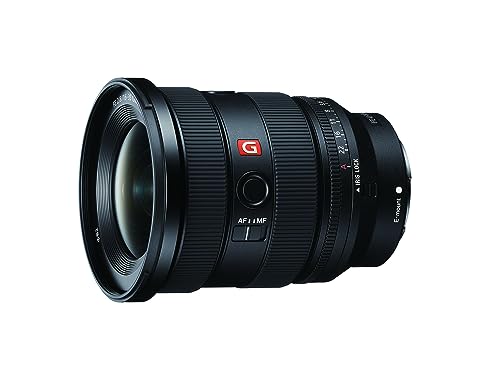
Sony FE 16-35mm f/2.8 GM II
Landscape, interior and event framing all sit inside one zoom, so the lens rarely leaves the body. Constant f/2.8 keeps exposure steady as you zoom, and an 82mm front thread accepts normal polarisers and ND filters. Four XD linear motors drive focus quietly enough for clips with on camera audio.
Pros
- Constant f/2.8 from 16mm through 35mm
- Flat front takes standard 82mm screw in filters
- XD linear motors stay quiet during video takes
Cons
- Heaviest lens here at 547 grams
- Overkill for anyone who only shoots daylight landscapes

Tamron 17-28mm f/2.8 Di III RXD
Cutting the range to 17-28mm drops weight to roughly 420 grams while keeping the constant f/2.8 aperture. Most wide work happens below 24mm anyway, so the missing 35mm setting costs less than the spec sheet suggests. A 67mm thread matches other Tamron Di III lenses, which keeps one filter set in play.
Pros
- Roughly 130 grams lighter than the GM II
- Shares a 67mm thread with the rest of the Di III line
- Focuses near 0.19m at the wide end
Cons
- Stops at 28mm, so no 35mm framing for portraits
- No aperture ring or custom button on the barrel

Canon RF 16mm f/2.8 STM
Full frame 16mm coverage arrives in a 165 gram prime with a 43mm filter thread. Close focus near 0.13m lets a foreground rock or a coffee cup dominate the frame. Corners soften wide open, and Canon leans on in camera correction profiles to straighten the geometry.
Pros
- Only 165 grams, so a jacket pocket carries it
- Focuses to roughly 0.13m for exaggerated foregrounds
- STM motor keeps focus noise out of clips
Cons
- Depends heavily on distortion correction profiles
- Corner detail drops noticeably at f/2.8

NIKKOR Z 14-30mm f/4 S
Reaching 14mm while still taking an 82mm screw in filter is rare, and it saves buying a square holder kit. Its front element sits flat, so circular polarisers and graduated ND filters mount directly. Constant f/4 keeps the retractable barrel near 485 grams with weather sealed S line construction.
Pros
- Standard 82mm filters thread on even at 14mm
- Retractable design shortens it inside a bag
- Weather sealed for coastal and mountain work
Cons
- f/4 limits handheld shooting in dim interiors
- Barrel must be extended before the camera will fire

Sigma 16mm f/1.4 DC DN Contemporary
On a crop body this prime frames like 24mm, the classic width for handheld vlogging and seated interviews. An f/1.4 aperture separates a subject from a busy background in a way no f/2.8 zoom manages. Sigma builds it around a 67mm thread with a dust and splash resistant mount seal.
Pros
- f/1.4 delivers real subject separation on a crop sensor
- 24mm equivalent framing suits arm length vlogging
- Sealed mount handles dust and light rain
Cons
- About 405 grams feels front heavy on a small body
- Image circle will not cover a full frame sensor
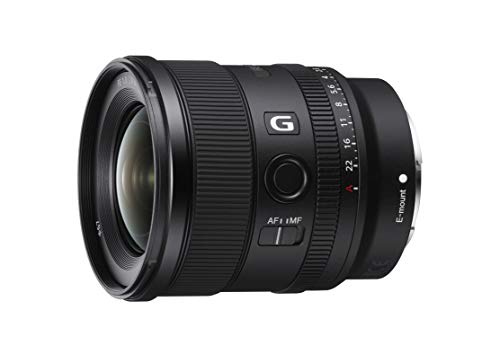
Sony FE 20mm f/1.8 G
Star fields reward a fast prime, and f/1.8 gathers roughly two and a half times the light of an f/2.8 zoom. Roughly 373 grams and a 67mm thread keep it travel friendly on a compact body. Its aperture ring de-clicks with a switch, which smooths exposure pulls during video.
Pros
- f/1.8 shortens star exposures and lowers ISO
- De-clickable aperture ring for smooth video pulls
- Autofocus works down to about 0.18m
Cons
- 20mm looks tame next to a 14mm or 16mm view
- No optical stabilisation, so the body must provide it

Canon EF-S 10-18mm f/4.5-5.6 IS STM
Canon APS-C DSLR owners get a 16mm equivalent view for just 240 grams. Optical stabilisation steadies handheld hallways and stairwells where the variable aperture would otherwise push ISO up. Tight rooms are where this zoom earns its place, not open landscapes at dusk.
Pros
- Optical stabilisation supports handheld interior shots
- Lightest zoom in this group at 240 grams
- 16mm equivalent framing covers small rooms
Cons
- Variable f/4.5 to f/5.6 aperture struggles after dark
- Plastic mount with no weather sealing
Side by side
| # | Model | Mount | Best for | Score | Price |
|---|---|---|---|---|---|
| 1 | Sony FE 16-35mm f/2.8 GM II | Sony E, full frame | Best overall | 9.4 | Check price |
| 2 | Tamron 17-28mm f/2.8 Di III RXD | Sony E, full frame | Best value | 9.2 | Check price |
| 3 | Canon RF 16mm f/2.8 STM | Canon RF, full frame | Best budget | 9.0 | Check price |
| 4 | NIKKOR Z 14-30mm f/4 S | Nikon Z, full frame | Best for landscape filters | 8.8 | Check price |
| 5 | Sigma 16mm f/1.4 DC DN Contemporary | Sony E or Micro Four Thirds, APS-C | Best for APS-C video | 8.6 | Check price |
| 6 | Sony FE 20mm f/1.8 G | Sony E, full frame | Best for night sky work | 8.3 | Check price |
| 7 | Canon EF-S 10-18mm f/4.5-5.6 IS STM | Canon EF-S, APS-C | Best for Canon DSLR owners | 8.0 | Check price |
Questions worth asking
What counts as a wide angle lens?
On full frame, anything below roughly 35mm reads as wide, and below 20mm is usually called ultra wide. Crop cameras reach the same look at shorter numbers, near 24mm and 14mm.
Is 16mm wide enough for landscape photography?
For mountains, coastlines and skylines, yes. Step to 14mm when a sweeping foreground matters or a cramped viewpoint stops you backing up.
Which wide angle lens is best for real estate photos?
Canon EF-S 10-18mm f/4.5-5.6 IS STM covers small rooms on a crop DSLR. NIKKOR Z 14-30mm f/4 S does the same job on Nikon Z with better corner control.
Can a full frame wide angle lens be used on an APS-C body?
Yes, and nothing breaks. Expect a narrower view, so a 16mm lens looks closer to 24mm and gives up much of its wide character.
Do I need f/2.8, or is f/4 fine?
Landscape work at small apertures rarely needs f/2.8, so f/4 saves weight. Events, interiors and night skies are where the extra stop earns its keep.
Why do wide angle lenses stretch faces at the edges?
Wide optics project a large field onto a flat sensor, so anything near the frame edge gets pulled outward. Keep people away from the corners, or back up and zoom in slightly.
Zoom or prime for wide angle video?
Primes such as the Sigma 16mm f/1.4 give a brighter aperture and stronger background separation. Zooms like the Tamron 17-28mm f/2.8 let you reframe mid take, which suits run and gun work.
Can I use screw in filters on ultra wide lenses?
Only where the front element is flat and threaded. NIKKOR Z 14-30mm f/4 S takes 82mm filters at its widest setting, while bulbous designs need a holder system.
Sony 16-35mm GM II vs Tamron 17-28mm: which is better?
Choose the GM II when 35mm framing and a custom button matter to your workflow. Take the Tamron for 130 fewer grams and a 67mm thread shared with its siblings.
Which wide angle lens is best for beginners?
Canon RF 16mm f/2.8 STM is the easiest entry on RF bodies, thanks to 165 grams and simple handling. Crop DSLR owners should start with the EF-S 10-18mm instead.
Final word
Get the Sony FE 16-35mm f/2.8 GM II if you shoot full frame and want one lens for landscapes, interiors and events, since its 82mm thread keeps a polariser in play. Carry the Tamron 17-28mm f/2.8 Di III RXD instead when 35mm framing is optional and 130 grams matters on a long hike. APS-C shooters should ignore both and buy the Sigma 16mm f/1.4 DC DN for its brighter aperture and 24mm equivalent framing.
Marcus Chen
Marcus covered consumer electronics for enthusiast tech publications for six years before joining ChoiceCrest. He specializes in translating manufacturer spec sheets into plain-language buying advice, with a focus on audio, computing accessories and smart-home gear.
You might also need
Nintendo Game & Watch: Super Mario Bros Review: Still Worth It as a Collectible?

Ray-Ban Meta (Gen 2) Wayfarer Smart Glasses: Worth $379 for Clear Lenses?
AlyKets Nikon UC-E6 Replacement USB Cable: Does a $7.95 Cord Work as Well as the Original?
