Stop Trailer Rocking With the Right Wheel Chock Set
The Camco X-Chock Dual Axle Wheel Stabilizer is the strongest overall pick, locking between both tires on one side to stop rocking. Rhino USA Heavy Duty Rubber Wheel Chocks suit single-axle trailers and cold climates. Valterra Chock-It fits tight budgets.
The Camco X-Chock Dual Axle Wheel Stabilizer is the best wheel chock set for most owners. It wedges between both tires on one side of a dual-axle trailer and removes the side-to-side rocking that a basic wedge chock cannot touch. Single-axle trailers and tow vehicles will not benefit from its X-frame, so those owners need a different pick below.
Dual-axle stabilizers, rubber wedges, and plastic chocks solve different problems, which makes this category trickier than it looks. We compared material, tire-size range, and weight rating across current Amazon listings, then checked owner feedback for cracking, slipping, and storage complaints.
Our top picks
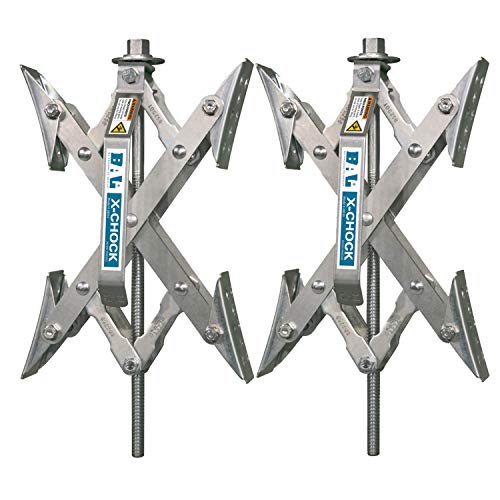
Camco X-Chock Dual Axle Wheel Stabilizer
This stabilizer expands between the two tires on one side of a dual-axle trailer and locks with a ratchet strap. Owners use it to stop the rocking that happens when someone walks inside a parked RV. It ships as a single unit covering one side, so most dual-axle owners buy two.
Pros
- Locks between two tires to stop rocking
- Rust-resistant powder coating
- Folds flat for storage
Cons
- Only works on dual-axle setups
- Not a substitute for a parking brake

Camco Wheel Stop Interlocking Chocks
These molded plastic wedges interlock into a single block for storage, then separate into a front and back chock. Single-axle travel trailers and pop-ups use them most often. They grip pavement and packed gravel without extra hardware.
Pros
- Interlock together for compact storage
- Lightweight to carry and place
- Works on pavement and gravel
Cons
- Plastic can crack in deep cold
- No rope or anchor included
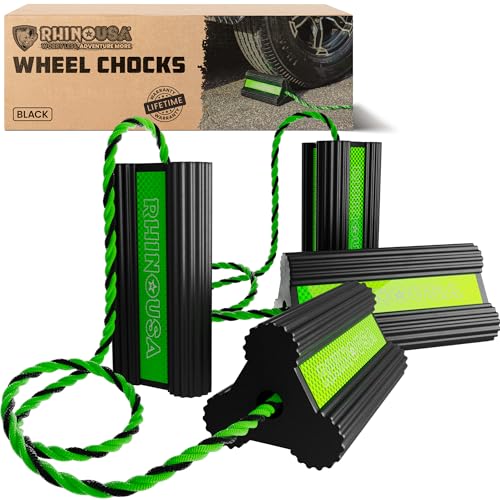
Rhino USA Heavy Duty Rubber Wheel Chocks
Solid rubber construction flexes instead of cracking when temperatures drop below freezing. The ridged base resists sliding on wet ramps better than smooth plastic. Owners running heavier trucks and toy haulers lean on this set.
Pros
- Rubber resists cracking in cold weather
- High-traction base on wet surfaces
- Handles heavier axle weights
Cons
- Heavier to carry than plastic
- Takes up more storage space

Valterra Chock-It Wheel Chock
A single lightweight wedge with a molded rope handle for quick retrieval from under the tire. It nests with itself for storage and costs less than most rubber sets. Weekend campers who only chock occasionally choose this one first.
Pros
- Rope handle speeds up removal
- Low entry cost
- Nests for compact storage
Cons
- Sold individually, not as a pair
- Less secure on steep grades
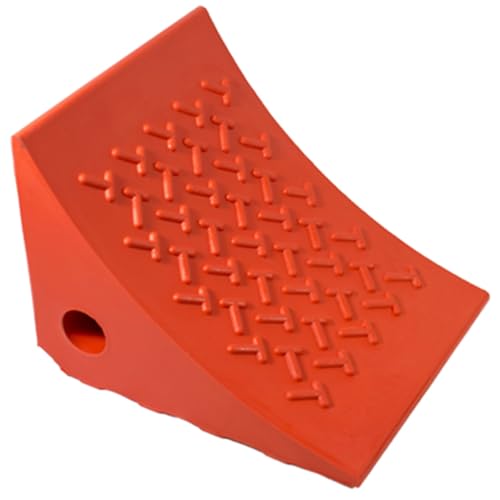
AME International Super Chocks
Shops servicing commercial trucks and trailers use this wide, flat-footed rubber chock to prevent tipping under heavier loads. The rubber compound holds up to years of outdoor storage. It costs more than consumer-grade sets, which fits its heavier-duty audience.
Pros
- Wide base resists tipping
- Rated for commercial tire sizes
- Long outdoor service life
Cons
- Priced above typical RV chocks
- Bulkier than most travel trailers need

CURT Trailer Wheel Chock
A low-profile rubber wedge built to slide into tight wheel wells on boat and utility trailers. It stands alone without a connecting strap, which keeps setup simple at a launch ramp. Owners use it mainly for short parking stops rather than long-term storage.
Pros
- Low profile fits tight wheel wells
- Simple one-piece design
- Grips ramps and driveways
Cons
- No strap connecting a pair
- Can shift on loose gravel

RecPro RV Wheel Chocks
These stack to change height for different tire diameters, which helps full-time RVers who switch between rigs. Rubber construction shrugs off sun exposure better than plastic over months of outdoor storage. The tradeoff is a higher price and more storage bulk.
Pros
- Stack to fit different tire diameters
- Withstands sun and temperature swings
- Wide tread contact area
Cons
- Costs more than basic plastic chocks
- Larger footprint in storage bays
How to pick the right one
What a wheel chock actually does A wheel chock wedges against a tire to stop forward or backward roll when a vehicle is parked. It is not a parking brake backup; it is a separate layer of safety for sloped driveways, campsites, and service bays. RVs and trailers need chocks more than cars do, since many trailers have weak or no parking brake of their own. Skipping chocks on a grade risks the trailer rolling into traffic or off a jack stand.
Rubber versus plastic: picking by climate Plastic chocks cost less and weigh less, which suits occasional campers who store gear in a tight bay. Rubber chocks flex instead of cracking when temperatures swing below freezing, so northern owners and four-season RVers should lean rubber. Ridged rubber bases also grip wet boat ramps better than smooth plastic. Weight and bulk are the tradeoff, since rubber chocks take up more space than a nesting plastic pair.
Single-axle wedges versus dual-axle stabilizers A single-axle trailer only needs a wedge chock at the front and back of one tire. Dual-axle trailers rock side to side as weight shifts inside, which a wedge chock cannot fix because it only blocks forward and backward roll. An X-chock stabilizer locks between the two tires on one side instead, eliminating that rocking motion entirely. Many dual-axle owners run both: wedges for parking safety, X-chocks for stability at camp.
Chocking on slopes, gravel, and loose pads Steep campsite pads and gravel lots need extra care, since a chock can slide before it fully seats. Place the chock tight against the tire before any weight shifts onto it, and recheck it after the trailer settles. On loose gravel, a wide-base rubber chock holds better than a narrow plastic wedge. For long-term parking on a real grade, pair a chock with wheel straps or a stabilizer jack rather than relying on the chock alone.
The lineup, side by side
| # | Model | Material | Best for | Score | Price |
|---|---|---|---|---|---|
| 1 | Camco X-Chock Dual Axle Wheel Stabilizer | Powder-coated steel scissor arms | Best overall | 9.4 | Check price |
| 2 | Camco Wheel Stop Interlocking Chocks | Molded plastic | Best for single-axle trailers | 9.0 | Check price |
| 3 | Rhino USA Heavy Duty Rubber Wheel Chocks | Solid rubber | Best for cold climates and heavy rigs | 8.9 | Check price |
| 4 | Valterra Chock-It Wheel Chock | Injection-molded plastic | Best budget pick | 8.6 | Check price |
| 5 | AME International Super Chocks | Solid rubber compound | Best for commercial and shop use | 8.4 | Check price |
| 6 | CURT Trailer Wheel Chock | Solid rubber | Best for boat and utility trailers | 8.2 | Check price |
| 7 | RecPro RV Wheel Chocks | Heavy-duty rubber | Best for full-time RV owners | 8.0 | Check price |
Frequently asked questions
Are wheel chocks necessary if my trailer has a parking brake?
Yes. Many trailer parking brakes are weak or absent, and chocks add a mechanical backup that does not depend on cables or hydraulics holding.
How many wheel chocks do I need for a travel trailer?
A single-axle trailer typically needs one chock per tire, so two total. Dual-axle trailers often add an X-chock stabilizer on top of standard wedges.
Can wheel chocks replace leveling blocks?
No. Chocks stop rolling, while leveling blocks raise a tire to level the trailer. Most RVers carry both separately.
Do rubber or plastic wheel chocks work better in winter?
Rubber holds up better in freezing temperatures because it flexes instead of cracking under cold stress.
What is an X-chock used for?
An X-chock expands between the two tires on one side of a dual-axle trailer to stop side-to-side rocking while parked.
How do I chock a wheel on a slope?
Seat the chock tight against the downhill side of the tire before unhitching, then recheck it once the trailer’s weight settles.
Is there a legal requirement to chock a parked trailer?
Some campgrounds and service yards require chocks as a safety policy, though it varies by location rather than a universal law.
Can one wheel chock set work for a car and an RV?
A compact plastic or rubber wedge can work for both, as long as its fit range covers the car’s smaller tire diameter.
How long do rubber wheel chocks last?
Outdoor storage and UV exposure matter most; a solid rubber chock typically lasts several seasons before the compound hardens or cracks.
Do wheel chocks stop trailer sway while driving?
No. Chocks only work while parked. Sway while towing is addressed with a sway control hitch, not a chock.
Our take
The Camco X-Chock Dual Axle Wheel Stabilizer is the right pick for anyone with a dual-axle trailer who wants the rocking gone at camp. Single-axle owners, especially in cold climates, should pick the Rhino USA rubber chocks instead for the same anti-crack durability without paying for an X-frame they cannot use. Shops servicing commercial trailers should skip the lighter consumer sets entirely and go straight to the AME International Super Chocks.
Tony Russo
Tony trained as an automotive technician and spent years in service and parts retail before moving into writing. He focuses on garage tools, car care products and accessories from a hands-on maintenance perspective.


