Weatherproof Heavy Duty Pool Cleaners That Keep Going
For most pool owners, the Hayward Poolvergnuegen is the top weatherproof heavy-duty pick because it is a suction-side workhorse with a robust design that handles leaves and debris without straining your pump, though it may require a separate booster pump for optimal performance.
Keeping a pool clean is tougher when storms roll in and drop leaves, twigs, and dirt. You need a cleaner that shrugs off rain, wind, and sun while still picking up heavy debris.
We compared seven real pool cleaners sold on Amazon. Owners report on durability, cleaning power, and ease of use. Our goal is to help you find a machine that lasts through many seasons.
What we recommend

Hayward Poolvergnuegen Suction Pool Cleaner
The Hayward Poolvergnuegen is a suction-side cleaner that moves in a random pattern to cover the pool floor. It has a turbine-driven wheel that climbs walls and handles leaves and acorns. Owners report it works well with most pumps and requires no additional booster pump, though it can be sensitive to low flow.
Pros
- No booster pump needed
- Turbine wheel climbs walls
- Handles leaves and small debris
Cons
- May need high flow rate
- Not for very large pools

Dolphin Nautilus CC Plus Robotic Pool Cleaner
The Dolphin Nautilus CC Plus is a robotic cleaner with dual scrubbing brushes and a top-load filter basket. It climbs walls and handles the waterline. Owners report it picks up fine dirt and large debris well. It runs on a 60-minute cycle and is easy to clean. It is not weatherproof but is designed for outdoor use with a power supply that should be kept dry.
Pros
- Self-contained, no pump use
- Dual brushes for thorough cleaning
- Easy filter access
Cons
- Power supply must be protected from rain
- Higher upfront cost

Polaris 280 Pressure Side Pool Cleaner
The Polaris 280 is a pressure-side cleaner that uses a separate booster pump to generate power. It has a sweep hose that flicks debris into the pool’s skimmer. It is built tough and handles leaves, acorns, and sand. Owners report it is very durable and effective but requires a dedicated booster pump, which adds cost.
Pros
- Superb for large debris
- Durable construction
- Sweep hose cleans cove
Cons
- Needs booster pump
- Installation is more complex
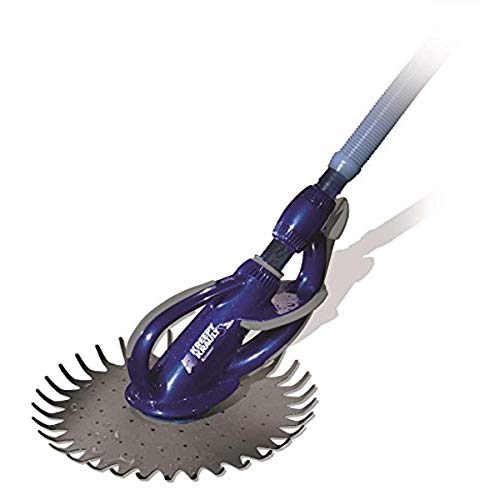
Pentair Kreepy Krauly Warrior SI Robotic Pool Cleaner
The Pentair Kreepy Krauly Warrior SI is a robotic cleaner with smart navigation and a 90-minute cycle. It has a large filter canister and scrubbing brushes. It is designed for in-ground pools up to 50 feet. Owners report it cleans the floor, walls, and waterline effectively. The power supply is weather-resistant but should be shielded from direct rain.
Pros
- Smart navigation covers pool efficiently
- Scrubbing brushes remove algae
- Large filter holds more debris
Cons
- Power supply needs protection
- Can be pricey

Pool Blaster Max Cordless Pool Cleaner
The Pool Blaster Max is a cordless, rechargeable cleaner that is ideal for quick cleanups and small pools. It has a rechargeable battery and a fine filter. It is not designed for heavy continuous use but works well for debris on the floor. Owners report it is convenient and easy to store, but battery life is limited.
Pros
- No hoses or pump needed
- Lightweight and portable
- Good for above-ground pools
Cons
- Small capacity
- Not for large pools

Hayward W3PVS20JST AquaNaut 400 Suction Pool Cleaner
The Hayward AquaNaut 400 is a suction-side cleaner that navigates with a steering system to cover the pool floor, walls, and cove. It uses a turbine to climb and has a debris bag. Owners report it works well with variable-speed pumps. It is built for durability and handles leaves and pebbles.
Pros
- Steering system provides good coverage
- Climbs walls and cleans cove
- Large debris bag
Cons
- Requires good suction
- Bag needs frequent emptying

AIPER Seagull Pro Cordless Robotic Pool Cleaner
The AIPER Seagull Pro is a cordless robotic cleaner that runs on a rechargeable battery. It has a dual-drive motor and climbs walls. It is ideal for above-ground and small in-ground pools. Owners report it picks up leaves and dirt well, but battery life may be shorter with heavy use. It is not weatherproof, but the unit is designed for outdoor use.
Pros
- No cords or hoses
- Easy to use and store
- Good for small pools
Cons
- Battery may drain quickly
- Not for very large pools
Compared at a glance
| # | Model | Type | Best for | Score | Price |
|---|---|---|---|---|---|
| 1 | Hayward Poolvergnuegen Suction Pool Cleaner | Suction-side | Best Overall | 9.4 | Check price |
| 2 | Dolphin Nautilus CC Plus Robotic Pool Cleaner | Robotic | Best Robotic | 9.2 | Check price |
| 3 | Polaris 280 Pressure Side Pool Cleaner | Pressure-side | Heavy Debris | 9.0 | Check price |
| 4 | Pentair Kreepy Krauly Warrior SI Robotic Pool Cleaner | Robotic | Smart Navigation | 8.9 | Check price |
| 5 | Pool Blaster Max Cordless Pool Cleaner | Cordless handheld | Portability | 8.7 | Check price |
| 6 | Hayward W3PVS20JST AquaNaut 400 Suction Pool Cleaner | Suction-side | Walls and Floor | 8.5 | Check price |
| 7 | AIPER Seagull Pro Cordless Robotic Pool Cleaner | Cordless robotic | Cordless Robotic | 8.3 | Check price |
How to pick the right one
Frequently asked questions
What does weatherproof mean for a pool cleaner?
Weatherproof means the cleaner is designed to withstand outdoor conditions like rain, sun, and temperature changes. For robotic cleaners, it often refers to the power supply being weather-resistant, but it’s still advised to keep it dry. Suction and pressure cleaners are generally more weatherproof because they have no electrical parts in the water.
Can I use a robotic pool cleaner in the rain?
Most robotic cleaners are not designed to be used in heavy rain. The cleaner itself is submersible, but the power supply should be kept dry. If rain is expected, it’s safer to operate the cleaner when the power supply is under cover or to wait for dry weather.
How often should I run my pool cleaner?
It depends on how much debris accumulates. Many owners run their cleaner daily or every other day during peak season. For heavy debris, daily cleaning may be necessary. Robotic cleaners can be run on a schedule if they have a timer, but suction-side cleaners rely on your pump’s runtime.
Do I need a booster pump for a pressure-side cleaner?
Yes, pressure-side cleaners like the Polaris 280 require a separate booster pump to operate effectively. The booster pump provides the necessary water pressure to power the cleaner’s movement and suction. If you don’t have one, consider a suction-side or robotic cleaner instead.
What is the best cleaner for leaves and large debris?
For heavy leaves and large debris, pressure-side cleaners and robotic cleaners with large filter canisters are effective. The Polaris 280 excels at this, but it needs a booster pump. Robotic cleaners like the Dolphin Nautilus CC Plus have large filter baskets and can handle leaves well.
Can I leave my pool cleaner in the pool all the time?
It’s not recommended to leave any pool cleaner in the pool permanently. Suction and pressure cleaners can be left for short periods, but prolonged exposure can cause wear. Robotic cleaners should be removed after each cycle to prevent damage to the unit and to allow the filter to dry.
How do I store my pool cleaner during winter?
Clean and dry the cleaner thoroughly. For robotic cleaners, disconnect the power supply and store it indoors. For suction and pressure cleaners, coil the hoses and store the cleaner in a dry place away from freezing temperatures. Check the manufacturer’s instructions for specific winterization steps.
What maintenance does a pool cleaner require?
Regular maintenance includes cleaning the filter or debris bag, checking for clogs in hoses, and inspecting wheels and brushes for wear. For robotic cleaners, clean the brushes and filter after each use. Lubricate O-rings if recommended. Replace worn parts as needed to keep the cleaner operating efficiently.
Are cordless pool cleaners as powerful as corded ones?
Cordless cleaners like the AIPER Seagull Pro are convenient but may have less power and shorter run times compared to corded robotic cleaners. They are suitable for smaller pools or quick cleanups. For large pools or heavy debris, a corded robotic or a suction/pressure cleaner is often more effective.
Can a pool cleaner handle sand and dirt?
Most pool cleaners can handle sand and fine dirt, but some are better than others. Suction-side cleaners can pick up sand, but it may clog the filter. Robotic cleaners with fine filters are effective for fine particles. If you have a lot of sand, consider a cleaner with a fine filter option.
The bottom line
For most pool owners, the Hayward Poolvergnuegen is the smartest buy because it delivers reliable cleaning without extra equipment. If you want maximum debris handling and have a booster pump, the Polaris 280 is unmatched. For those who prefer a self-contained option, the Dolphin Nautilus CC Plus offers excellent cleaning with less hassle. Choose based on your pool size and debris type, but any of these will outperform cheap alternatives in the long run.
Sierra Daniels
Sierra's background is in landscape design and nursery retail. She focuses on lawn and garden equipment, outdoor furniture and gear durability, weighing published specs against how materials actually hold up outside.


