Home Weather Stations: Which Sensors You Actually Need
Ambient Weather WS-2902 fits most homes, reporting wind, rain, UV and solar radiation over Wi-Fi to Weather Underground. AcuRite Iris keeps wind and rainfall on a single mast while dropping UV. Davis Vantage Vue 6250 belongs on exposed coastal and ridge sites, refreshing every 2.5 seconds.
Ambient Weather WS-2902 answers most household questions, because one solar-powered array logs wind speed, wind direction, rainfall, temperature, humidity, UV index and solar radiation, then publishes straight to Weather Underground. Its plastic anemometer cups are the weak link, and salt air or repeated hard freezes will eventually finish them. Anyone on a ridge, a farm or a coastline should read the Davis Vantage Vue entry first.
Listings blur together because every box claims five-in-one, yet update intervals, wireless range and logging behaviour differ enormously. We compared which variables each unit measures, how often the outdoor array reports, stated range, power arrangements and network integrations. Owner feedback about anemometer bearings and clogged rain funnels after two winters broke the ties. Stations that keep reporting through a bad season finished higher.
The shortlist, ranked
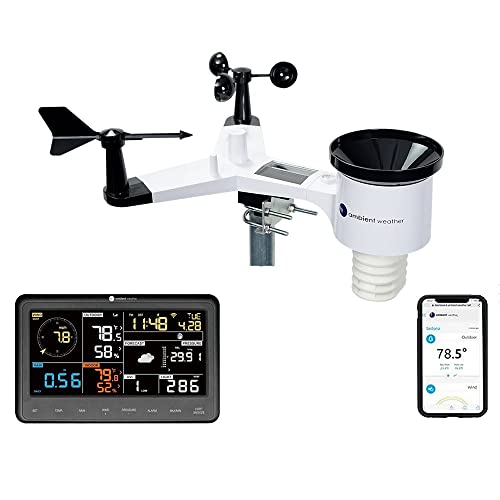
Ambient Weather WS-2902
One integrated array handles wind speed and direction, rainfall, temperature, humidity, UV index and solar radiation, two variables beyond the usual five-in-one set. Readings reach the console about every 16 seconds, then leave the network for Ambient Weather Network and Weather Underground. A small solar panel keeps the array charged, with AA cells carrying it through overcast stretches.
Pros
- UV and solar radiation share the array with wind and rain
- Uploads to Weather Underground with no add-on bridge
- Solar charging backed by replaceable AA cells
Cons
- Plastic anemometer cups wear out in salt air
- Console has to stay inside Wi-Fi coverage to publish
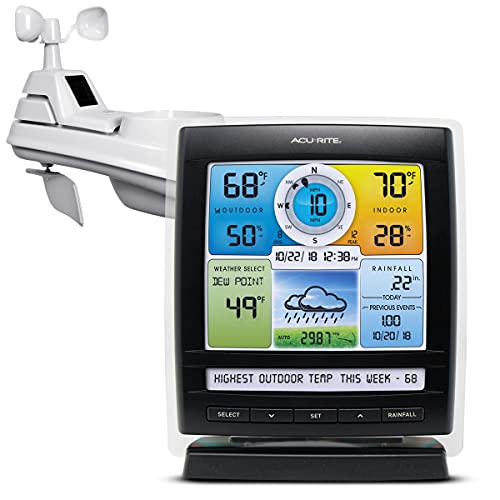
AcuRite Iris 5-in-1 Weather Station
Iris reads wind speed, wind direction, rainfall, temperature and humidity from a single mast-mounted sensor. Forecast icons on the colour console come from your own barometric trend rather than a regional feed. Owners report the self-emptying collector keeps pace with heavy downpours, though pine needles still need clearing out each autumn.
Pros
- Forecast built from on-site pressure readings
- Single mast mount cuts installation to one pole
- Console digits stay legible across a kitchen
Cons
- No UV or solar radiation sensor
- Some bundles need a separate Wi-Fi bridge

La Crosse Technology S88907 Wireless Weather Station
Treat this as a temperature and humidity console rather than a sensor array, which is exactly what plenty of households want. A remote transmitter sends outdoor readings up to 330 feet to a colour display that logs daily highs and lows. Wind and rain go unmeasured, so it answers comfort questions instead of site questions.
Pros
- Quickest setup of anything listed here
- Automatic min and max tracking on both sensors
- Battery backup keeps the display alive through outages
Cons
- No anemometer or rain gauge at all
- Forecast icons stay generic rather than site specific

Davis Instruments Vantage Vue 6250
Davis seals the Vantage Vue suite against coastal salt, freezing rain and sustained wind. Readings refresh roughly every 2.5 seconds, so gusts register instead of being averaged away. Wireless range runs to about 1000 feet line of sight, which lets the array stand well clear of roof turbulence.
Pros
- Fastest refresh here at roughly 2.5 seconds
- 1000 foot range clears outbuildings and tree lines
- Sealed suite holds up through salt air and hard freezes
Cons
- Internet upload needs a separate WeatherLink module
- No UV or solar radiation measurement
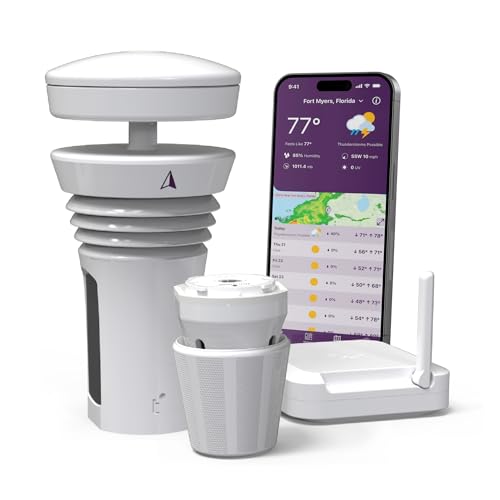
Tempest Weather System
Ultrasonic sensing replaces spinning cups, and a haptic sensor replaces the tipping bucket, so no bearing seizes and no funnel clogs. One solar-powered unit mounts on a single pole and uploads over Wi-Fi with no console in the loop. Lightning detection rides along inside the same housing, useful for anyone running outdoor work or livestock.
Pros
- No bearings, cups or funnels to service
- Lightning detection built into the single unit
- Solar power with no battery changes to schedule
Cons
- Haptic rain readings need calibrating against a manual gauge
- A Wi-Fi outage stops data, since no console holds it

Netatmo Smart Home Weather Station
Netatmo points its attention indoors, logging carbon dioxide, noise level, temperature, humidity and pressure. Outside, a slim aluminium module reports temperature and humidity only, with rain and wind modules sold separately. CO2 alerts earn their keep in a sealed home office where the door stays shut all afternoon.
Pros
- CO2 alerts prompt ventilation before concentration climbs
- Aluminium modules suit a living room shelf
- Voice assistant routines work without extra hubs
Cons
- Wind and rain require separate add-on modules
- No console, so the phone app is the only display

AcuRite Atlas Weather Station
Atlas layers lightning strike detection and light intensity onto AcuRite’s wind, rain, temperature and humidity set. Strike count and approximate distance appear on the console, which helps decide when to clear a pool or a ball field. A solar-powered fan draws air across the temperature sensor, so midday sun does not inflate the reading.
Pros
- Strike count and distance read off the console
- Fan aspiration sharpens accuracy in direct sun
- Widest sensor list AcuRite offers
Cons
- Nearby appliances can trigger false strike counts
- Larger array calls for a sturdier mounting pole
How to pick the right one
What a home weather station measures Entry consoles report indoor and outdoor temperature and humidity, which settles most everyday questions. Five-in-one arrays add wind speed, wind direction and rainfall, turning the unit into a record of your own plot rather than a regional summary. Seven-in-one models layer on UV index and solar radiation, worth having for gardeners and solar panel owners. Barometric pressure is the quiet essential, since no station can forecast locally without it. Check the sensor list for pressure before believing any forecast claim on the box.
Where to mount the sensors Placement ruins more stations than hardware failure does. Put the anemometer at least six feet above the roofline and away from walls that funnel wind, or readings run low all year. Shade the temperature sensor and keep it off brick, which radiates stored heat into the evening. Rain gauges want open sky, never a spot beneath a gutter or a branch. Confirm the quoted range covers the distance to your console, remembering that walls and foil-backed insulation cut that 330 foot figure sharply.
Wi-Fi uploading and keeping your data Publishing to Weather Underground or the Ambient Weather Network turns a garden into a public station and gives you graphed history to revisit. WS-2902 and Tempest handle that natively. Davis and AcuRite need an add-on bridge, which means another box and another outlet near the router. Anyone comparing this June with last June, or feeding readings into Home Assistant, saves real friction by choosing a station that uploads on its own.
Moving parts and harsh weather sites Cup anemometers and tipping bucket gauges work fine until bearings dry out or debris blocks the funnel. Plan on clearing the gauge each autumn and replacing cups after a few seasons near the coast. Tempest sidesteps mechanical wear with ultrasonic wind sensing and a haptic rain sensor, trading that for rainfall calibration against a manual gauge. Davis goes the opposite way, keeping moving parts and building them to survive. Choose by climate and exposure, not by which approach sounds more modern.
The lineup, side by side
| # | Model | Measures | Best for | Score | Price |
|---|---|---|---|---|---|
| 1 | Ambient Weather WS-2902 | Wind speed and direction, rain, temperature, humidity, UV, solar radiation | Best overall | 9.4 | Check price |
| 2 | AcuRite Iris 5-in-1 Weather Station | Wind speed and direction, rain, temperature, humidity | Best value | 9.2 | Check price |
| 3 | La Crosse Technology S88907 Wireless Weather Station | Indoor and outdoor temperature and humidity | Best budget | 9.0 | Check price |
| 4 | Davis Instruments Vantage Vue 6250 | Wind speed and direction, rain, temperature, humidity, barometric pressure | Best for harsh climates | 8.8 | Check price |
| 5 | Tempest Weather System | Wind, rain, temperature, humidity, pressure, UV, solar, lightning | Best with no moving parts | 8.6 | Check price |
| 6 | Netatmo Smart Home Weather Station | Temperature, humidity, CO2, noise, pressure | Best for indoor air quality | 8.3 | Check price |
| 7 | AcuRite Atlas Weather Station | Wind, rain, temperature, humidity, UV, light intensity, lightning | Best for lightning awareness | 8.0 | Check price |
Questions worth asking
What is the difference between a 5-in-1 and a 7-in-1 weather station?
Five-in-one arrays cover wind speed, wind direction, rainfall, temperature and humidity. Seven-in-one models such as the Ambient Weather WS-2902 add UV index and solar radiation, which matter for gardening decisions, sun exposure and estimating solar panel output.
How accurate are home weather stations?
Temperature and humidity land close to official figures when the sensor sits shaded and aspirated. Rainfall is reliable once the gauge is level and clear. Wind is the weakest variable, because few homes can mount an anemometer high enough to escape roof turbulence.
Where should a home weather station be mounted?
Aim for the anemometer six feet or more above the roofline in clear air, a shaded temperature sensor, and open sky above the rain gauge. Bolting everything to one short pole beside a wall produces data that describes the wall.
Do weather stations need Wi-Fi to work?
Console models from AcuRite, Davis and La Crosse display readings with no network at all. Wi-Fi adds remote access, graphing and public uploading. Tempest is the exception, since it ships without a console and relies entirely on the connection.
Which weather station is best for coastal or mountain sites?
Davis Vantage Vue 6250 has the strongest record for surviving salt spray, freezing rain and sustained wind. Its 1000 foot range also lets the array sit on a clear mast well away from the building.
Can a weather station detect lightning?
AcuRite Atlas and Tempest both report strike counts with an approximate distance. Neither substitutes for an official warning service, and electrical noise from nearby appliances can add false counts.
Is an ultrasonic anemometer better than spinning cups?
Ultrasonic sensing has no bearings to seize and nothing to snap off in a gale, so upkeep falls to almost nothing. Cup anemometers stay easier to verify and repair, and a well-built one like the Davis unit runs for many seasons.
How do I share my weather data on Weather Underground?
Ambient Weather consoles upload directly once you enter a station ID and key in the settings menu. AcuRite and Davis reach the same networks only through an extra bridge or a WeatherLink module.
How long does a home weather station last?
Electronics usually outlive the moving parts. Expect several seasons from plastic cups in mild weather and fewer near the coast, plus an annual funnel cleaning. Rechargeable cells in the outdoor array typically need swapping every two to three years.
Our pick
Buy the Ambient Weather WS-2902 for a typical suburban garden, since seven sensors plus native Weather Underground uploading give you a full local record with no extra bridge box. Exposed coasts, ridges and open farmland call for the Davis Vantage Vue 6250 instead, where a sealed suite and 2.5 second refresh outlast consumer plastics. Households chasing indoor comfort rather than site weather get more from the Netatmo and its CO2 alerts.
Dana Whitfield
Dana spent eight years buying and merchandising for a regional kitchenware retailer before moving into editorial work. She has handled thousands of SKUs across cookware, small appliances and kitchen organization, and focuses on the practical differences that matter once a product is actually in daily use.