Weather-Resistant Camp Stoves for Wind, Rain and Cold
MSR WindBurner ranks first: its radiant burner sits enclosed in the pot base, so crosswind barely changes boil times. Backpackers wanting the same shelter near 3 ounces should look at Soto WindMaster. For group meals, Camp Chef Everest 2X pairs two 20,000 BTU burners with fold-up panels.
MSR WindBurner belongs in the pack when a forecast turns ugly. Its radiant burner sits enclosed inside the pot base, out of reach of a crosswind, and a pressure regulator holds output as the canister empties. Cookware is the catch, because the system is built around MSR pots rather than whatever mug you already carry.
Weather resistance usually gets sold as a foil shield clipped around a burner, the weakest version of the idea. Geometry does the real work, backed by a regulator and a heat exchanger that traps warmth before wind takes it. We compared burner designs, regulator specifications, quoted boil times, fuel types and weights. Owner reports covered what specifications cannot, mainly behaviour in sustained wind and below freezing.
Before you buy
What makes a camping stove weather resistant Three design features carry most of the load. Geometry leads: a recessed head like the Soto WindMaster, or an enclosed burner like the WindBurner, gives a gust nothing to push against. Regulators come next, holding fuel flow steady as a canister empties and chills. Heat exchangers finish the job, and that ridged ring under a Jetboil or WindBurner pot pulls warmth in before wind carries it away. Foil shields help slightly, though wrapping one around a canister-top burner traps heat against the fuel and is genuinely risky.
Canister, propane, liquid fuel and wood compared Screw-on canisters remain the default for good reason: light, clean, lit in seconds. Cold is their weakness, where pressure sags and output fades, and that is where the WhisperLite International and its hand pump take over. One pound propane cylinders feed the car camping stoves and deliver the most output per unit of fuss. Wood, the BioLite route, ends fuel purchases altogether but depends on dry tinder, a poor bet through a wet week. Choose the fuel around the trip, not around the stove you already like.
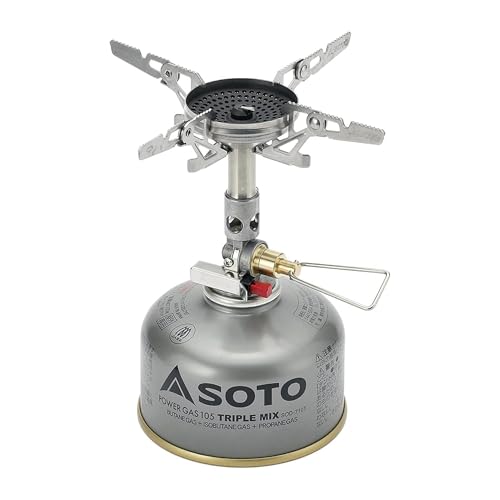
Backpacking above treeline and in the cold Up high, wind is constant rather than occasional, and shelter is what saves fuel. Soto WindMaster weighs about 3 ounces and needs no shield, which keeps both the pack and the flame steady. WindBurner costs weight at roughly 15.5 ounces for the system, and buys the most consistent boils in this group. Canister output falls once temperatures approach freezing, regulated or not. Tucking a canister inside a jacket for a few minutes before cooking recovers more performance than most campers expect.
Cooking for a group at a campsite Two burners change the menu, because coffee stops competing with eggs for one flame. Camp Chef Everest 2X supplies 20,000 BTU per burner, enough to keep a pan hot with wind crossing the table. Coleman’s Cascade Classic handles the same meals more slowly on 22,000 BTU combined. Check pan capacity before buying, since a stove taking a 10 inch and a 12 inch pan side by side saves one of them ending up on the ground. Pairs cooking simple meals can skip both and carry a canister system instead.
The top picks, ranked

MSR WindBurner Stove System
Enclosing a radiant burner inside the pot base is why wind barely shifts this stove’s boil time. Canister pressure sags as fuel drains, and a built-in regulator compensates, which plain screw-on burners cannot do. Its 1.0 litre pot locks onto the burner, keeping the whole assembly upright on uneven ground.
Pros
- Boil times hold through sustained wind
- Regulator keeps output steady on a low canister
- Locking pot will not tip off the burner
Cons
- Built around MSR pots rather than any cookware
- Heavier than a bare burner and a titanium mug
Soto WindMaster
Recessing the burner head inside a concave housing drops the flame below the rim, where a gust cannot reach it. A micro regulator steadies output as temperature and canister pressure fall. Pot supports swap between the four-arm 4Flex for stability and the three-arm TriFlex for weight.
Pros
- Wind protection with no shield to carry
- Takes any pot instead of a matched system
- Packs down inside a standard mug
Cons
- Detachable pot supports go missing easily
- No heat exchanger, so boils trail the WindBurner

Jetboil Flash Cooking System
Jetboil quotes 100 seconds for half a litre, and speed is the whole argument here. A FluxRing exchanger welded under the cup grabs heat that would otherwise drift off. On the cozy, a colour-changing indicator signals a boil without lifting the lid.
Pros
- Quickest boil here for coffee and dehydrated meals
- Heat indicator ends the lid-lifting habit
- Cup, stand and canister nest together for packing
Cons
- Simmer control is coarse for actual cooking
- Open burner loses more to wind than the WindBurner

Camp Chef Everest 2X Two-Burner Stove
Two burners at 20,000 BTU each put output nearer a kitchen hob than a camp stove, and a breeze that stalls a backpacking burner barely registers. Panels on three sides fold up to shelter both rings. Push-button ignition skips the lighter hunt in rain, while the valves drop low enough to hold a simmer.
Pros
- Output enough to feed a group in wind
- Valves simmer rather than only roar
- Latching lid keeps grease off packed gear
Cons
- Too heavy and bulky to carry beyond the car
- Propane cylinders eat real storage space
Coleman Cascade Classic Camping Stove
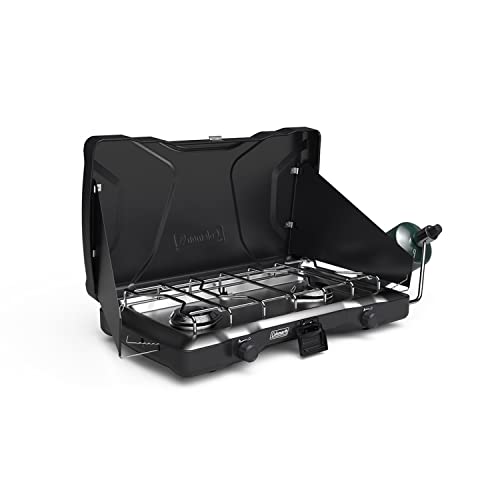
Coleman’s long-running two-burner runs the same 1 pound propane cylinders as the Camp Chef while sitting at the budget end of the category. WindBlock panels fold out and adjust around the pan instead of staying fixed. Combined output is 22,000 BTU, so windy days simply take longer.
Pros
- Least expensive route to two burners at a campsite
- Panels adjust around the pan being used
- Fuel and spare parts stocked almost everywhere
Cons
- Lower combined output than the Everest 2X
- Lights by match, with no built-in igniter

MSR WhisperLite International
Pumping the bottle by hand supplies the pressure, so cold cannot sap performance the way it drains a canister. Fuel options run to white gas, kerosene and unleaded petrol, which matters where canisters are not sold. Jets clear in the field with the supplied tool, turning a blocked stove into a short repair rather than a cold dinner.
Pros
- Dependable well below freezing
- Multi-fuel range suits international travel
- Serviceable in camp instead of replaced
Cons
- Priming and pumping add minutes to every meal
- Simmering takes practice next to a regulated burner

BioLite CampStove 2+
Twigs and pine cones take the place of canisters, stripping fuel weight from the pack and canister rules from a flight. Heat from the fire drives a thermoelectric module, which spins an internal fan and charges a phone over USB through a 3,200 mAh battery. Damp conditions are the real constraint, since wet wood lights slowly and smokes.
Pros
- No canisters to buy, carry or fly with
- Charges a phone while dinner cooks
- Fan-forced burn smokes less than an open fire
Cons
- Wet wood makes lighting slow and frustrating
- Needs constant feeding rather than a set flame
Compared at a glance
| # | Model | Type | Best for | Score | Price |
|---|---|---|---|---|---|
| 1 | MSR WindBurner Stove System | Integrated canister stove system | Best overall | 9.4 | Check price |
| 2 | Soto WindMaster | Canister-top burner | Best for backpacking | 9.2 | Check price |
| 3 | Jetboil Flash Cooking System | Integrated canister stove system | Best for fast boils | 9.0 | Check price |
| 4 | Camp Chef Everest 2X Two-Burner Stove | Two, 20,000 BTU each | Best for car camping | 8.8 | Check price |
| 5 | Coleman Cascade Classic Camping Stove | Two, 22,000 BTU combined | Best budget two-burner | 8.6 | Check price |
| 6 | MSR WhisperLite International | Liquid fuel stove with a separate fuel bottle | Best for cold weather | 8.3 | Check price |
| 7 | BioLite CampStove 2+ | Twigs, wood pellets, pine cones | Best without fuel canisters | 8.0 | Check price |
Good to know
What is the best camping stove for windy conditions?
MSR WindBurner, because its burner sits enclosed within the pot base instead of exposed beneath it. Soto WindMaster reaches similar shelter with a recessed head at roughly 3 ounces. Both hold their boil times where an open burner starts to stutter.
Do camping stoves work in the rain?
Canister and propane burners light and run fine in rain, though a tarp or vestibule makes the job pleasant. Wood burners like the BioLite CampStove 2+ are the exception, since damp fuel will not catch. Never run any stove inside a closed tent.
Is a canister stove or a liquid fuel stove better?
Canisters win on weight, speed and simplicity in ordinary conditions. Liquid fuel wins below freezing, at altitude and anywhere canisters are unavailable, which is the WhisperLite International case exactly. Most campers own a canister stove and add liquid fuel only for winter.
How many BTUs does a camping stove need?
Around 20,000 BTU per burner cooks for a group in wind, which is what Camp Chef Everest 2X provides. Coleman Cascade Classic spreads 22,000 BTU across both burners and suits smaller meals. Backpacking burners are rated differently and should be judged on boil time instead.
Can you use a windscreen with a canister stove?
Only with care, because a full wrap around a canister-top burner traps heat against the fuel. Leave a gap for airflow and never enclose the canister itself. Recessed and enclosed burners remove the need for a screen at all.
Which camping stove boils water fastest?
Jetboil Flash, at a quoted 100 seconds for half a litre in still air. MSR WindBurner trails slightly on paper, then closes the gap once wind arrives. Heat exchangers welded to the pot are what make both quick.
Do camping stoves work below freezing?
Regulated canister burners hold output closer to freezing than unregulated ones, then fade as pressure drops. Pumped liquid fuel stoves ignore the temperature entirely. Warming a canister inside a jacket before cooking buys back part of the loss.
Can you simmer on a camping stove?
Propane two-burners such as the Everest 2X simmer well, with valves fine enough for a sauce. Integrated systems like the Jetboil Flash are built to boil and control heat coarsely. Soto WindMaster sits between them and holds a low flame better than most burners its size.
What is the best camping stove for backpacking?
Soto WindMaster, thanks to about 3 ounces of weight, a recessed flame and compatibility with any pot. Anyone prioritising a guaranteed boil over grams should carry the WindBurner instead. Winter trips point toward the WhisperLite International and a fuel bottle.
Is the MSR WindBurner worth it compared to a Jetboil Flash?
In calm weather, no, since the Flash boils faster and packs a push-button igniter. In wind, yes, because the enclosed burner keeps boil times predictable when the Flash slows. Pick by the conditions you actually camp in, not by the still-air numbers.
Our take
MSR WindBurner is the buy for anyone whose trips regularly meet bad weather, since the enclosed burner and regulator protect the one outcome that matters, a boil on schedule. Gram counters should take the Soto WindMaster and their own pot, trading slightly slower boils for roughly twelve ounces saved. When a car carries the load and four people are eating, Camp Chef Everest 2X settles it.
Derek Holt
Derek has a background coaching recreational and amateur athletes and has worked the sales floor at specialty fitness retailers. He focuses on equipment durability, ergonomics and realistic use cases rather than marketing claims.