Watercolor Paints Compared: Pigment, Grade and Rewetting
Winsor and Newton Professional Watercolour leads on pigment strength and lightfastness among artist grade sets. Daniel Smith Extra Fine suits painters who want granulating texture. Winsor and Newton Cotman Sketchers Pocket Box gives beginners honest student grade quality at a lower cost of entry.
Winsor and Newton Professional Watercolour is the set worth building a palette around. Daniel Smith Extra Fine follows close behind for painters who love granulation, and Cotman remains the sensible entry point. All three behave predictably on paper, which matters more than colour count.
Two sets can share a colour name while holding completely different pigments inside, and cheap binders produce paint that lifts, streaks or refuses to rewet. That makes watercolour hard to shop for on labels alone. We compared pigment codes, published lightfastness ratings, how readily dried pans reactivate, and what owners report about consistency between batches.
The best picks, ranked

Winsor and Newton Professional Watercolour Half Pan Set
Most watercolour advice circles back to this set as the reference point. A honey based binder and a mostly single pigment colour range mix cleanly with a high pigment load. Based on specifications, most colours carry the top lightfastness ratings, so finished work holds up on a wall. Owners report the pans rewet quickly even after months sitting dry.
Pros
- Strong pigment load means fewer layers
- Mostly single pigment colours mix without mud
- Rewets fast after long storage
Cons
- Costly to replace a full set at once
- Small mixing area in the compact tins

Daniel Smith Extra Fine Watercolor Essentials Set
Unusual mineral pigments built Daniel Smith’s reputation, separating and settling on the paper for visible texture flat colours cannot match. Six tubes make up a split primary palette, a smarter starting point than a large random selection. Owners report the tubes stay workable in a palette well and rewet reliably.
Pros
- Granulation adds texture without extra technique
- Split primary layout mixes a huge range
- Very high pigment concentration
Cons
- Granulating colours can look busy in fine detail
- Tubes need decanting into a palette to travel
Winsor and Newton Cotman Sketchers Pocket Box
Cotman is the student line from the same house as the professional range. It behaves like real watercolour rather than poster paint, which is rare at this grade. A fold out mixing lid turns the pocket box into a complete travel kit. Owners report the colours are weaker than artist grade but layer predictably instead of turning chalky.
Pros
- Behaves like proper watercolour at a student grade
- Complete travel kit including a brush
- Easy to refill with individual pans
Cons
- Lower pigment load needs more layers
- Some hues are pigment mixes, not single pigments
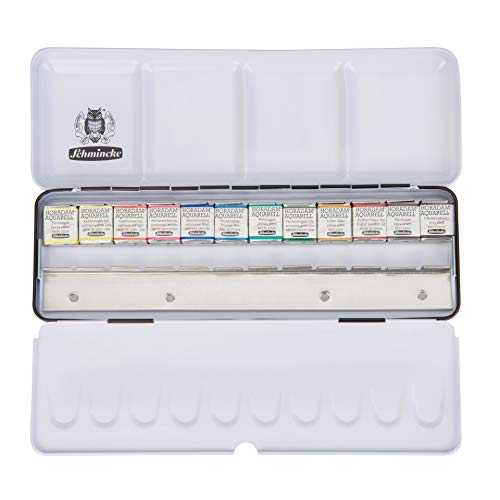
Schmincke Horadam Aquarell Metal Set
Reactivating almost instantly with a wet brush is what Horadam pans are known for, suiting painters who work fast or paint in short sittings. A binder keeps the pans slightly soft, so they never go glassy the way some artist grade paints do. Owners report the colours stay vivid dry rather than drying back several shades lighter.
Pros
- Fastest rewetting pans in the group
- Minimal dry back compared with rivals
- Excellent lightfastness across the range
Cons
- Soft pans can smear if the tin is closed damp
- Fewer granulating options than Daniel Smith

Van Gogh Watercolour Pocket Box
Royal Talens positions Van Gogh between student and artist grade, with stronger pigment than Cotman and a lower price of entry than full professional lines. Most configurations include a fold out palette and a water brush in the pocket box format. Owners report clean, bright colours with fewer muddy mixes than typical beginner sets.
Pros
- Cleaner mixes than most student ranges
- Compact box suits outdoor sketching
- Lightfastness marked on each pan
Cons
- Less pigment strength than top artist grades
- Plastic box hinge is a weak point over time

Kuretake Gansai Tambi 36 Color Set
A traditional Japanese formulation lays down more opaquely than Western watercolour, which makes Gansai Tambi excel over dark paper and for brush lettering. Large flat pans load easily with a big brush. Owners report the colours are bright and creamy, though lightfastness is not documented the way European artist grades are.
Pros
- Very easy to load a large brush
- Semi opaque coverage works on toned paper
- Bright, saturated colour straight from the pan
Cons
- Lightfastness is not fully documented
- Less suited to delicate transparent glazing

Prang Oval-8 Watercolor Paint Set
Most people first met Prang Oval-8 at school, and it remains sensible for practice sheets, children and casual colouring where paint cost should not discourage experimenting. Large oval pans sit under a lid that doubles as a mixing tray. Owners report vivid colours that are far weaker than artist grade, making this a learning tool rather than a finishing paint.
Pros
- Cheapest way to practise wash control
- Large pans are easy for small hands
- Lid works as a mixing tray
Cons
- Weak pigment and poor lightfastness
- Colours lift easily when layered
How they compare
| # | Model | Format | Best for | Score | Price |
|---|---|---|---|---|---|
| 1 | Winsor and Newton Professional Watercolour Half Pan Set | Half pans in a metal tin | Best overall | 9.4 | Check price |
| 2 | Daniel Smith Extra Fine Watercolor Essentials Set | Tubes, essentials six colour set | Best for granulation | 9.1 | Check price |
| 3 | Winsor and Newton Cotman Sketchers Pocket Box | Half pans in a folding plastic box | Best value | 8.9 | Check price |
| 4 | Schmincke Horadam Aquarell Metal Set | Half pans in a metal tin | Best for rewetting | 8.7 | Check price |
| 5 | Van Gogh Watercolour Pocket Box | Pans in a folding pocket box | Best for stepping up from student paint | 8.5 | Check price |
| 6 | Kuretake Gansai Tambi 36 Color Set | 36 large flat pans | Best for lettering and opaque work | 8.2 | Check price |
| 7 | Prang Oval-8 Watercolor Paint Set | Eight oval pans with lid tray | Best budget | 8.0 | Check price |
How to choose
Artist grade vs student grade watercolour Pigment concentration and filler content mark the real difference. Artist grade paints carry more pigment and less filler, so a small amount goes further and colours stay strong when diluted. Student paints substitute cheaper pigments and use hue names to imitate expensive colours. Chalky washes that refuse to darken no matter how many layers go down usually point back to paint grade.
How to read pigment codes instead of colour names Every reputable tube prints a pigment index code such as PB29 or PY35, and those codes reveal what is actually inside. Colour names alone do not. Single pigment paints mix far more cleanly, since combining two three pigment paints stacks six pigments into mud. Building a palette from mostly single pigment colours is the single biggest upgrade most painters can make.
Pans vs tubes, and which rewets fastest Fresh, strong colour from tubes suits large washes, while pans are quicker to pick up and better for travel. Squeeze tube paint into an empty palette and let it dry, and it becomes a pan, which is how many painters actually work. Rewetting speed is the variable to watch. Schmincke Horadam reactivates almost instantly, while other brands need a longer soak, so short painting sessions favour fast rewetting over colour count.
Why lightfastness ratings matter An ASTM or brand specific scale describes how well a colour resists fading in light. Sketchbook work that lives in a drawer rarely needs to worry about this. Framed and hung work is a different story, and some traditionally beautiful pigments rank among the worst offenders. Check the rating printed on the tube or pan before committing a favourite colour to a finished piece.
Common questions
Is artist grade watercolour worth it for a beginner?
A small artist grade set often teaches faster than a large student set, because the colours behave predictably and reveal what watercolour can actually do. A practical compromise pairs a student box such as Cotman for practice with two or three artist grade tubes for finished work.
How many watercolour colours do I actually need?
Six to twelve is plenty for most painters. A split primary palette with a warm and cool version of each primary, like the Daniel Smith Essentials set, mixes almost anything. Large sets mostly add convenience colours you could have mixed yourself.
What does granulating watercolour mean?
Granulating pigments are heavier particles that settle into the paper’s texture instead of staying evenly suspended, giving washes a mottled, mineral look. Daniel Smith is the best known source of these pigments. Landscapes benefit from the effect, while fine detail work often finds it distracting.
Why does watercolour paint dry lighter than it looks wet?
That effect is called dry back, and every watercolour shows it to some degree. Cheaper paints with more filler show it most. Owners report Schmincke Horadam among the ranges with the least dry back, but the general fix is to mix stronger than looks right while wet.
Can I refill a watercolour pan set instead of buying new?
Yes, and it costs much less. Both Winsor and Newton lines sell individual half pans, and any tube paint can be squeezed into an empty pan and left to dry. Refilling also lets you replace only the colours you actually use up.
Do watercolour paints expire?
Not really. Dried pans can last decades if kept dry and clean. Tubes can dry out or separate, but even a hardened tube can usually be cut open and used as a pan. Mould is the real failure mode, and it comes from storing a set damp.
What paper pairs best with artist grade watercolour paint?
Cotton paper at around 300gsm handles water far better than wood pulp, and good paint on bad paper still looks bad. Spend on paper before upgrading paint if budget is tight, since paper controls how washes settle and lift.
Are Japanese gansai paints the same as watercolour?
Related, but not identical. Gansai such as Kuretake Gansai Tambi sits more opaquely on the surface, which suits lettering and work on toned paper. Western watercolour is built around transparency and glazing, so owning both covers different jobs.
What is the best watercolour set for painting outdoors?
A compact pocket box with a built in palette, such as Cotman Sketchers or Van Gogh’s pocket box, travels best. Pans beat tubes for plein air work because there is no squeezing or capping in the field.
Final word
Winsor and Newton Professional Watercolour rewards the most painters, combining strong single pigment colours with reliable lightfastness and quick rewetting. Choose Daniel Smith Extra Fine for texture and granulation in your washes, and start with the Cotman Sketchers Pocket Box if you are still learning wash control.
Jake Monroe
Jake worked as a residential contractor for over a decade before shifting to full-time writing. He evaluates power tools, hand tools and workshop gear through the lens of someone who has actually used them on job sites, not just read the box.


