Hose Faucet Timers That Skip Watering When It Rains
Based on specifications, the Orbit B-hyve Smart Hose Faucet Timer ranks first because weather based rain skipping prevents overwatering during storms. The Melnor AquaTimer 4-Zone Digital Water Timer suits gardens needing separate schedules per bed, and the Orbit Single-Dial Hose Faucet Timer covers a single hose reliably at low cost.
Buy the Orbit B-hyve Smart Hose Faucet Timer if you want a hose timer that adapts to real weather instead of running through a downpour. Choose the Melnor AquaTimer 4-Zone Digital Water Timer when different beds need different schedules, or the Orbit Single-Dial Hose Faucet Timer for one hose and one simple job.
Water timers are hard to judge from a listing because the detail that matters, how the valve behaves when a battery dies, never appears in the specs. We compared outlet counts, scheduling flexibility, valve types, battery arrangements, and what owners report about long term reliability across seven models to build this ranking.
The top picks, ranked
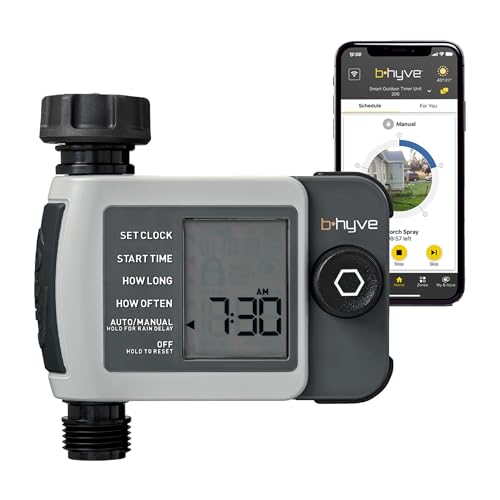
Orbit B-hyve Smart Hose Faucet Timer
This connected faucet timer pairs to a phone via Bluetooth, and adds Wi-Fi control when paired with the optional hub. Local weather data adjusts schedules automatically, skipping cycles when rain is forecast. Owners report the app is straightforward and the hub is worth adding when the tap sits far from the router.
Pros
- Skips watering automatically when rain is forecast
- Full schedule control from a phone app
- Manual override available on the unit itself
Cons
- Remote access away from home requires the separate hub
- More components can fail than on a mechanical timer

Melnor AquaTimer 4-Zone Digital Water Timer
Four outlets on this digital timer each run independent schedules, letting a vegetable bed, a container group, a lawn sprinkler, and a soaker hose water on separate timing from one tap. Splitting schedules this way is the difference between correct watering and compromise. Owners report that one controller managing four zones beats stacking several timers on a splitter.
Pros
- Four genuinely independent watering schedules
- Eliminates splitters and multiple separate timers
- Manual watering possible without disrupting the program
Cons
- Adds noticeable bulk and weight to the tap connection
- Includes no weather awareness of any kind

RAINPOINT Smart Water Timer with WiFi Hub
A Wi-Fi hub ships with this timer rather than sold separately, so remote control and rain delay work right out of the box. Multiple timers can share one hub, useful for gardens with taps at opposite ends. Owners report hub placement needs planning, since signal must pass through a metal tap on an exterior wall.
Pros
- Wi-Fi hub included instead of a separate purchase
- One hub can cover several timers around a garden
- Watering history logged inside the companion app
Cons
- Signal range to outdoor taps requires planning ahead
- App reliability depends on the manufacturer’s cloud service
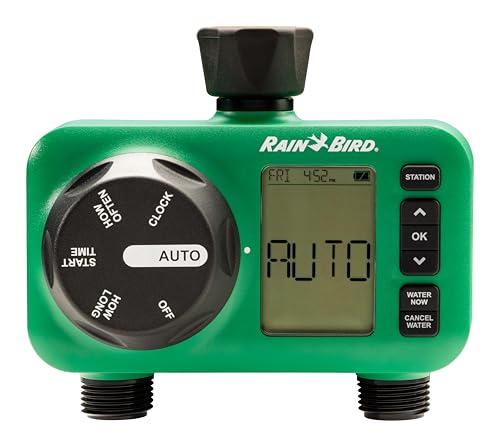
Rain Bird Electronic Hose End Timer
This digital hose end timer, from an established irrigation manufacturer, skips the app, hub, and account entirely. An on-unit display handles scheduling, suiting gardens where the routine rarely changes once set. Owners report choosing it for irrigation grade hardware without connectivity to maintain.
Pros
- Requires no app, account, or hub setup
- Comes from an established irrigation manufacturer
- Simple to program once and leave alone
Cons
- Offers no weather awareness or remote control
- Limited to a single outlet

Orbit Single-Dial Hose Faucet Timer
Programming reduces to choosing a frequency and a duration on this single dial timer, which covers what many gardens actually need. No display exists to fail, and no app requires updating. Owners report buying it for a single soaker hose or container group where reliable repetition matters more than flexibility.
Pros
- Nearly impossible to program incorrectly
- Low cost for a whole set of taps
- Needs no app or connectivity to maintain
Cons
- Offers very limited scheduling options
- Lacks manual override on some versions

Raindrip Analog Water Timer
Purely mechanical operation defines this wind up timer, which opens the valve for a set duration and closes it as the dial returns to zero. Batteries and electronics play no part, so it cannot fail open when a cell dies. Owners report using it as a safety measure during hand watering, since it shuts off the tap if attention wanders.
Pros
- No batteries or electronics that can fail
- Cannot leave a tap running indefinitely
- Simple design that lasts for years
Cons
- Cannot run an unattended repeating schedule
- Requires winding before every use

Nelson Dual Outlet Electronic Water Timer
Two independently programmed outlets on this digital timer cover the common case of a lawn sprinkler on one schedule and a drip line on another. Physical buttons handle the controls rather than an app. Owners report it as a middle option when a single outlet falls short and four outlets go further than needed.
Pros
- Two independent zones without extra hardware
- Simple button-based programming
- More compact than four-zone units
Cons
- Includes no weather awareness
- Display can be hard to read in bright sunlight
How to pick the right one
How many zones does your garden actually need? A single outlet timer forces every plant on that tap onto one schedule, which fails the moment a lawn sprinkler and a container drip line share the same tap. Containers need short, frequent watering. Established beds need long, infrequent soaks, and a lawn sits somewhere between the two. Two or four outlet timers let each zone run on its own schedule from a single tap. Count how many genuinely different schedules your garden needs before buying, then choose a timer with at least that many outlets instead of stacking timers on a splitter.
Why weather-aware timers pay for themselves Most irrigation schedules fail the same way: they water regardless of what the sky is doing. A connected timer that checks local forecast data and skips a cycle after rain saves water, saves money, and prevents waterlogged soil. Rain sensors offer a low-tech alternative, interrupting a cycle without any app involved. Seasonal manual adjustment works too, though it depends on someone remembering to do it.
What happens when the battery dies mid-cycle Nobody publishes this detail, yet every owner eventually discovers it. Most battery-powered timers use a latching solenoid valve that holds its current position when power drops, so a dead battery mid-cycle can leave the valve open. Replace batteries at the start of every season regardless of the indicator, and use quality alkaline cells rather than the cheapest option available. Check the unit after any cold snap, and consider a manual shutoff valve upstream if you travel for long stretches.
Protecting a timer from frost and sun damage Frost damages more water timers than any other cause, because trapped water expands and cracks the valve housing. Disconnect, drain, and store the timer indoors before the first frost each year, without exception. Direct summer sun degrades plastic housings and fades displays, so a shaded position or a simple cover extends the timer’s life. Fit a filter washer at the tap if your water carries grit, since a lodged particle causes the slow leak that people often mistake for a failed unit.
How they compare
| # | Model | Outlets | Best for | Score | Price |
|---|---|---|---|---|---|
| 1 | Orbit B-hyve Smart Hose Faucet Timer | Single outlet, dual outlet version available | Best overall | 9.4 | Check price |
| 2 | Melnor AquaTimer 4-Zone Digital Water Timer | Four independently programmed | Best for multiple zones | 9.2 | Check price |
| 3 | RAINPOINT Smart Water Timer with WiFi Hub | Single or dual depending on model | Best value smart timer | 9.0 | Check price |
| 4 | Rain Bird Electronic Hose End Timer | Single outlet | Best simple digital | 8.8 | Check price |
| 5 | Orbit Single-Dial Hose Faucet Timer | Single outlet | Best budget | 8.6 | Check price |
| 6 | Raindrip Analog Water Timer | Mechanical wind up timer | Best without batteries | 8.3 | Check price |
| 7 | Nelson Dual Outlet Electronic Water Timer | Two independently programmed | Best dual outlet | 8.0 | Check price |
Good to know
Will a water timer work without much water pressure?
Most hose faucet timers need a minimum pressure to open and close the valve reliably, often just a few pounds per square inch, though some need more. Gravity fed systems from a water butt usually fall short of that minimum. Look for a model specifically rated for low pressure or gravity feed if that describes your setup.
What happens if the battery dies mid cycle?
It depends on the valve design. Many timers use a latching solenoid that holds its position without power, so a failure mid cycle can leave water running. Changing batteries at the start of each season matters for this reason, and a manual shutoff valve upstream is worth fitting before any long trip.
Can I connect several timers to one tap?
Yes, using a splitter, and plenty of people do exactly that. Weight on the tap connection and pressure drop when two zones run together are the main drawbacks. A multi-outlet timer stays lighter on the fitting and usually staggers zones automatically so they do not compete for pressure.
Do I need to bring a water timer inside for winter?
Yes. Water trapped in the valve body freezes, expands, and cracks the housing. Disconnect the timer before the first frost, drain it completely, remove the batteries, and store it somewhere dry. This single habit determines whether a timer lasts one season or several.
Are smart water timers worth buying?
For a garden watered on autopilot, yes, mainly because weather based skipping prevents watering during and after rain. Anyone home most days who adjusts watering by eye may not need an app to maintain. A connected device also depends on the manufacturer keeping its cloud service running.
How long should each watering cycle run?
Longer, less frequent cycles generally suit beds and lawns better, since they encourage roots to grow downward instead of staying near the surface. Containers are the exception and need shorter, more frequent watering because they dry out fast. Check soil moisture a few inches down rather than judging from the surface, and adjust with the season.
Why is my water timer leaking or dripping?
A grit particle on the valve seat or a perished washer usually causes it. Disconnect the unit, check the inlet filter washer, and inspect the rubber seals for wear. Overtightening a hose connector can also distort the washer and cause drips. A cracked housing almost always means old frost damage, and the unit needs replacing.
Is a water timer compatible with drip irrigation systems?
Yes, and the pairing works well, since drip systems need frequent short runs nobody wants to do by hand. Check the pressure requirements of your drip components first, since many need a regulator between the timer and the drip line. Add a filter too, since drip emitters clog easily.
Is a two-outlet timer enough, or do I need four zones?
A two-outlet timer covers most gardens with a lawn on one schedule and a bed or drip line on another. Four zones make sense once containers, a vegetable bed, and a lawn all need separate timing. Buying more outlets than needed just adds unnecessary bulk to the tap connection.
Our take
The Orbit B-hyve Smart Hose Faucet Timer suits most gardens best, since skipping a cycle when rain is forecast beats any other single feature in this category. Gardens needing several genuinely different schedules do better with the Melnor AquaTimer 4-Zone, which no single-outlet unit can match. Whichever timer you pick, bring it indoors before the first frost.
Sierra Daniels
Sierra's background is in landscape design and nursery retail. She focuses on lawn and garden equipment, outdoor furniture and gear durability, weighing published specs against how materials actually hold up outside.
