Catching a Water Leak Before It Floods a Room
The Govee Water Leak Detector gives the fastest, most reliable phone alerts for individual appliance monitoring. Homeowners who want automatic protection should look at Flo by Moen’s whole-home system, while anyone covering multiple small spots can rely on the budget-friendly Kasa Smart Water Leak Sensor.
The Govee Water Leak Detector earns the top spot for sending fast phone alerts over Wi-Fi without needing a separate hub, a convenience many competing sensors lack. Its main limitation is that it only monitors the single spot where it sits, not the whole home’s water supply. Buyers who want automatic protection for the entire house have a stronger option covered below.
We compared published sensor range, connectivity type, alert speed and additional shutoff features rather than running our own flood simulation testing.
Before you buy
What a water leak detector actually monitors Most leak detectors sit on the floor or near a water source, like under a sink or behind a washing machine, and alert when their moisture sensor touches water. Whole-home systems like Flo by Moen take a different approach, monitoring water flow at the main line and shutting off supply automatically rather than waiting for water to reach a spot sensor. Matching detector type to the actual risk, a specific appliance versus the whole plumbing system, determines which approach makes more sense.
Wi-Fi standalone sensors versus hub-based systems The Govee, Kasa, Honeywell Home Lyric and D-Link sensors all connect directly to home Wi-Fi without needing a separate hub, simplifying setup for most households. The Samsung SmartThings sensor requires an existing or newly purchased hub, which pays off mainly for households already invested in that ecosystem. Buyers without any existing smart home hub should generally prefer a standalone Wi-Fi sensor to avoid extra setup steps.
Spot monitoring versus automatic whole-home shutoff Placing individual sensors like the Govee or Kasa detectors near washing machines, water heaters and under sinks catches leaks at those specific locations quickly. Flo by Moen’s main-line system catches leaks anywhere in the home’s plumbing, including inside walls where a spot sensor would never be placed. Homeowners with a history of plumbing issues or an older home benefit most from combining both approaches rather than relying on one alone.
Alerts while away from home versus local warnings Wi-Fi connected sensors send a phone notification regardless of whether anyone is home, important for vacation homes or long workdays away. The Zircon Leak Alert skips phone notifications entirely, relying on a loud local alarm that only helps if someone is nearby to hear it. Buyers who travel often or own a second property should prioritize Wi-Fi connected sensors over local-alarm-only models.
Our top picks
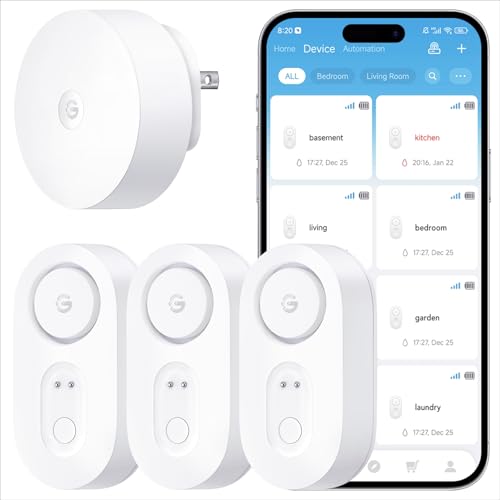
Govee Water Leak Detector
This small puck sensor connects directly to home Wi-Fi, sending a phone alert within seconds of detecting moisture on its base plate. No separate hub is required, unlike some competing systems that need additional hardware for remote notifications. A loud onboard alarm also sounds locally, useful for alerting someone already in the house before a phone notification even arrives.
Pros
- Fast phone alerts without needing a separate hub
- Loud local alarm warns anyone already in the house
- Simple setup through a standard Wi-Fi connection
Cons
- Only monitors the single spot where it is placed
- Does not shut off water automatically like whole-home systems

Flo by Moen Smart Water Shutoff
Unlike the puck-style sensors elsewhere in this list, this system installs directly on the home’s main water line, monitoring flow and automatically shutting off water if it detects a leak pattern. It can catch leaks anywhere in the plumbing system, not just at one specific appliance or spot. Professional installation is typically required, a bigger commitment than placing a battery-powered sensor.
Pros
- Automatically shuts off water when a leak pattern is detected
- Monitors the entire home’s plumbing, not just one spot
- Catches leaks that spot sensors elsewhere in the home would miss
Cons
- Professional installation adds cost beyond the device itself
- Covers the whole home’s water line, not specific appliance leaks directly below sensors
Kasa Smart Water Leak Sensor KL100
This sensor covers the same basic spot-monitoring job as the Govee detector at a lower cost per unit, making it practical to place several around a home without a large total cost. Wi-Fi connectivity sends alerts directly to the Kasa Smart app without a hub. A trailing probe extends the sensor’s detection area slightly beyond the base plate alone, useful for placement near a water heater or washing machine.
Pros
- Lower cost per unit makes multi-spot coverage affordable
- Trailing probe extends detection slightly beyond the base plate
- No hub required for Wi-Fi alerts
Cons
- No local alarm as loud as the Govee detector’s
- Still limited to monitoring individual spots, not the whole home

Honeywell Home Lyric Wi-Fi Water Leak and Freeze Detector
Beyond standard leak detection, this sensor also monitors ambient temperature and humidity, alerting if a room gets cold enough to risk frozen pipes. It suits homeowners in colder climates or vacation homes left unattended during winter months. Wi-Fi connectivity sends alerts directly without a separate hub, similar to the Govee and Kasa sensors.
Pros
- Freeze detection adds protection beyond just water leaks
- Useful for vacation homes left unattended in winter
- No hub required for Wi-Fi alerts
Cons
- Costs more than basic leak-only sensors like the Kasa KL100
- Freeze detection feature adds little value in warmer climates

Samsung SmartThings Water Leak Sensor
This sensor integrates directly with the SmartThings app and hub ecosystem, useful for households already running Samsung smart home devices or a SmartThings-compatible Samsung smart TV as a hub. It can trigger automations, like turning off a smart water valve, when paired with other compatible SmartThings devices. Without an existing SmartThings hub, setup requires adding one, unlike standalone Wi-Fi sensors.
Pros
- Integrates with other SmartThings devices for automations
- Longer battery life than most Wi-Fi based sensors
- Works well for households with an existing SmartThings hub
Cons
- Requires a SmartThings hub if one is not already installed
- Less convenient for households without any existing Samsung smart devices

D-Link Wi-Fi Water Sensor DCH-S161
D-Link keeps this sensor’s feature set simple, covering basic moisture detection and phone alerts without freeze detection or hub requirements. A compact size fits easily under sinks or behind water heaters without standing out. It suits buyers who want straightforward spot monitoring without extra smart home ecosystem considerations.
Pros
- Simple setup without hub or ecosystem requirements
- Compact size fits discreetly under sinks or appliances
- Straightforward phone alerts for basic leak monitoring
Cons
- No freeze detection or additional sensing features
- Fewer smart home integrations than the Samsung SmartThings sensor

Zircon Leak Alert Battery-Powered Sensor
This basic sensor sounds a loud local alarm when it detects moisture but does not connect to Wi-Fi or send phone alerts at all. It suits buyers who mainly want an audible warning while home, like under a kitchen sink, rather than remote notifications while away. Its lower cost and simple design make it practical for placing several units around a home without a large budget.
Pros
- Lowest cost among the leak detectors in this list
- No app or network setup required at all
- Loud local alarm works even during an internet outage
Cons
- No phone alerts, so leaks go unnoticed while away from home
- No smart home integration or automation support
Compared at a glance
| # | Model | Connectivity | Best for | Score | Price |
|---|---|---|---|---|---|
| 1 | Govee Water Leak Detector | Wi-Fi, no hub required | Best Overall for Spot Monitoring | 9.0 | Check price |
| 2 | Flo by Moen Smart Water Shutoff | Wi-Fi built-in | Best Whole-Home Protection | 8.9 | Check price |
| 3 | Kasa Smart Water Leak Sensor KL100 | Wi-Fi, no hub required | Best Value for Multiple Spots | 8.6 | Check price |
| 4 | Honeywell Home Lyric Wi-Fi Water Leak and Freeze Detector | Wi-Fi, no hub required | Best for Cold Climate Homes | 8.5 | Check price |
| 5 | Samsung SmartThings Water Leak Sensor | Zigbee, requires SmartThings hub | Best for SmartThings Ecosystem Households | 8.4 | Check price |
| 6 | D-Link Wi-Fi Water Sensor DCH-S161 | Wi-Fi, no hub required | Best Simple Standalone Sensor | 8.2 | Check price |
| 7 | Zircon Leak Alert Battery-Powered Sensor | None, standalone local alarm | Best Budget Pick | 7.8 | Check price |
Frequently asked questions
How do water leak detectors send alerts?
Most, including the Govee and Kasa sensors, connect to home Wi-Fi and send a push notification to a phone app within seconds of detecting moisture.
Do water leak detectors need a hub?
Not always. The Govee, Kasa, Honeywell Home Lyric and D-Link sensors connect directly to Wi-Fi, while the Samsung SmartThings sensor requires a hub.
Can a water leak detector shut off my water automatically?
Only whole-home systems like Flo by Moen include automatic shutoff. Spot sensors like the Govee or Kasa detectors only send an alert without stopping water flow.
Where should I place a water leak detector?
Common spots include under sinks, behind washing machines, near water heaters and under dishwashers, anywhere a slow leak could go unnoticed.
How long do water leak detector batteries last?
Most spot sensors last around a year per battery, though the Samsung SmartThings sensor using Zigbee can last closer to two years.
Do I need professional installation for a leak detector?
Spot sensors like the Govee or Kasa models are simple DIY placement. Whole-home systems like Flo by Moen typically need professional installation on the main water line.
Can a leak detector also warn about frozen pipes?
The Honeywell Home Lyric adds temperature and humidity monitoring specifically to warn about freeze risk alongside standard leak detection.
Will a water leak detector work without internet?
Most Wi-Fi models stop sending remote alerts without internet, though some, like the Govee detector, still sound a local alarm regardless of connection status.
Are basic non-connected leak alarms worth buying?
For a low-cost local warning while home, yes, as with the Zircon Leak Alert, though they provide no protection if nobody is nearby to hear the alarm.
Our take
The Govee Water Leak Detector is the strongest overall pick for monitoring specific appliances and spots without needing a hub. Homeowners who want automatic protection across the whole plumbing system should choose Flo by Moen instead, since its main-line shutoff catches leaks spot sensors cannot. Buyers covering multiple locations on a budget can skip premium sensors and rely on the Kasa Smart Water Leak Sensor for affordable multi-spot coverage.
Marcus Chen
Marcus covered consumer electronics for enthusiast tech publications for six years before joining ChoiceCrest. He specializes in translating manufacturer spec sheets into plain-language buying advice, with a focus on audio, computing accessories and smart-home gear.