Picking a Voice Recorder for Interviews, Lectures, or Music
Sony’s ICD-UX570 suits everyday dictation with a flip-out USB plug and 35-hour battery life. Zoom’s H1n fits musicians and podcasters who need true stereo capture. EVISTR’s L157 covers budget note-taking with 32GB built in. Microphone type and battery life matter most for daily use.
Sony’s ICD-UX570 stands out for daily dictation, pairing a flip-out USB connector with a 35-hour battery. Its built-in speaker sounds thin during playback in noisy rooms, so headphones help for review.
Recorders split into three camps: pocket dictaphones, XY stereo units for music, and rugged lecture recorders. We compared mic type, storage, and battery drain across models built for interviews, lectures, and field recording, drawing on manufacturer specs and owner reports.
How to pick the right one
What to look for in a voice recorder Microphone type should match the job. XY stereo pairs suit music and ambience, while zoom or directional mics isolate a single speaker across a room. Battery life matters more for all-day conferences than short interviews. Storage capacity decides how many hours of uncompressed WAV a unit holds before a transfer.
Best for interviews and podcasting Two-input models like the Zoom H4n Pro let a host and guest record on separate tracks for cleaner editing later. A headphone jack lets an interviewer catch wind noise or clipping in real time. Portable stereo units without XLR inputs still work fine for single-person interviews.
Best for lectures and long meetings Zoom microphones on units like the Olympus WS-882 pull a distant lecturer’s voice above room noise. Battery life above 40 hours avoids a mid-lecture swap. A hold switch stops the recorder from pausing if bumped inside a bag.
Storage and budget tradeoffs Built-in storage saves the cost of a microSD card but caps total capacity once filled. Expandable storage costs more upfront but scales for archiving years of recordings. Compressed MP3 saves space, while WAV keeps more detail for later editing.
What we recommend
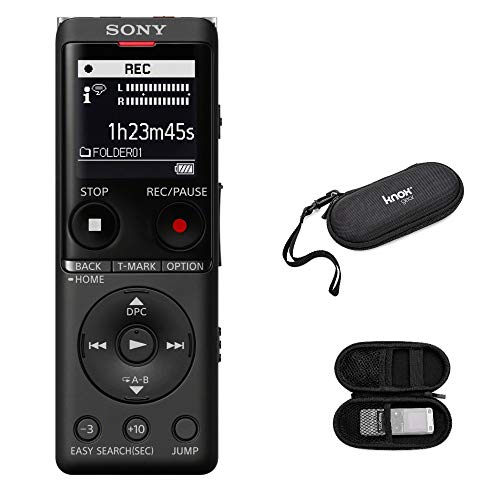
Sony ICD-UX570
A flip-out USB plug lets this recorder connect straight to a computer without a cable. Sony’s S-Microphone system cuts wind noise during outdoor interviews. Battery life stretches past 35 hours on two AAA cells.
Pros
- Built-in USB connector skips cable transfers entirely
- Battery runs past 35 hours on standard AAA cells
- Compact enough to carry in a shirt pocket
Cons
- Built-in speaker sounds tinny during playback
- No microSD slot for expanded storage

Zoom H1n
An XY stereo mic pair captures rehearsals, room ambience, and podcast interviews in true stereo. A dedicated headphone jack lets a user monitor levels while recording. Threading on the base fits a standard microphone stand.
Pros
- XY stereo pair captures a real stereo image
- Headphone jack allows real-time level monitoring
- Mounts on any standard mic stand thread
Cons
- Single AA battery drains faster in cold weather
- No internal storage, so a microSD card is required

Zoom H4n Pro
Two XLR combo inputs let an external mic or instrument record alongside the onboard stereo pair. Four tracks can record simultaneously, useful for a host running two guests. Phantom power drives condenser microphones without a separate mixer.
Pros
- Four-track simultaneous recording for multi-guest shows
- XLR inputs supply phantom power for condenser mics
- Supports microSD cards up to 128GB
Cons
- Bulkier to carry than pocket dictaphones
- Menu depth takes longer to learn than simpler units

Tascam DR-05X
A newer analog circuit lowers self-noise compared with the earlier DR-05. Omnidirectional mics pick up ambient sound evenly for nature and lecture recordings. A tripod thread on the base steadies it outdoors.
Pros
- Newer analog circuit lowers self-noise versus older models
- Tripod mount steadies the unit for outdoor recording
- Overdub and variable-speed playback built in
Cons
- Menu navigation takes practice to learn
- Plastic body feels less rugged than metal competitors

Olympus WS-882
A zoom microphone narrows focus toward a speaker across a lecture hall. Eight gigabytes of storage holds hundreds of hours of speech-quality audio. A slide switch locks controls to prevent accidental stops mid-recording.
Pros
- Zoom microphone isolates a distant speaker’s voice
- 55-hour battery covers a full day of conferences
- Hold switch prevents accidental button presses
Cons
- No stereo mode for music-quality recording
- File organization software feels dated

Sony ICD-PX370
A built-in stereo microphone pairs with a 55-hour battery for a fraction of the cost of pro units. Noise-cutting mode reduces air conditioner hum during meetings. Playback speed adjusts without pitch distortion for reviewing dense lectures.
Pros
- 55-hour battery life at a low price point
- Playback speed adjusts without pitch distortion
- Noise-cutting mode reduces AC hum in recordings
Cons
- No microSD slot for expanded storage
- Plastic belt clip feels flimsy over time

EVISTR L157
Thirty-two gigabytes of storage ship built in, more than most recorders at this price. A digital display shows file length and remaining space during recording. Voice activation starts recording automatically once sound crosses a threshold.
Pros
- 32GB of storage included at a low price
- Voice activation starts recording without a button press
- Digital display shows remaining storage at a glance
Cons
- Microphone sensitivity picks up handling noise
- Build quality feels less durable than name-brand units
Compared at a glance
| # | Model | Recording format | Best for | Score | Price |
|---|---|---|---|---|---|
| 1 | Sony ICD-UX570 | MP3/LPCM | Best overall | 9.4 | Check price |
| 2 | Zoom H1n | XY stereo condenser | Best for musicians and podcasters | 9.2 | Check price |
| 3 | Zoom H4n Pro | XY stereo condenser | Best for multitrack recording | 9.0 | Check price |
| 4 | Tascam DR-05X | Omnidirectional stereo | Best for field recording | 8.8 | Check price |
| 5 | Olympus WS-882 | 8GB plus microSD slot | Best for lectures and meetings | 8.6 | Check price |
| 6 | Sony ICD-PX370 | 4GB | Best value | 8.3 | Check price |
| 7 | EVISTR L157 | 32GB | Best budget | 8.0 | Check price |
Questions worth asking
How long do voice recorder batteries typically last?
Dictation recorders like the Sony ICD-PX370 run up to 55 hours on standard batteries. Stereo units with active preamps, such as the Zoom H1n, often need a fresh AA every 8 to 10 hours.
What’s the difference between XY and omnidirectional microphones?
XY stereo mics angle two capsules toward each other for a focused stereo image, useful for music and podcasts. Omnidirectional mics pick up sound evenly from all directions, better suited to ambient field recording.
Can a voice recorder replace a USB microphone for podcasting?
Yes. Models with XLR inputs like the Zoom H4n Pro record broadcast-quality audio and can double as a USB audio interface when connected to a computer.
Is 4GB of storage enough for a voice recorder?
At standard MP3 bitrates, 4GB holds roughly 70 to 80 hours of speech recording. That’s enough for most students and professionals who transfer files weekly.
Which voice recorder works best in a large lecture hall?
The Olympus WS-882’s zoom microphone narrows focus toward the front of a room, cutting through side conversations and HVAC noise.
Do voice recorders need a microSD card to work?
Not always. Units like the Sony ICD-UX570 and ICD-PX370 include built-in storage. The Zoom H1n and Tascam DR-05X require a separate microSD card.
How does playback speed adjustment help with transcription?
Slowing playback without pitch distortion, a feature on the Sony ICD-PX370, lets a listener catch every word in dense lectures without replaying sections repeatedly.
Are voice recorders still useful compared to smartphone apps?
Dedicated recorders offer longer battery life, physical buttons that work without unlocking a screen, and microphones tuned for voice. Those are real advantages over a phone’s general-purpose mic.
Voice recorder vs smartphone: which fits a musician better?
A dedicated unit like the Zoom H1n captures true stereo with a real mic pair, something a phone’s single mic can’t match for rehearsal or ambience recording.
Our take
For most people, the Sony ICD-UX570 balances battery life, storage, and portability better than the rest of this list. Podcasters and musicians should look at the Zoom H1n or H4n Pro instead, since stereo and multitrack capture outperform dictation-focused units. Students on a tight budget still get reliable results from the EVISTR L157 or Sony ICD-PX370.
Marcus Chen
Marcus covered consumer electronics for enthusiast tech publications for six years before joining ChoiceCrest. He specializes in translating manufacturer spec sheets into plain-language buying advice, with a focus on audio, computing accessories and smart-home gear.
You might also need
Nintendo Game & Watch: Super Mario Bros Review: Still Worth It as a Collectible?

Ray-Ban Meta (Gen 2) Wayfarer Smart Glasses: Worth $379 for Clear Lenses?
AlyKets Nikon UC-E6 Replacement USB Cable: Does a $7.95 Cord Work as Well as the Original?
