Which Vertical Mouse Actually Fits Your Hand and Grip
Based on grip angle, shell size and multi device pairing, the Logitech MX Vertical suits most hands best among seven current models. The Logitech Lift fits smaller hands better, while the Anker 2.4G Wireless Vertical Mouse offers an affordable way to test the format first.
Most people should start with the Logitech MX Vertical for its 57 degree angle and multi device pairing. The Logitech Lift suits smaller hands better, and the Anker 2.4G Wireless Vertical Mouse offers a low cost way to test the format before committing further.
Comfort with a vertical mouse depends far more on hand size and grip style than on any feature list. Angles across current models range from about 55 to 90 degrees, and steeper shells demand a longer adjustment. We compared grip angles, shell dimensions against typical hand sizes, button layouts, sensor specifications and what owners report about the switch.
The top picks, ranked

Logitech MX Vertical
A 57 degree shell shifts the forearm toward a neutral handshake position without feeling extreme on day one. Bluetooth or the Logi Bolt receiver connect up to three devices, and a USB-C port handles charging. Textured rubber on the shell and a molded thumb rest separate it from cheaper vertical mice.
Pros
- Balances a neutral forearm angle with an easy adjustment period
- Switches between three paired devices with one press
- USB-C charging works even mid use
Cons
- Shell size overwhelms smaller hands
- Costs more than most vertical mice on this list
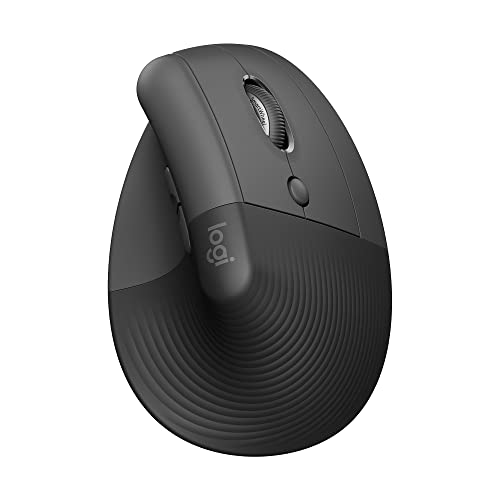
Logitech Lift Vertical Ergonomic Mouse
Logitech shrank the MX Vertical concept into a shell built for small to medium hands. A 57 degree angle carries over, along with multi device pairing over Bluetooth or the Logi Bolt receiver. Quiet click switches suit shared offices, and a left handed version exists, which is rare in this category.
Pros
- Sized for hands the MX Vertical leaves unsupported
- Quiet switches reduce click noise in open offices
- Left handed version available, unusual for this category
Cons
- Runs on a replaceable AA battery instead of a rechargeable cell
- Large hands may find the shell too small

Evoluent VerticalMouse 4
Evoluent has built vertical mice longer than any competitor, and the VerticalMouse 4 keeps a near vertical shell with a pronounced lip under the palm. Small, regular and left handed versions let buyers match their hand size precisely. Wired and wireless options both exist. Adjustment takes longer than gentler angles, but committed users tend to stay with it long term.
Pros
- Delivers the most neutral forearm position in this group
- Offered in multiple hand sizes plus a left handed model
- Palm lip keeps the little finger off the desk
Cons
- Longest learning curve among the seven mice here
- Software and design feel older next to Logitech models

Kensington Pro Fit Ergo Vertical Wireless Mouse
Kensington built this for office fleets rather than home enthusiasts. A 60 degree shell pairs over Bluetooth or a 2.4GHz receiver, and a DPI switch sits on top for quick changes. AA batteries keep it running in workplaces where charging cables tend to disappear. Build quality is plain but solid, and it sits well under the premium options.
Pros
- Dual wireless modes cover both desktop and laptop setups
- Priced below the premium vertical mice in this roundup
- AA batteries mean no charging downtime
Cons
- Maximum sensor resolution trails the wireless competition
- Plastic shell feels less refined than Logitech’s finish

Anker 2.4G Wireless Vertical Ergonomic Optical Mouse
Anker’s vertical mouse remains a common way to trial the grip without much commitment. An angled shell, thumb rest and three DPI settings cover ordinary office tasks. A 2.4GHz USB receiver handles the connection rather than Bluetooth, so confirm a spare port is free. Owners report it holding up well over years of daily use.
Pros
- Lowest cost sensible way to try a vertical grip
- Thumb rest stays comfortable despite the modest price
- Plug and play setup needs no extra software
Cons
- No Bluetooth option, so it occupies a USB port
- Shell size runs large for smaller hands

J-Tech Digital Scroll Endurance Wired Vertical Mouse
Desktop users who dislike managing batteries or pairing settle well with the Scroll Endurance. A removable palm rest and five buttons, including a top mounted DPI switch, round out the layout. Sensor resolution reaches 2,400 DPI for detailed work. It reads as a practical office tool rather than a design statement.
Pros
- Skips batteries and pairing steps entirely
- Removable palm rest adjusts to different grip styles
- Wired connection avoids any wireless input lag
Cons
- Cable adds clutter on an otherwise tidy desk
- Poor fit for laptop users who move around

Delux M618 Mini Wireless Vertical Mouse
Compact hands and travelers gain the smallest vertical mouse in this lineup with the M618 Mini. Both Bluetooth and a 2.4GHz receiver are supported, and USB charging replaces disposable batteries. Fewer buttons and a shorter palm shelf come with the smaller footprint compared to full size vertical mice.
Pros
- Small enough to fit inside a laptop bag
- Dual wireless modes switch between machines quickly
- Rechargeable battery skips disposable AA cells
Cons
- Too small to support a large hand comfortably
- Shorter palm shelf than full size vertical mice
Side by side
| # | Model | Grip angle | Best for | Score | Price |
|---|---|---|---|---|---|
| 1 | Logitech MX Vertical | 57 degrees | Best overall | 9.4 | Check price |
| 2 | Logitech Lift Vertical Ergonomic Mouse | 57 degrees | Best for small and medium hands | 9.2 | Check price |
| 3 | Evoluent VerticalMouse 4 | Near fully vertical | Best for a fully vertical grip | 9.0 | Check price |
| 4 | Kensington Pro Fit Ergo Vertical Wireless Mouse | 60 degrees | Best value | 8.8 | Check price |
| 5 | Anker 2.4G Wireless Vertical Ergonomic Optical Mouse | Angled ergonomic shell | Best budget | 8.6 | Check price |
| 6 | J-Tech Digital Scroll Endurance Wired Vertical Mouse | Wired USB | Best wired option | 8.3 | Check price |
| 7 | Delux M618 Mini Wireless Vertical Mouse | Compact, small hand oriented | Best for travel | 8.0 | Check price |
Before you buy
How does a vertical mouse change hand position? Rotating the hand toward a handshake grip cuts down the forearm pronation a flat mouse forces all day. Gentler angles near 55 to 60 degrees, used by the Logitech and Kensington models, feel familiar within a day or two. Near vertical shells like the Evoluent push posture further but stretch out the adjustment period. First time buyers usually do better starting in the middle of that range.
Which hand size fits which shell? Shell size causes more complaints than any spec sheet number. An oversized mouse leaves fingers stretching across buttons with no palm support, while an undersized one curls the hand awkwardly. Measuring from the wrist crease to the middle fingertip against listed dimensions avoids most fit mistakes. Logitech addresses this directly by selling the larger MX Vertical and the smaller Lift as separate models instead of one compromise shape.
Wired or wireless, and how does that match your setup? Desktop users who never move their machine get the simplest setup from a wired vertical mouse, since there is no battery or pairing to manage. Laptop owners benefit more from Bluetooth, which frees up a USB port for other accessories. A 2.4GHz receiver often delivers slightly steadier response than Bluetooth, at the cost of that port. Multi device pairing pays off for anyone switching between a work laptop and a personal computer on one desk.
What should first time buyers expect during the adjustment period? Nearly everyone loses some speed and accuracy during the first few days on a vertical mouse, since fine motor control shifts to different muscles. Owners commonly describe one to two weeks before movement feels normal again. Keeping the old mouse nearby for precision heavy tasks during that stretch is a reasonable compromise, not a failure. Steeper angles like the Evoluent extend this window, while gentler shells like the Anker shorten it.
Frequently asked questions
Do vertical mice actually help with wrist pain?
Many users report less strain because the handshake grip cuts forearm rotation compared with a flat mouse. Results vary by person, and a mouse is only one part of a workstation. Persistent pain or numbness calls for a qualified professional, not just new hardware.
How long does it take to adjust to a vertical mouse?
Most owners describe a few clumsy days followed by one to two weeks before movement feels normal. Steeper angles, like the Evoluent VerticalMouse 4, stretch that window further than gentler shells. Lowering cursor sensitivity during the transition often helps, since movement now comes more from the forearm.
Are vertical mice good for gaming?
Competitive gaming usually favors a low profile shape and very high sensor speed, so vertical mice trail there. Slower paced strategy titles and general use work fine with a vertical grip. Most models in this category prioritize comfort and office features over polling rate.
What angle should I choose for a vertical mouse?
A range of 55 to 60 degrees, used by the Logitech and Kensington models, is the easiest entry point. Near vertical shells around 85 to 90 degrees, like the Evoluent, give a more neutral forearm position but take longer to learn. Starting gentle and moving steeper later suits most new users.
Is there a left handed vertical mouse?
Yes, though options stay limited. The Logitech Lift and several Evoluent VerticalMouse models come in left handed builds. Most other vertical mice ship right hand only, since the asymmetric shell cannot simply be flipped.
Do vertical mice need special software to work?
They function as plug and play devices without any install. Manufacturer apps, like Logitech Options+ for the MX Vertical and Lift, unlock extra button mapping and pointer tuning. Evoluent and Kensington ship their own utilities for the same purpose.
Should I add a wrist rest to a vertical mouse?
A gel or foam rest sometimes helps, but many vertical mice already include a built in palm or thumb support. Stacking an external rest on top can push the hand into an awkward angle. Desk height that keeps the forearm roughly level matters more than any added rest.
Is a trackball better than a vertical mouse for wrist pain?
The two solve different problems. A trackball removes arm movement almost entirely, which suits tight desks and shoulder discomfort. A vertical mouse changes wrist rotation but keeps normal arm movement, and some people alternate between both through the day.
Which vertical mouse works best for small hands?
The Logitech Lift and the Delux M618 Mini both target smaller hands, with shells sized down from the standard MX Vertical shape. Compare the mouse length listed against your palm before buying, since fit varies even within the small hand category.
The bottom line
The Logitech MX Vertical remains the strongest overall pick, pairing an approachable 57 degree angle with multi device pairing and real palm support for larger hands. Choose the Logitech Lift when the MX feels oversized, the Evoluent VerticalMouse 4 for the most neutral position available, or the Anker 2.4G Wireless Vertical Mouse to test the format at low cost first.
Dana Whitfield
Dana spent eight years buying and merchandising for a regional kitchenware retailer before moving into editorial work. She has handled thousands of SKUs across cookware, small appliances and kitchen organization, and focuses on the practical differences that matter once a product is actually in daily use.