How to Clear Sawdust and Fumes From a Closed Workshop
AC Infinity’s CLOUDLINE T8 leads on whole shop airflow for ducted setups. Vivosun’s 8 Inch Inline Fan delivers similar CFM for less money. Lasko’s High Velocity Utility Fan handles spot ventilation near a bench without any ducting at all.
Sawdust hangs in the air long after a cut finishes, and paint fumes can linger for hours in a closed garage. AC Infinity’s CLOUDLINE T8 moves enough air through ducting to clear a two car garage. Vivosun’s 8 Inch Inline Fan comes close for noticeably less money. Quick spot airflow near a workbench calls for the Lasko High Velocity Utility Fan instead, with no ducting required.
Shop size, ceiling height and existing ductwork vary enough that no single fan fits every layout. We compared rated CFM against typical shop volumes, checked duct diameter compatibility, and weighed owner reports on noise during long sanding or painting sessions.
Our top picks

AC Infinity CLOUDLINE T8 Inline Duct Fan
This 8 inch inline fan rated at 738 CFM clears fumes and dust from a mid size shop once ducted to an exterior vent. A variable speed controller drops noise during light use. Woodworking shop owners report it holds up well under continuous daily cycling.
Pros
- High CFM covers larger shop volumes
- Variable speed control lowers noise at partial use
- Metal housing feels durable for daily cycling
Cons
- Needs existing or added ducting to install
- Costs more than basic inline fans

Vivosun 8 Inch Inline Duct Fan
Rated at 750 CFM, this inline fan moves air comparable to pricier rivals at a lower cost. Its metal fan blade balances well, keeping vibration low during long runs. Owners mount it inline with flexible ducting to pull fumes straight outside during finishing work.
Pros
- Strong CFM for the price point
- Metal blade keeps vibration noise low
- Fits standard 8 inch flexible ducting
Cons
- Ships without a variable speed controller
- Runs louder than the CLOUDLINE at full speed

Lasko High Velocity Utility Fan
This floor standing fan pivots to aim airflow straight at a bench or open garage door, with no ducting required. Three speeds cover light dusting up through heavier fumes near an open door. Owners like moving it between a workbench and a paint booth setup.
Pros
- Requires no installation, just plug in and aim
- Pivoting head directs air where needed
- Handle and rear grip make repositioning easy
Cons
- Depends on an open door or window to exhaust air
- Less effective in fully enclosed spaces than ducted fans

iLiving 12 Inch Wall Mounted Shutter Exhaust Fan
Mounted through a wall or window opening, this fan pulls 960 CFM with shutters that close automatically when off to block drafts. A thermostat option can trigger it during hot weather. Owners with detached garages use it for fume clearing and summer cooling alike.
Pros
- High CFM suits larger detached shops
- Automatic shutters block drafts when idle
- Doubles as summer heat exhaust
Cons
- Requires cutting or fitting a wall opening
- Louder than inline duct fans at similar CFM

XPOWER FC-300 Multi Purpose Utility Fan
This floor fan tilts through several angles, doubling as a drying fan after painting and a general airflow booster on hot days. A daisy chain outlet lets owners link multiple units off one cord. Auto body shop reviewers cite it for clearing paint fumes near open bay doors.
Pros
- High rated CFM for an untucked floor fan
- Daisy chain outlet simplifies multi fan setups
- Tilting head suits both floor and elevated use
Cons
- Bulkier footprint than standard utility fans
- Still needs an open exhaust path for fumes

Air King 9166 Wall Mount Ventilation Fan
Built for continuous industrial duty, this 16 inch fan mounts to a wall bracket and moves 3560 CFM on high. Its totally enclosed motor resists dust intrusion better than open frame designs. Metalworking shop owners value the sealed motor around grinding dust.
Pros
- Very high airflow for large shop spaces
- Sealed motor resists dust and debris
- Adjustable tilt bracket directs airflow
Cons
- Needs dedicated wall space for its large footprint
- Overkill for small single car garages
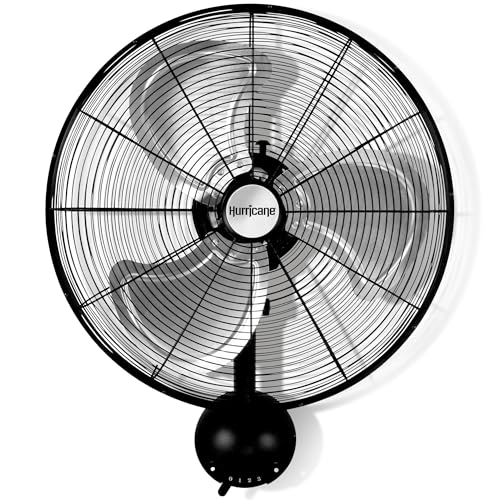
Hurricane Pro Wall Mount Fan 20 Inch
A 20 inch metal blade pushes strong airflow across a shop floor at a price well under industrial rivals. Adjustable tilt and multiple speeds cover general ventilation and cooling. Owners install it above a workbench to keep sawdust and fumes moving toward an open door.
Pros
- Strong airflow for the price paid
- Metal blade holds up to shop conditions
- Adjustable tilt directs air across the room
Cons
- Lacks an enclosed motor, so dust can reach internals
- Falls short of larger industrial fans on CFM
Side by side
| # | Model | Duct size | Best for | Score | Price |
|---|---|---|---|---|---|
| 1 | AC Infinity CLOUDLINE T8 Inline Duct Fan | 8 inches | Best overall | 9.3 | Check price |
| 2 | Vivosun 8 Inch Inline Duct Fan | 8 inches | Best value | 9.0 | Check price |
| 3 | Lasko High Velocity Utility Fan | Pivoting floor fan | Best for spot ventilation | 8.7 | Check price |
| 4 | iLiving 12 Inch Wall Mounted Shutter Exhaust Fan | 12 inches | Best for wall mounting | 8.5 | Check price |
| 5 | XPOWER FC-300 Multi Purpose Utility Fan | Multiple tilt positions | Best for drying and airflow combined | 8.3 | Check price |
| 6 | Air King 9166 Wall Mount Ventilation Fan | 16 inches | Best for permanent installation | 8.1 | Check price |
| 7 | Hurricane Pro Wall Mount Fan 20 Inch | 20 inches | Best budget wall fan | 8.0 | Check price |
How to pick the right one
What to look for in a workshop ventilation fan Match rated CFM to your shop’s cubic footage; a fan sized for a small garage barely moves air in a larger bay. Inline duct fans exhaust air outside through ducting, while wall mount and floor fans rely on a nearby open door or window. Noise matters too when the shop sits near living space, so check the decibel rating at the speed you will actually run.
How much airflow does a garage shop actually need Woodworking and sanding produce fine particulate that lingers unless it gets actively exhausted outside. An inline duct fan tied to a dust collection setup or a simple exterior vent clears that particulate far better than a floor fan pushing air around a closed room. Variable speed control helps balance airflow against how much conditioned air escapes in winter.
Best setup for welding, painting and finishing fumes Fumes from welding, painting or solvent based finishes need direct extraction near the source, not general room mixing. A pivoting utility fan aimed at an open door pulls fumes out quickly during a finishing pass. Wall mounted exhaust fans with automatic shutters suit a fixed paint or weld station instead.
When a shop needs permanent, higher capacity ventilation A detached garage or larger fabrication shop generally outgrows portable fans and benefits from a dedicated wall mounted exhaust fan rated in the thousands of CFM. Pair it with a fresh air inlet on the opposite wall so replacement air can enter as the fan exhausts. Continuous duty industrial fans with sealed motors handle daily grinding and welding dust better than open frame designs.
Good to know
How many CFM do I need to ventilate a garage workshop?
A common rule targets replacing the shop’s full air volume every few minutes. For a typical two car garage around 600 square feet with 8 foot ceilings, that lands near 500 to 1000 CFM depending on how often you run dust producing tools.
Can an inline duct fan double as dust collection?
It can help move fine dust toward an exterior vent, but it is not a substitute for a dedicated dust collector with filtration at the source. Pairing both gives better results than either alone.
What is the difference between an inline fan and a wall mount exhaust fan?
Inline fans sit within ducting and push air through a hose to a vent point, useful where the exhaust path bends or runs some distance. Wall mount fans sit directly in a wall or window opening with a short, straight exhaust path.
How loud are workshop ventilation fans in decibels?
Ratings here range from around 23 dB at minimum speed on premium inline fans up to the mid 50s on higher CFM wall mount units at full speed, comparable to a running dishwasher.
Do I need a fresh air inlet if I install an exhaust fan?
Yes, ideally. An exhaust fan pulling air out without a replacement air path can struggle to reach rated CFM and may depressurize the space, pulling air from unwanted gaps instead.
Can these fans handle welding fumes?
Higher CFM wall mount and floor fans aimed at an open door help clear welding fumes, though a dedicated fume extraction arm positioned at the source works better for heavy welding use.
Which ventilation fan works best for a small one car garage?
A compact inline duct fan in the 400 to 700 CFM range, or a pivoting utility floor fan aimed at an open door, usually suits a single car garage without overwhelming the space.
Is a wall mounted or portable fan better for a rented shop space?
Portable floor and utility fans require no permanent wall cutting, making them the better fit for rented or shared shop space where modifications are not allowed.
Inline duct fan vs floor fan for a workshop, which should I pick?
Choose an inline duct fan when ducting to the outside already exists or is easy to add, since it exhausts fumes fully rather than just circulating them. A floor fan works better as a quick, portable option near an open door.
Final word
AC Infinity’s CLOUDLINE T8 is the pick for any shop that already has, or can add, ducting to an exterior vent. Choose the Vivosun 8 Inch Inline Fan instead if variable speed control matters less than saving money. Shops without ducting options should rely on the Lasko High Velocity Utility Fan positioned near an open door.
Jake Monroe
Jake worked as a residential contractor for over a decade before shifting to full-time writing. He evaluates power tools, hand tools and workshop gear through the lens of someone who has actually used them on job sites, not just read the box.