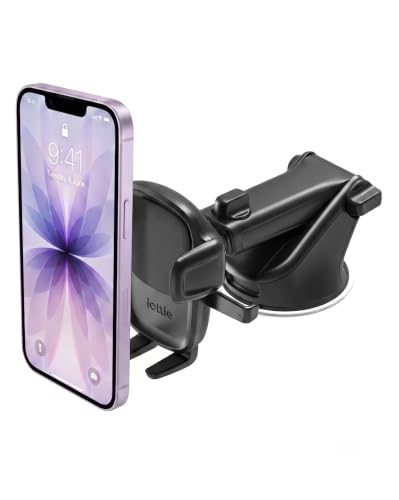
Car Chargers Fast Enough to Keep Up With Your Phone
Anker’s PowerDrive III Duo balances fast dual-port charging with a compact plug profile. UGREEN’s 30W USB-C charger suits owners prioritizing value, and Baseus’s 65W charger fits anyone charging a laptop or tablet alongside a phone.
A weak car charger barely keeps a phone’s battery from dropping during a long drive with navigation running. Anker’s PowerDrive III Duo delivers enough combined wattage across two ports to actually charge most phones while in use, fits low-profile sockets without blocking neighboring controls, and only falls short for owners needing laptop-level power output.
We compared chargers by total and per-port wattage, which fast-charging protocols each one supports, such as USB-C Power Delivery or Quick Charge, and how many devices can charge at once. Real-world charging speed under active phone use mattered more than marketed peak wattage alone.
Our top picks

Anker PowerDrive III Duo
Anker balances a compact plug housing with enough combined output across two ports to fast-charge one device or split power evenly between two. Its PowerIQ circuitry adjusts output automatically based on the connected device.
Pros
- Compact housing does not block nearby dashboard controls
- Adaptive output works across different phone brands
- Established brand with strong long-term reliability
Cons
- USB-A only, no USB-C port on this model
- 36W combined is lower than dedicated USB-C PD chargers

Scosche USB-C Car Charger
Scosche focuses this charger entirely on USB-C Power Delivery output, aimed at newer phones that charge fastest over USB-C rather than USB-A. The single-port design keeps the plug slim for tight 12V sockets.
Pros
- Dedicated USB-C PD output maximizes modern phone charging speed
- Slim housing fits tight or recessed 12V sockets
- Simple single-port design with no wasted output splitting
Cons
- Only one port limits it to a single device
- No USB-A port for older cables and accessories

UGREEN 30W USB-C PD Car Charger
UGREEN offers a solid 30W Power Delivery output at a price below many name-brand competitors, covering fast charging for most phones without paying for features like a second port you may not need.
Pros
- 30W output covers fast charging for most modern phones
- Lower price than comparable name-brand single-port chargers
- Compact design minimizes socket clutter
Cons
- Single port only, no option to charge two devices
- Lower combined wattage than dual-port or higher-watt chargers

Baseus 65W Car Charger
Baseus pushes output high enough to charge a laptop or tablet through USB-C PD while a second USB-A port handles a phone on Quick Charge simultaneously. This covers device types a standard phone-focused charger cannot.
Pros
- 65W output can charge select laptops and tablets
- Dual protocol support covers both USB-C and USB-A devices
- Two ports allow charging a phone and tablet together
Cons
- Larger housing than single-port chargers
- Full 65W only reaches one port at a time under load

Belkin BoostCharge Dual USB-A Car Charger
Belkin keeps this charger small enough to barely protrude from the socket, trading some peak wattage for a low-profile design that will not catch on a driver’s knee or clothing. It suits owners who just need steady, reliable charging.
Pros
- Low-profile housing avoids snagging on knees or clothing
- Reliable steady output for everyday charging needs
- Established brand backing with solid warranty support
Cons
- 24W combined output is modest next to higher-watt options
- No USB-C port included
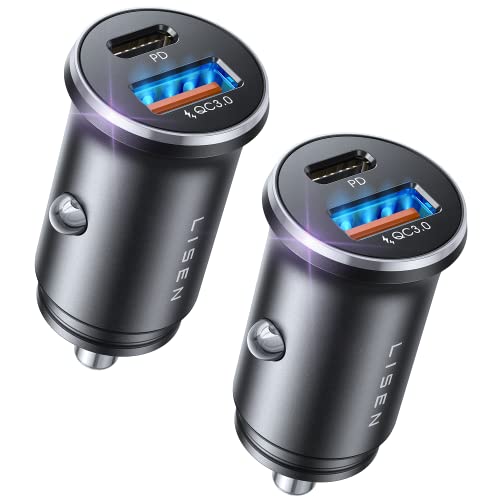
LISEN 69W Dual USB-C Car Charger
LISEN sells this charger in pairs, which suits households or families wanting matching fast chargers in two vehicles without buying two separate listings. Combined 69W output handles most phones and some tablets on USB-C.
Pros
- Two-pack covers multiple vehicles at once
- 69W combined output handles phones and most tablets
- USB-C ports match newer device cables
Cons
- No USB-A port for older cables
- Buying only one charger means paying for an unused second unit

iOttie Easy Power Car Charger
iOttie keeps this charger deliberately simple, a single reliable USB-A port without extra protocols or a second port to manage. It fits owners who just want one steady charging point and nothing more complicated.
Pros
- Straightforward single-port design with no added complexity
- Reliable steady charging for everyday phone use
- Lower cost than multi-port or high-wattage chargers
Cons
- No fast-charging protocol support beyond basic output
- Only charges one device at a time
Compared at a glance
| # | Model | Ports | Best for | Score | Price |
|---|---|---|---|---|---|
| 1 | Anker PowerDrive III Duo | 2 | Best overall | 9.0 | Check price |
| 2 | Scosche USB-C Car Charger | 1 | Best for USB-C fast charging | 8.6 | Check price |
| 3 | UGREEN 30W USB-C PD Car Charger | 1 | Best value | 8.5 | Check price |
| 4 | Baseus 65W Car Charger | 2 (USB-C and USB-A) | Best for laptops and tablets | 8.7 | Check price |
| 5 | Belkin BoostCharge Dual USB-A Car Charger | 2 | Best compact design | 8.2 | Check price |
| 6 | LISEN 69W Dual USB-C Car Charger | 2 | Best 2-pack bundle | 8.4 | Check price |
| 7 | iOttie Easy Power Car Charger | 1 | Best for simple single-port reliability | 8.0 | Check price |
What matters most
Why wattage alone does not tell the full story A charger’s peak wattage rating matters less than whether it supports the specific fast-charging protocol your phone uses, such as USB-C Power Delivery or Quick Charge. A high-wattage charger without the right protocol will still charge slowly on an incompatible device.
USB-C versus USB-A ports Most phones released in the last several years charge fastest over USB-C, while older devices and some accessories still use USB-A cables. Check your own cables before buying a charger with only one connector type.
Single port versus dual port chargers A single dedicated port, like Scosche’s or UGREEN’s, delivers its full rated output to one device without splitting power. A dual-port charger splits combined wattage between two devices, which can slow charging if both ports are in use at once under a lower combined rating.
Charging laptops and tablets from a 12V socket Standard phone chargers rarely output enough wattage to meaningfully charge a laptop. A higher-output charger like Baseus’s 65W model is closer to what laptops need, though charging speed will still be slower than a wall outlet.
Frequently asked questions
What wattage charger do I need for my phone?
Most modern phones fast-charge fully between 20 and 30 watts, so a charger in that range covers typical needs. Check your phone’s specifications for its maximum supported input before assuming higher wattage always helps.
Is USB-C faster than USB-A for car charging?
USB-C with Power Delivery generally charges modern phones faster than USB-A, since most newer devices are designed around that protocol. Older devices with USB-A cables see no difference.
Can a car charger charge my phone while using navigation?
A charger with enough wattage, generally 20 watts or more, can keep up with a phone actively running navigation and screen display, while a weak charger may only slow the battery drain rather than actually charging it.
Do dual-port chargers split power between both ports?
Many do split the combined wattage rating across both ports when used simultaneously, though some premium models manage output per port more intelligently. Check the specific charger’s per-port rating under simultaneous use.
Can I charge a tablet with a standard phone car charger?
A basic phone charger can still charge a tablet, just more slowly, since tablets often need higher wattage to charge at a reasonable rate. A higher-output charger like Baseus’s 65W model handles tablets better.
Will a high-wattage charger damage my phone?
No, modern phones and USB-C Power Delivery negotiate the appropriate charging rate automatically, so a higher-wattage charger will not overcharge or damage a device built for a lower rate.
How do I know if my charger supports fast charging?
Check the listed protocol, such as USB-C Power Delivery or Quick Charge, and confirm your phone supports the same protocol. Matching protocols on both charger and device is what actually enables fast charging, not wattage alone.
Do car chargers wear out over time?
Yes, like any electronic accessory, internal components can degrade with heat exposure and years of use, which can show up as slower charging or intermittent connection. A charger that stops working reliably after a few years is worth replacing rather than troubleshooting indefinitely.
The bottom line
The Anker PowerDrive III Duo is the easiest overall pick for most drivers who just need reliable dual-port USB-A charging. Owners with newer USB-C phones who want the fastest charging should choose the Scosche or UGREEN single-port USB-C charger instead, since dedicated USB-C PD output beats a split dual-port design for that use case. Anyone who also charges a tablet or laptop from the car needs to skip standard phone chargers entirely and go with the higher-output Baseus 65W model.
Tony Russo
Tony trained as an automotive technician and spent years in service and parts retail before moving into writing. He focuses on garage tools, car care products and accessories from a hands-on maintenance perspective.