Which Vacuum Sealer Actually Stops Freezer Burn?
FoodSaver V4840 leads for everyday sealing, pairing automatic bag detection with built in roll storage. Need something simpler? The Nesco VS-12 covers basic sealing at a lower cost. Anyone sealing soups or marinades should look at the VacMaster VP215, a chamber sealer that vacuums the whole bag instead of pulling air through an open end.
Three models stand out for different reasons. FoodSaver’s V4840 automates bag detection and stores roll stock inside the unit, which suits daily use. Nesco’s VS-12 strips the feature list down to two buttons and a lower price. Liquids change the equation entirely, and that’s where the VacMaster VP215 chamber sealer takes over from the external designs on this list.
External and chamber sealers solve the same problem in different ways, and that split matters more than any single spec sheet number. We compared suction strength, bag compatibility and moisture handling across seven models. Owner reports on motor longevity and daily reliability filled in what spec sheets leave out.
What we recommend
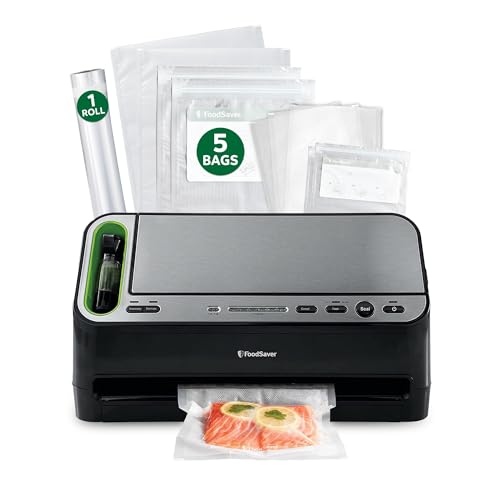
FoodSaver V4840 2-in-1
Bag detection switches automatically between dry and moist settings once a bag sits in the sealing channel. Built in roll storage and a cutter make custom bag lengths possible without buying separate rolls. A handheld port takes an accessory hose for jars and canisters.
Pros
- Automatic sensing removes guesswork on settings
- Roll storage cuts down on separate bag purchases
- Handheld attachment seals jars and canisters
Cons
- Runs louder than several external rivals
- Replacement rolls cost more than generic bags

FoodSaver FM5200
FM5200 keeps the core FoodSaver feature set at a lower price than the V4840. Automatic and manual modes cover most dry and moist foods. A retractable handheld sealer reaches wide mouth jars, and vertical storage keeps the footprint small.
Pros
- Costs less than the flagship V4840
- Vertical design frees up counter space
- Retractable handheld sealer included
Cons
- No built in roll cutter like the V4840
- Moist mode struggles with very wet contents

Nesco VS-12
Two buttons run the whole machine, seal and vacuum seal, with no display to learn. Standard 11 inch bags and rolls from multiple brands fit the chamber. Owners describe it as fine for occasional home use rather than daily heavy sealing.
Pros
- Fits generic bags, not just one brand
- Controls need no learning curve
- Costs less than automatic sensing models
Cons
- No moist food setting for wet items
- Motor suits lighter, less frequent use

Anova Culinary Precision Vacuum Sealer Pro
Anova built its reputation on sous vide circulators, and this sealer adds a pulse mode for delicate fish and produce. Gentle sealing avoids crushing soft food before a water bath. Vertical storage tucks the unit into a narrow counter gap.
Pros
- Pulse mode protects delicate foods from crushing
- Gentle mode suits sous vide bag prep
- Vertical footprint fits tight counter space
Cons
- Bag rolls are harder to find than FoodSaver’s
- Sealing chamber limits very wide bags

Weston Pro-2300 Commercial Grade
A commercial duty motor runs longer sealing sessions than typical home units allow before needing a cooldown. Its 15 inch sealing bar fits bulk meat cuts and garden harvests. Stainless accented housing signals daily use rather than weekly.
Pros
- Motor handles back to back sealing runs
- Wide sealing bar fits larger bags
- Built for near daily use
Cons
- Takes up more counter space than compact sealers
- Runs louder during operation

VacMaster VP215 Chamber Vacuum Sealer
Rather than clamping a bag opening, the VP215 lowers the whole bag into a vacuum chamber. Liquids and marinades seal cleanly since nothing pulls toward an open end. Standard embossed bags work here, skipping the channeled rolls external sealers need.
Pros
- Seals liquids without pulling them into the motor
- Uses cheaper standard bags instead of proprietary rolls
- Seal strength stays consistent across bag types
Cons
- Much larger and heavier than external sealers
- Costs more than every other model here

Geryon E2900-MS
A slim body slides into a drawer instead of sitting out on the counter. Automatic and manual modes plus a moist setting match pricier FoodSaver models at a lower cost. Owners call it adequate for light to moderate use.
Pros
- Built in cutter and starter roll included
- Slim profile stores easily in a drawer
- Offers both automatic and manual modes
Cons
- Motor feels less durable under heavy daily use
- Seal strength varies on thicker bags per some reviews
How to pick the right one
What’s the difference between external and chamber vacuum sealers? External sealers, the type most kitchens own, clamp a bag’s open end and draw air out through the seal itself. Chamber sealers lower the entire bag into a sealed compartment before removing air from the whole space. That distinction lets chamber units handle liquids and marinades without the spillage external sealers struggle with. Expect a higher price and a bigger footprint in return.
How do you choose a vacuum sealer for everyday food storage? Automatic bag detection, a moist food setting and reasonably priced bags cover most everyday sealing, the strengths built into the FoodSaver V4840 and FM5200. Bag cost adds up over months of regular use. Checking whether a sealer accepts generic bags, as the Nesco VS-12 does, can matter as much as the unit’s own price. Storage footprint counts too, since larger sealers eat counter space fast.
What should sous vide cooks or bulk preppers look for? Sous vide cooks benefit from a gentle or pulse setting that avoids crushing delicate fish, a feature Anova built specifically for that use. Bulk preppers, sealing large cuts of meat or a garden harvest, need a wide sealing bar and a motor rated for extended runs, which is where the Weston Pro-2300 fits in. Both use cases push past what a basic budget sealer handles well. Neither buyer should expect a compact home sealer to keep pace.
Is a chamber sealer worth it for liquids, soups or marinades? Standard external sealers struggle with wet contents, since suction pulls liquid toward the sealing strip before it closes. A chamber sealer like the VacMaster VP215 avoids that by vacuuming the whole bag environment instead of pulling through an open end. Freezing a marinade solid first works as a simpler workaround for households that rarely seal liquids. Buying a dedicated chamber unit only pays off with regular liquid sealing.
How they stack up
| # | Model | Sealer type | Best for | Score | Price |
|---|---|---|---|---|---|
| 1 | FoodSaver V4840 2-in-1 | External, automatic | Best overall | 9.4 | Check price |
| 2 | FoodSaver FM5200 | External, automatic and manual modes | Best value | 9.1 | Check price |
| 3 | Nesco VS-12 | External, manual | Best budget | 8.7 | Check price |
| 4 | Anova Culinary Precision Vacuum Sealer Pro | External, automatic with pulse mode | Best for sous vide | 8.4 | Check price |
| 5 | Weston Pro-2300 Commercial Grade | External, commercial duty motor | Best for heavy or frequent use | 8.2 | Check price |
| 6 | VacMaster VP215 Chamber Vacuum Sealer | Chamber vacuum sealer | Best for liquids and marinades | 8.0 | Check price |
| 7 | Geryon E2900-MS | External, automatic and manual | Best for small kitchens | 8.0 | Check price |
Common questions
Do vacuum sealers really extend food freshness?
Removing air slows oxidation and freezer burn, the main causes of degraded texture in frozen storage. Food safety guidance and manufacturer testing both point to sealed, air free packaging as the biggest factor.
Can you use any bag with a vacuum sealer?
External sealers need channeled or embossed bags so air can escape during the seal cycle. Chamber sealers, including the VacMaster VP215, work with plain standard bags instead.
What’s the difference between dry and moist settings?
Moist settings run a longer, slower cycle suited to foods releasing liquid or condensation. Dry settings seal faster and work well for grains, bread or dry snacks.
Are generic vacuum sealer bags as good as brand name bags?
Many generic bags perform fine in external sealers that skip a proprietary connector. Seal consistency can still vary more than it does with brand specific bags.
How wide a bag can a home vacuum sealer handle?
Standard external sealers typically cap out around 11 inches wide. Commercial duty models like the Weston Pro-2300 stretch that to 15 inches.
Is a chamber vacuum sealer worth the extra cost?
It pays off mainly for households sealing liquids, marinades or large batches on a regular basis. Lower per bag costs can offset the higher upfront price over time.
Can a vacuum sealer seal jars and canisters?
Several models, including the FoodSaver V4840 and FM5200, include a handheld attachment or port built for wide mouth jars. Canister lids with a matching valve work the same way.
How loud are vacuum sealers during operation?
Motor noise varies by model and duty rating. Commercial duty units like the Weston Pro-2300 generally run louder than compact home sealers like the Nesco VS-12.
How long does vacuum sealed food last in the freezer?
Vacuum sealed meat and produce commonly last one to three years in a freezer, well beyond unsealed storage. Actual time still depends on the food type and freezer temperature consistency.
The bottom line
Most households do well with the FoodSaver V4840, since automatic detection and roll storage cover daily sealing without much thought. Budget shoppers should look at the Nesco VS-12 for occasional use. Anyone sealing liquids or marinades regularly gets steadier results from the VacMaster VP215 chamber sealer.
Dana Whitfield
Dana spent eight years buying and merchandising for a regional kitchenware retailer before moving into editorial work. She has handled thousands of SKUs across cookware, small appliances and kitchen organization, and focuses on the practical differences that matter once a product is actually in daily use.
You might also need

Which Pillow Actually Stops Neck Pain at Night
How Much Laundry Detergent Do You Actually Need?
Blender or Food Processor: Which One Do You Actually Need?
