TV Antennas That Pull In Free Channels Reliably
The ClearStream Flex is the best overall TV antenna, adapting between indoor and outdoor mounting while pulling in a wide range of broadcast channels. The Antennas Direct ClearStream 4MAX suits rural homes far from towers, and the Mohu Leaf 50 covers simple indoor installs in cities.
The ClearStream Flex is the best overall TV antenna, because its flexible mounting works equally well indoors near a window or outdoors on a wall, pulling in a wide range of broadcast channels without a complicated install. It covers less distance than dedicated long-range outdoor antennas, so anyone living far from broadcast towers can get a stronger signal from the Antennas Direct ClearStream 4MAX instead.
We compared rated broadcast range, built-in amplification, indoor versus outdoor design, and installation difficulty using manufacturer specifications and feedback from cord-cutters in varied signal areas.
What we recommend

ClearStream Flex Amplified Antenna
A flexible, bendable panel mounts flat against a window indoors or on an exterior wall outdoors, adapting to whichever location gets a cleaner line of sight to broadcast towers. Built-in amplification extends range in moderate-signal suburban areas.
Pros
- Works equally well mounted indoors or outdoors
- Built-in amplifier boosts weaker suburban signals
- Flexible panel design simplifies mounting in tight spaces
Cons
- Range falls short of dedicated long-range outdoor antennas
- Performance still depends heavily on line of sight to towers
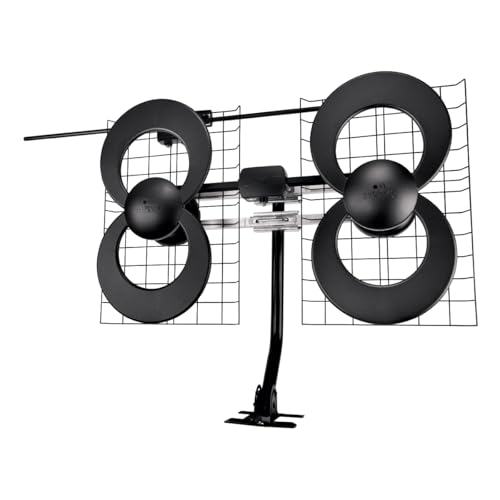
Antennas Direct ClearStream 4MAX
A larger outdoor panel design reaches broadcast towers up to roughly 70 miles away under good conditions, suiting homes well outside typical suburban coverage. Mounting to a roof or high outdoor point improves results further over attic or indoor placement.
Pros
- Longest rated range among the antennas in this comparison
- All-weather design holds up to outdoor exposure
- Mast mounting improves line of sight over rooftops and trees
Cons
- Requires outdoor installation, ruling out simple indoor setups
- Larger panel is more visible than compact indoor antennas

Mohu Leaf 50
A thin, paper-like panel mounts flat on a wall or window with no visible bulk, suiting apartments and rentals where drilling or outdoor mounting is not an option. Reversible design lets either side face the window depending on signal results.
Pros
- Nearly invisible profile suits apartments and rentals
- No drilling or outdoor mounting required
- Reversible design allows quick repositioning for better signal
Cons
- Shorter range than outdoor-mounted antennas
- City buildings and dense construction can block reception indoors

1byone Amplified Outdoor Antenna
A directional Yagi-style design focuses reception toward broadcast towers in one general direction, which improves range for rural homes where towers cluster in a known area. A built-in amplifier with adjustable gain helps tune reception without replacing the whole unit.
Pros
- Directional design improves range toward a known tower cluster
- Adjustable amplifier gain fine-tunes signal strength
- Strong performance for rural, low-density signal areas
Cons
- Directional design performs worse if towers spread across multiple directions
- Needs rotation or repositioning if tower layout changes

ANTOP AT-414B
Weatherproofing and a flat panel design make this antenna equally suited to an attic installation or direct outdoor mounting, depending on what a home’s layout allows. A built-in 4G LTE filter reduces interference from nearby cell towers in dense areas.
Pros
- 4G LTE filter reduces cell tower interference in cities
- Weatherproof build works mounted in an attic or outdoors
- Smart amplifier adjusts gain automatically for signal strength
Cons
- Attic mounting still underperforms a clear rooftop location
- Installation is more involved than simple indoor antennas

GE Attic/Outdoor HD Antenna
A straightforward panel design costs less than premium long-range antennas while still supporting both attic and outdoor mounting options. Reasonable range covers most suburban households without needing a dedicated amplifier.
Pros
- Lower price than most 60-plus mile rated antennas
- Flexible attic or outdoor mounting options
- Reasonable range for typical suburban households
Cons
- No built-in amplifier included at this price point
- Fewer interference filtering features than pricier competitors

RCA Compact Outdoor Yagi Antenna
A compact directional design keeps cost low while still outperforming basic indoor antennas for households within moderate range of broadcast towers. Simple mounting hardware suits a straightforward DIY outdoor install.
Pros
- Lowest price among outdoor antennas in this comparison
- Simple mounting hardware suits a quick DIY install
- Outperforms basic indoor antennas for moderate-distance reception
Cons
- Range and amplification trail every other outdoor antenna here
- No amplifier option limits results in weaker signal areas
What to look for
Indoor Versus Outdoor Antennas: What Actually Changes Reception Outdoor antennas, mounted higher and with a clearer line of sight, consistently outperform indoor models at the same rated range, since walls, insulation and nearby buildings all weaken a broadcast signal before it reaches an indoor panel. Renters and apartment dwellers often have no outdoor mounting option, making indoor antennas like the Mohu Leaf 50 the only practical choice. Homeowners within range of their local towers see the biggest reception jump by moving an antenna outdoors, even without upgrading the antenna itself.
Directional Versus Omnidirectional Reception A directional Yagi-style antenna, like the 1byone Amplified Outdoor Antenna, focuses reception toward one general area, which helps when most broadcast towers cluster together but hurts if towers are scattered in different directions. Flat panel antennas like the ClearStream Flex generally receive more broadly without needing precise aiming. Checking a local broadcast tower map before buying reveals which design actually fits a given household’s situation.
When Amplification Helps and When It Does Not Amplifiers boost weak signals, which helps in suburban areas at moderate distance from towers, but amplifying an already strong nearby signal can sometimes cause overload and worse reception. Antennas with adjustable gain, like the 1byone model, let a household dial in the right amount rather than guessing. Homes very close to broadcast towers often get cleaner results from an antenna without heavy amplification.
Rural and Long-Range Reception Realities The Antennas Direct ClearStream 4MAX and 1byone Amplified Outdoor Antenna target the longest realistic ranges in this comparison, but even their rated distances assume reasonably flat terrain without hills or dense forest blocking the signal path. Mountainous or heavily wooded rural areas may still struggle regardless of antenna choice. Checking a signal strength map for a specific address gives a far more realistic expectation than any antenna’s advertised maximum range.
The lineup, side by side
| # | Model | Range | Best for | Score | Price |
|---|---|---|---|---|---|
| 1 | ClearStream Flex Amplified Antenna | Up to 60 miles | Best Overall | 9.1 | Check price |
| 2 | Antennas Direct ClearStream 4MAX | Up to 70 miles | Best for Long Range and Rural Areas | 9.0 | Check price |
| 3 | Mohu Leaf 50 | Up to 50 miles | Best Indoor Flat Antenna | 8.6 | Check price |
| 4 | 1byone Amplified Outdoor Antenna | Up to 65 miles | Best for Rural Long-Range Reception | 8.7 | Check price |
| 5 | ANTOP AT-414B | Up to 65 miles | Best for Attic or Outdoor Installation | 8.4 | Check price |
| 6 | GE Attic/Outdoor HD Antenna | Up to 60 miles | Best Value | 8.2 | Check price |
| 7 | RCA Compact Outdoor Yagi Antenna | Up to 40 miles | Best Budget | 7.9 | Check price |
Common questions
How far can a TV antenna realistically pick up channels?
Advertised ranges assume ideal, flat line-of-sight conditions. Real-world reception is often shorter due to hills, trees, buildings or distance from the nearest broadcast tower.
Do indoor antennas work as well as outdoor ones?
No, outdoor antennas consistently outperform indoor models at the same rated range, since walls and insulation weaken signal strength before it reaches an indoor panel.
What does an antenna amplifier actually do?
It boosts weak incoming signals, which helps at moderate distances from towers, though overly strong nearby signals can sometimes overload an amplifier and worsen reception.
Is a directional antenna better than an omnidirectional one?
It depends on tower layout. A directional antenna works better if towers cluster in one direction, while an omnidirectional antenna suits scattered tower locations.
Can an antenna in the attic work as well as one on the roof?
Attic mounting underperforms a clear rooftop location, since the roof material and attic structure still absorb some signal, but it beats most indoor placements.
Do I need a 4G LTE filter on my antenna?
Mainly in cities with nearby cell towers, where cellular signals can interfere with broadcast reception. Rural households usually see little benefit from this filter.
How many channels can I expect with a free TV antenna?
This varies heavily by location, but many metro areas receive 20 to 80 or more free channels, including major networks and smaller digital subchannels.
Does a more expensive antenna always mean better reception?
Not always. Matching the antenna’s range and design to the household’s actual distance and direction from towers matters more than price alone.
The bottom line
The ClearStream Flex stands out overall for its flexible indoor or outdoor mounting and dependable suburban range. Rural households far from broadcast towers should choose the Antennas Direct ClearStream 4MAX instead, since its extended range and mast mounting reach farther. Budget-focused buyers within moderate range get solid value from the RCA Compact Outdoor Yagi Antenna.
Marcus Chen
Marcus covered consumer electronics for enthusiast tech publications for six years before joining ChoiceCrest. He specializes in translating manufacturer spec sheets into plain-language buying advice, with a focus on audio, computing accessories and smart-home gear.
You might also need
Nintendo Game & Watch: Super Mario Bros Review: Still Worth It as a Collectible?

Ray-Ban Meta (Gen 2) Wayfarer Smart Glasses: Worth $379 for Clear Lenses?
AlyKets Nikon UC-E6 Replacement USB Cable: Does a $7.95 Cord Work as Well as the Original?
