Trekking Poles for Every Trail and Pack Weight
The Black Diamond Trail Pro leads this comparison as the most adjustable, durable trekking pole for varied terrain. Minimalist hikers who want the lightest setup should look at the Black Diamond Distance Carbon Z, while anyone packing poles into a small bag benefits more from the folding Leki Micro Vario Carbon.
The Black Diamond Trail Pro takes the top spot because its FlickLock Pro lever adjusts length quickly even with gloves on, and the cork grip reduces hand fatigue on long descents. Its main limitation is weight, since the three-section aluminum shaft is heavier than folding carbon poles built for minimalist packing.
We compared published shaft material, locking mechanism, folded length and weight across each pole rather than hiking with all seven ourselves.
The top picks, ranked

Black Diamond Trail Pro Trekking Poles
A FlickLock Pro lever adjusts the three-section aluminum shaft quickly, even while wearing gloves on a cold morning. A cork grip with a foam extension below it reduces hand fatigue and absorbs sweat better than plain rubber grips. A tungsten carbide tip bites into rock and hardpack more securely than softer metal tips.
Pros
- FlickLock Pro lever adjusts quickly even with gloves on
- Cork grip reduces hand fatigue on long descents
- Tungsten carbide tip grips rock and hardpack securely
Cons
- Heavier than folding carbon poles built for minimalist packing
- Bulkier packed length than Z-pole style folding designs

Black Diamond Distance Carbon Z
A Z-pole folding design collapses into three short sections connected by an internal cord, deploying in seconds. Carbon fiber construction keeps the weight well below standard adjustable aluminum poles. The fixed length design means hikers must choose a size at purchase rather than adjusting on the trail.
Pros
- Among the lightest trekking poles available
- Z-pole folding deploys in seconds via internal cord
- Compact folded length fits easily into a pack
Cons
- Fixed length cannot be adjusted on the trail
- Carbon shaft is less repairable than aluminum if damaged

Leki Micro Vario Carbon
A folding design combined with a short adjustable extension gives more length flexibility than fixed Z-pole designs. Carbon shaft construction keeps the pole light while folding down small enough for carry-on luggage. An Aergon grip shape supports a natural hand angle during repeated pole plants.
Pros
- Folding design packs small enough for travel luggage
- Adjustable extension adds flexibility over fixed Z-poles
- Aergon grip supports a natural hand angle
Cons
- Costs more than non-folding aluminum poles
- Folding joints need occasional inspection for wear

REI Co-op Traverse Trekking Poles
An aluminum shaft with a basic flip-lock adjustment keeps the price below carbon or folding pole designs. The straightforward three-section design adjusts to fit a range of hiker heights. The flip-lock mechanism takes slightly longer to adjust than the FlickLock Pro lever on premium poles.
Pros
- Lower price than carbon or folding pole designs
- Simple flip-lock adjusts to a range of hiker heights
- EVA foam grip absorbs moisture reasonably well
Cons
- Flip-lock adjusts slower than premium lever locks
- Heavier than carbon shaft alternatives
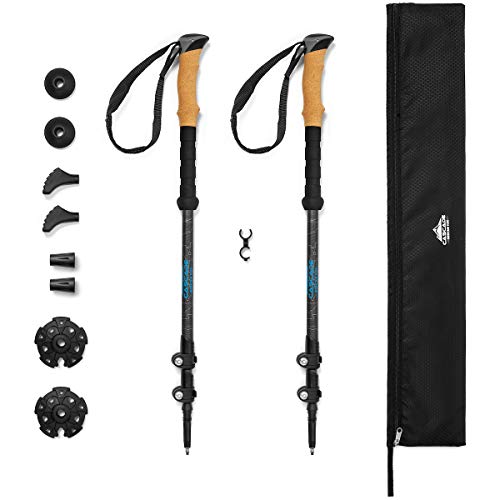
Cascade Mountain Tech Carbon Fiber Trekking Poles
A carbon fiber shaft brings lighter weight to a price point closer to aluminum poles than premium carbon brands. A quick-lock adjustment mechanism sets length without needing to twist multiple times. The lock mechanism feels slightly less secure under heavy downhill pressure than the FlickLock Pro on pricier poles.
Pros
- Carbon fiber weight at a price closer to aluminum poles
- Quick-lock mechanism sets length without multiple twists
- Lighter in the hand than most aluminum alternatives
Cons
- Lock feels less secure under heavy downhill pressure than premium levers
- Carbon shaft is less repairable than aluminum if cracked

Montem Ultra Strong Trekking Poles
A 7075 aluminum shaft resists bending better than standard aluminum poles under heavy loads or awkward falls. A wider flip-lock lever clamps down firmly, reducing slippage on steep, repeated descents. The reinforced shaft adds weight compared to carbon alternatives built for speed over durability.
Pros
- 7075 aluminum resists bending better than standard aluminum
- Wide flip-lock lever reduces slippage on descents
- Cork-blend grip holds up well to repeated use
Cons
- Heavier than carbon fiber poles on this list
- Less packable than folding Z-pole designs
TrailBuddy Trekking Poles
A straightforward aluminum design with simple flip-lock adjustment makes these poles easy to set up for a first-time hiker. An optional anti-shock spring absorbs some impact on downhill sections. The lighter-gauge aluminum feels less sturdy under heavy pack loads than the Montem Ultra Strong.
Pros
- Simple flip-lock adjustment is easy for first-time users
- Optional anti-shock spring eases downhill impact
- Lower price point suits occasional hikers
Cons
- Lighter-gauge aluminum feels less sturdy under heavy loads
- Fewer grip material options than premium poles
The lineup, side by side
| # | Model | Shaft Material | Best for | Score | Price |
|---|---|---|---|---|---|
| 1 | Black Diamond Trail Pro Trekking Poles | Aluminum, 3-section | Best Overall | 9.0 | Check price |
| 2 | Black Diamond Distance Carbon Z | Carbon fiber | Best Ultralight Folding | 8.8 | Check price |
| 3 | Leki Micro Vario Carbon | Carbon fiber | Best Packable | 8.7 | Check price |
| 4 | REI Co-op Traverse Trekking Poles | Aluminum, 3-section | Best Budget | 8.1 | Check price |
| 5 | Cascade Mountain Tech Carbon Fiber Trekking Poles | Carbon fiber | Best Value Carbon | 8.3 | Check price |
| 6 | Montem Ultra Strong Trekking Poles | 7075 aluminum | Best Heavy-Duty | 8.4 | Check price |
| 7 | TrailBuddy Trekking Poles | Aluminum, 3-section | Best for Beginners | 8.0 | Check price |
What to look for
What to look for in trekking poles Shaft material decides the tradeoff between weight and durability, with carbon lighter but less repairable than aluminum if bent or cracked. Locking mechanism, lever-style FlickLock versus twist or flip-lock, affects how quickly and securely length adjusts on the trail. Fold style matters for travel, since Z-pole and folding designs pack smaller than traditional telescoping poles.
Adjustable poles versus fixed-length folding poles Adjustable poles like the Black Diamond Trail Pro and REI Co-op Traverse change length for uphill and downhill sections on the same hike. Fixed-length folding poles like the Black Diamond Distance Carbon Z trade that flexibility for a lighter, more compact package. Hikers who stick to one general terrain type benefit more from fixed-length simplicity than those tackling varied elevation.
Carbon versus aluminum shaft tradeoffs Carbon shafts, used in the Leki Micro Vario and Cascade Mountain Tech poles, cut weight noticeably compared to aluminum. Aluminum shafts, like on the Montem Ultra Strong, bend under heavy stress rather than snapping outright, which some hikers see as a safety advantage in remote terrain. Budget aluminum poles like the TrailBuddy close most of the weight gap for occasional use at a lower price.
Packability for travel and storage Folding Z-pole and vario designs, like the Black Diamond Distance Carbon Z and Leki Micro Vario Carbon, collapse small enough for carry-on luggage or a daypack side pocket. Traditional telescoping poles like the Montem Ultra Strong collapse less compactly but offer simpler, more repairable mechanisms. Frequent travelers should prioritize folded length; home-based hikers can prioritize durability instead.
Common questions
What is the lightest trekking pole available?
The Black Diamond Distance Carbon Z is among the lightest here, thanks to its carbon fiber Z-pole folding design.
Are carbon trekking poles better than aluminum?
Carbon poles weigh less, but aluminum poles like the Montem Ultra Strong bend rather than snap under heavy stress, which some hikers prefer.
What trekking poles fold down for travel?
The Black Diamond Distance Carbon Z and Leki Micro Vario Carbon both fold into compact lengths suited to carry-on luggage.
What is the best budget trekking pole?
The REI Co-op Traverse offers a usable aluminum design with basic flip-lock adjustment at a lower price than carbon poles.
Do trekking poles come with shock absorption?
Some do. The TrailBuddy Trekking Poles include an optional anti-shock spring to ease downhill impact.
How do FlickLock and flip-lock mechanisms differ?
FlickLock, used on the Black Diamond Trail Pro, is a lever mechanism that adjusts quickly, while flip-lock designs like the REI Co-op Traverse take slightly longer to secure.
What trekking pole is best for heavy pack loads?
The Montem Ultra Strong uses 7075 aluminum built to resist bending under heavier loads than standard aluminum poles.
Can trekking poles be adjusted for height?
Most adjustable models, including the Black Diamond Trail Pro and Cascade Mountain Tech, change length, while Z-pole designs like the Distance Carbon Z are fixed.
What grip material is best for trekking poles?
Cork grips, used on the Black Diamond Trail Pro and Montem Ultra Strong, absorb sweat and reduce hand fatigue better than plain foam.
The bottom line
Most hikers covering varied terrain should choose the Black Diamond Trail Pro, since its lever adjustment and cork grip handle both climbs and descents comfortably. Minimalist backpackers who prioritize weight over adjustability should pick the Black Diamond Distance Carbon Z instead. Frequent travelers who need poles to pack into a suitcase should go with the Leki Micro Vario Carbon.
Sierra Daniels
Sierra's background is in landscape design and nursery retail. She focuses on lawn and garden equipment, outdoor furniture and gear durability, weighing published specs against how materials actually hold up outside.


