How to Pick a Safe Trampoline for Kids: 7 Models Compared
Skywalker’s 12ft Round Trampoline with Enclosure ranks first because its net attaches directly to the jump mat, closing the usual foot trap gap. Zupapa’s 12FT Trampoline with Safety Enclosure brings thicker galvanised steel for years outdoors. Little Tikes’ 7ft Trampoline with Enclosure suits toddlers and smaller gardens.
Skywalker’s 12ft Round Trampoline with Enclosure tops this list because its net clips to the jump mat instead of the frame, sealing the gap where ankles get caught. Zupapa’s 12FT model wins on frame durability, and Little Tikes’ 7ft version is sized right for toddlers and tight gardens.
Two trampolines can list the same diameter and weight limit yet behave completely differently once installed, because enclosure attachment and frame gauge rarely appear in the headline bullet points. We compared published specs, enclosure designs and owner feedback on assembly and rust across current Amazon listings, then ranked each model on how it holds up after repeated seasonal use.
How to pick the right one
What makes a trampoline enclosure actually safe? Where the enclosure net attaches matters more than whether one exists at all. Nets that connect outside the spring ring leave a gap right where ankles and feet slip through. Skywalker’s mat mounted design closes that gap by clipping the net to the jump mat itself. Listings that skip this detail are worth skipping too, since it usually means the gap is there.
Why does frame steel gauge matter for outdoor trampolines? Almost every kids trampoline claims a rust resistant frame, yet tube thickness varies widely between brands. Zupapa’s tubing runs noticeably heavier than budget competitors, and owners report it still holds up after several winters outdoors. Thin gauge frames soften at the leg joints within a season or two once exposed to real weather. Spending more here pays off fastest if the trampoline stays outside year round.
What size trampoline actually fits a small backyard? A published diameter describes the frame, not the clearance a trampoline actually needs. Fences, washing lines and low branches all count against the safe margin around the perimeter. Ten feet in an open spot beats fourteen feet wedged against a fence line. Overhead clearance matters as much as the ground footprint, especially for taller kids.
How much does a trampoline’s weight limit really matter? Weight limits describe an engineering ceiling, not a target to reach regularly. Jumping near that ceiling wears springs and frame joints faster, even without a failure. Limits across this list range from around 100 pounds on the smallest models to over 400 pounds on the Zupapa. Buying above a child’s current weight leaves room for growth, siblings and the occasional adult.
The shortlist, ranked

Skywalker Trampolines 12ft Round Trampoline with Enclosure
A net that clips straight to the jump mat sets this trampoline apart, closing the gap above the springs where feet normally slip through. Padding runs the full length of each enclosure pole, not just at the top. Two people should expect an afternoon to put it together, which matches most 12 foot models.
Pros
- Net attaches at the mat instead of outside the springs
- Enclosure poles padded along their full length
- Replacement parts stay easy to find
Cons
- Assembly runs several hours even with two people
- Spring pad fades before the frame does

Zupapa 12FT Trampoline with Safety Enclosure
Thicker galvanised tubing and extra springs explain why owners keep reporting this one is still solid after several winters outside. A 425 pound weight limit clears the category average by a wide margin, so teenagers and adults can join in. A ladder, rain cover and repair kit ship in the box rather than as add-ons.
Pros
- Highest weight limit in this comparison
- Heavier steel resists winter corrosion better than lighter frames
- Ladder, cover and repair kit included at no extra cost
Cons
- Box weight makes assembly and moving harder
- Costs more upfront than the Skywalker 12ft

Little Tikes 7ft Trampoline with Enclosure
Built for younger children rather than teenagers, this size fits patios and small yards where a 12 foot round would not. Lower overall height puts a parent’s hand closer to a jumping toddler. Weight and age limits sit well below the full size models here, so treat it as a stage rather than a decade long purchase.
Pros
- Footprint suits small yards and patios
- Lower height makes supervision easier
- Assembles faster than full size rounds
Cons
- Outgrown within a few years
- Lowest weight limit of the seven
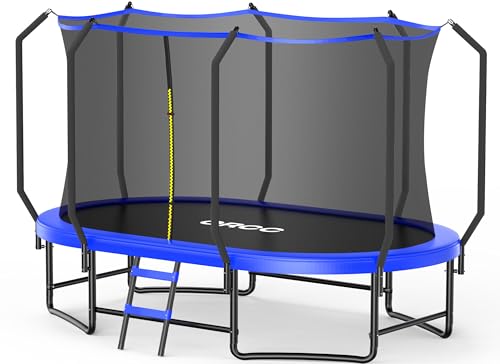
ORCC 10FT Trampoline
Ten feet is the size most backyards can actually fit, and ORCC keeps a weight rating close to the 12 foot models despite the smaller footprint. Foam sleeves cover the enclosure poles, and the spring pad runs thicker than budget competitors. Owners describe the included ladder and anchor kit as basic but usable.
Pros
- Weight rating holds up well for a 10 foot frame
- Foam sleeved poles instead of thin padding
- Zip and clip double entry closure
Cons
- Spring pad thinner than the Zupapa or Skywalker
- Instructions leave some steps unclear
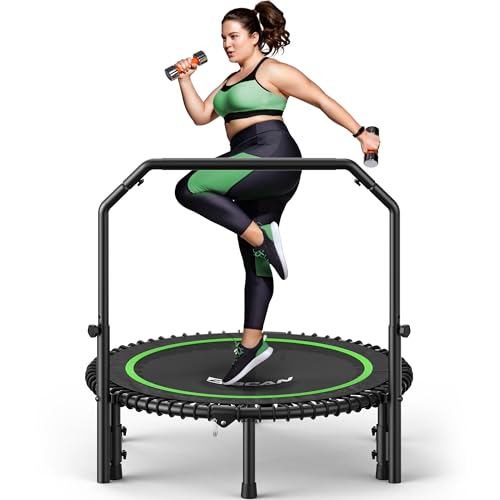
Skywalker Trampolines 40in Mini Trampoline with Handlebar
Rainy days and nervous first time jumpers are what this mini trampoline is for. A height adjustable handlebar gives a toddler something to grip while they find their balance. Padding covers the entire frame edge, so no metal shows, but bounce height stays modest by design.
Pros
- Usable indoors on rainy days
- Handlebar helps toddlers balance early on
- Frame edge fully padded
Cons
- Bounce is minimal compared with full size models
- Children outgrow it within a season or two

SereneLife Kids Fitness Trampoline
This is the lowest cost way to get an enclosed trampoline, covering a net and a padded frame for a young child. Steel gauge runs lighter than the outdoor focused models, so keeping it under cover extends its life. Most owners report finishing assembly in under an hour without help.
Pros
- Least expensive enclosed option here
- Assembles quickly without a second person
- Light enough to move indoors
Cons
- Lighter steel is not built for permanent outdoor exposure
- Jumping surface is noticeably smaller than the 10 or 12 foot rounds

Bounce Pro 14ft Trampoline
Fourteen feet is the largest jumping surface in this lineup, which works well for older kids and siblings sharing the space. A zip and clip entry closes the full height net, and galvanised tubing forms the frame. Space is the real constraint, since it needs a genuinely large flat yard with clearance overhead.
Pros
- Largest jump surface among these seven
- Handles older children and multiple siblings
- Full height net with a secure zip and clip closure
Cons
- Needs a large, obstruction free yard
- Two person assembly can take half a day
The lineup, side by side
| # | Model | Size | Best for | Score | Price |
|---|---|---|---|---|---|
| 1 | Skywalker Trampolines 12ft Round Trampoline with Enclosure | 12 foot round | Best overall | 9.4 | Check price |
| 2 | Zupapa 12FT Trampoline with Safety Enclosure | 12 foot round | Best build quality | 9.2 | Check price |
| 3 | Little Tikes 7ft Trampoline with Enclosure | 7 foot round | Best for toddlers | 9.0 | Check price |
| 4 | ORCC 10FT Trampoline | 10 foot round | Best mid size | 8.8 | Check price |
| 5 | Skywalker Trampolines 40in Mini Trampoline with Handlebar | 40 inch mini | Best for indoor use | 8.6 | Check price |
| 6 | SereneLife Kids Fitness Trampoline | Compact, roughly 36 to 60 inches depending on variant | Best budget | 8.3 | Check price |
| 7 | Bounce Pro 14ft Trampoline | 14 foot round | Best for older children | 8.0 | Check price |
Questions worth asking
What age is right for a first trampoline?
Small enclosed models often list a minimum age around three years. Paediatric guidance leans more cautious for full size garden trampolines. Age matters less than constant supervision and limiting the mat to one jumper.
Is it safe for two kids to jump together?
Most manufacturers and safety groups recommend one jumper at a time. Collisions between jumpers, or a smaller child launched by a bigger one, cause a large share of trampoline injuries. It is the rule families break most often and the one that prevents the most harm.
Do trampolines need to be anchored to the ground?
Yes, in nearly every backyard setting. Wind can lift a large round frame off the ground without one. Anchor kits cost little, yet many listings do not include them, so plan to buy a set separately.
Can a trampoline stay outside through winter?
Galvanised frames handle winter weather fine. The mat, spring pad and net wear out faster from sun and frost than the frame does. Storing the net and pad indoors, or fitting a cover, stretches their lifespan noticeably.
How long does it take to set up a trampoline?
Twelve and fourteen foot models take two people most of an afternoon. Attaching the springs is the slow part, and a spring pulling tool speeds it up considerably. Mini trampolines go together in under an hour.
What should a trampoline sit on, grass or concrete?
Level grass is the better surface, since it cushions falls just outside the mat. Concrete or patio stone offers no give at all. A sloped yard should be levelled properly rather than propped with blocks under the legs.
How often should springs and netting be inspected?
A monthly check during the jumping season catches most problems early. Look for stretched or missing springs, tears along the mat stitching, and any pad that has slipped and exposed metal. Replacement parts are widely sold for the major brands here.
Are spring free trampolines safer than spring models?
They remove the risk of a foot catching between springs, which is a real but fairly small share of injuries. Falls and collisions between jumpers cause more harm than the springs themselves. An enclosure and one jumper at a time still matter more than the spring design.
What is the difference between a 10ft and 12ft trampoline?
Two feet of diameter changes the required clearance more than it changes the bounce. A 10 foot model like the ORCC fits tighter yards while keeping a weight limit close to some 12 foot rounds. Twelve foot frames such as the Skywalker or Zupapa suit yards with more open space.
Mini trampoline vs full size, which is better for toddlers?
A mini trampoline with a handlebar, like Skywalker’s 40 inch model, suits toddlers still learning balance and works indoors on rainy days. Full size rounds such as the Little Tikes 7ft give more room to grow into. Bounce height and jumping area both stay far smaller on a mini.
Our pick
Skywalker’s 12ft Round Trampoline with Enclosure remains the pick for most families, since its mat mounted net removes the gap responsible for most enclosure injuries. Families keeping a trampoline outside for years, with heavier or older jumpers, get more mileage from Zupapa’s thicker steel and higher weight limit. Little Tikes’ 7ft size fits toddlers and small yards now, even though it will be outgrown.
Rachel Simmons
Rachel previously worked in child-product retail and brings a practical, detail-first eye to gear reviews, focusing on safety standards, ease of use and the fine print that matters most for new caregivers.