Training Potties Toddlers Won’t Fight You On
The BabyBjorn Smart Potty wins overall because its removable inner bowl makes emptying fast and clean. The Munchkin Arm and Hammer Multi-Stage 3-in-1 Potty stretches across the whole training arc for less money. Car trips and holidays are better served by the OXO Tot 2-in-1 Go Potty.
Most families settle fastest on the BabyBjorn Smart Potty, since its removable inner bowl lifts out and rinses without dismantling anything. One purchase covering standalone potty, toilet seat reducer and step stool comes from the Munchkin Arm and Hammer Multi-Stage 3-in-1 Potty. Car journeys and holidays are what the OXO Tot 2-in-1 Go Potty solves.
Two things decide whether potty gear earns its shelf space: how unpleasant emptying becomes, and whether a child will sit on it willingly. A one piece moulded potty looks simple until you carry the whole thing to the toilet. No splash guard means a mess with boys within days. We compared bowl removal, splash guard shape, seat height, stability and cleaning access, then ranked seven models by the stage and situation each suits.
How to pick the right one
Standalone potty or toilet seat reducer, which comes first? A floor potty feels less intimidating, lets a child climb on and off independently and keeps feet planted, which helps successful bowel movements. A seat reducer skips a later transition and saves cleaning a bowl, but it needs a step stool and can feel frightening at height for some children. Many families run both at once, a floor potty downstairs and a reducer plus stool in the bathroom.
What matters most in daily use: emptying Whatever the packaging emphasises, the part you interact with daily is the bowl. A removable inner bowl with a smooth interior and a pouring lip beats a one piece design every time. Textured plastic, tight corners and decorative moulding all trap mess. Check whether the bowl lifts from the top or slides out the back, since rear removal is awkward against a wall.
Splash guards, stability and comfortable sitting Boys need a front guard high enough to work but not so high it makes sitting down awkward, which is why removable guards are common. Stability matters just as much, since a potty that slides on tile puts a child off entirely. Look for a rubberised base edge, a wide footprint and a seat height low enough that feet reach the floor flat.
When to start, and how long it usually takes Readiness signs include staying dry for longer stretches, showing interest in the bathroom and pulling clothing up and down unassisted. Pushing before those appear tends to extend the process rather than shorten it. Keeping the potty visible in the room where a child plays, not only in the bathroom, is a widely reported way to cut resistance in the first weeks.
What we recommend

BabyBjorn Smart Potty
A compact potty with a removable inner bowl and a high back a toddler can lean against. The bowl lifts straight out, so emptying and rinsing takes seconds rather than a two handed operation. Its small footprint suits a bathroom with no room for a larger, throne style potty.
Pros
- Inner bowl makes emptying genuinely quick
- Small footprint fits tight bathrooms
- Backrest helps a toddler sit properly
Cons
- Single stage only, no toilet seat function
- Splash guard is modest for standing boys
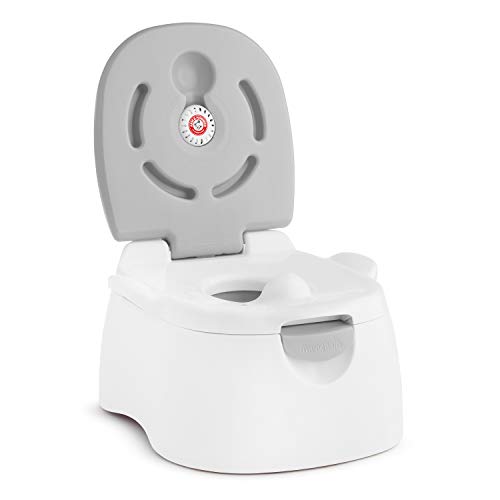
Munchkin Arm and Hammer Multi-Stage 3-in-1 Potty
Standalone potty first, then a toilet seat reducer, then a step stool once training ends. That progression means one purchase covers roughly two years of a child’s development. A baking soda odour control feature in the bowl is a small but noticeable improvement between emptying.
Pros
- Covers three stages in one product
- Removable bowl for easy cleaning
- Step stool stage stays useful for years
Cons
- Compromises slightly at every stage
- Seat reducer fit varies by toilet shape

Summer Infant My Size Potty
Shaped like a small adult toilet, complete with a flush handle and a toilet paper holder, this helps children wary of the real thing. Familiarity is the point, since the jump to a full sized toilet becomes smaller later. The bowl removes from the back for emptying.
Pros
- Familiar shape eases the transition
- Flush handle appeals to reluctant children
- Stable wide base
Cons
- Takes up more floor space
- More crevices to wipe down

Fisher-Price Learn-to-Flush Potty
Pressing the handle plays a short celebratory sound, which works well for children who need a reason to keep trying. Parents tire of the reward sound faster than toddlers do, so treat it as a short term motivator rather than a long term feature. The bowl lifts out from the top.
Pros
- Sound reward motivates hesitant toddlers
- Removable splash guard for boys
- Sturdy base does not tip easily
Cons
- Sounds become tiresome for parents
- Battery compartment needs keeping dry

OXO Tot 2-in-1 Go Potty
Folds flat for a bag and opens either as a standalone potty with a disposable liner, or as a seat reducer on a public toilet. Newly trained toddlers often refuse public toilet seats outright, which is exactly what this dual function solves. Owners report the legs lock firmly once opened.
Pros
- Folds small enough for a changing bag
- Doubles as a public toilet seat reducer
- Legs lock securely when open
Cons
- Requires buying liner bags
- Less comfortable than a moulded potty

Jool Baby Nova Potty Training Toilet
A simple moulded potty with a removable bowl and a splash guard, covering the essentials with nothing extra to clean around. A smooth interior is the practical payoff, since mess has nowhere to hide. Families wanting a second potty for another floor of the house suit this best.
Pros
- Low cost makes a second potty easy
- Smooth interior wipes clean fast
- No batteries or moving parts
Cons
- No backrest support
- Lightweight enough to slide on tile

Nuby My Real Potty Training Toilet
A larger potty with a lid and a flush sound, aimed at children past the earliest stage who want something closer to the real thing. Odour stays contained between emptying thanks to the lid, which matters if the potty lives in a bedroom overnight. It is bulkier than early stage potties.
Pros
- Lid contains odour between emptying
- Feels closer to a real toilet
- Roomy seat suits taller toddlers
Cons
- Too large for very small children
- More parts to clean than basic potties
Side by side
| # | Model | Type | Best for | Score | Price |
|---|---|---|---|---|---|
| 1 | BabyBjorn Smart Potty | Standalone potty | Best overall | 9.4 | Check price |
| 2 | Munchkin Arm and Hammer Multi-Stage 3-in-1 Potty | 3-in-1 convertible | Best value | 9.2 | Check price |
| 3 | Summer Infant My Size Potty | Standalone potty | Best for realistic transition | 9.0 | Check price |
| 4 | Fisher-Price Learn-to-Flush Potty | Standalone potty with sounds | Best for motivation | 8.8 | Check price |
| 5 | OXO Tot 2-in-1 Go Potty | Folding travel potty | Best for travel | 8.6 | Check price |
| 6 | Jool Baby Nova Potty Training Toilet | Standalone potty | Best budget | 8.3 | Check price |
| 7 | Nuby My Real Potty Training Toilet | Standalone potty with lid | Best for older toddlers | 8.0 | Check price |
Good to know
When should potty training start?
Most children show readiness somewhere between eighteen months and three years, and the signals matter more than age. Staying dry for a couple of hours, noticing a wet nappy and showing interest in the toilet are the usual indicators.
Is a standalone potty or a seat reducer better?
A standalone potty is usually easier at the start, since a child can sit independently with feet on the floor. A seat reducer avoids a second transition later. Using both is common, and neither approach is wrong.
How do you clean a training potty properly?
Empty into the toilet, rinse the bowl, then wipe with a mild disinfectant suitable for surfaces children touch. Rinse again so no residue remains. Bowls with smooth interiors and few corners take a fraction of the time, which is why removable inner bowls are worth prioritising.
Do musical potties actually help?
For some children the reward sound provides useful motivation in the first weeks. Others ignore it entirely. Since the novelty fades fast, treat it as a small bonus rather than the deciding feature.
What is the best potty for travel and public toilets?
A folding travel potty that doubles as a seat reducer covers both problems, and disposable liners make roadside stops manageable. Many newly trained children refuse full sized public toilet seats, so carrying a reducer prevents accidents on days out.
Should the potty stay in the bathroom?
In the early days, keeping it in the room where the child spends most time reduces accidents, since toddlers give very little warning. Moving it toward the bathroom gradually once they use it reliably makes the final transition easier.
Do boys need a different potty than girls?
Boys benefit from a splash guard, and a removable one is preferable since a fixed high guard can make sitting down uncomfortable. Otherwise the same potties work for all children, and most training starts sitting down regardless.
How long does potty training usually take?
It varies widely, from a few intensive days to several months of gradual progress, and setbacks after illness or a house move are normal rather than a failure. Night training typically follows daytime success by months, not weeks.
What age is too old for a training potty?
There is no fixed cutoff. Larger, toilet styled potties with a lid suit older toddlers who feel babyish on a small basic model, and switching straight to a seat reducer works too once a child is tall enough to climb up safely.
Our pick
Day to day, the BabyBjorn Smart Potty is the one most families end up happiest with, largely because emptying it stays quick and unfussy. A single purchase that stretches from first attempts to a step stool at the sink points to the Munchkin Arm and Hammer Multi-Stage 3-in-1 Potty instead, and the OXO Tot 2-in-1 Go Potty belongs in the car either way.
Rachel Simmons
Rachel previously worked in child-product retail and brings a practical, detail-first eye to gear reviews, focusing on safety standards, ease of use and the fine print that matters most for new caregivers.


