Which Toy Tool Set Actually Survives Toddler Play?
Melissa and Doug’s Deluxe Wooden Toolbox leads for durability and open ended building, backed by a case that keeps pieces together. Black and Decker’s Junior Power Tools Workshop suits children ready for a full bench with a working drill. Battat’s Toolbox Take-Along fits toddlers who need oversized, simple pieces and a light case.
Melissa and Doug’s Deluxe Wooden Toolbox holds up best for most families, pairing solid wooden tools with a case that stops pieces scattering. Households with floor space for a full bench often prefer Black and Decker’s Junior Power Tools Workshop instead. Toddlers under four generally do better with Battat’s Take-Along Tool Kit and its oversized pieces.
Listings blur three distinct products: chunky toddler kits, pretend play sets with a case, and motorised workbenches for older preschoolers. Picking the wrong category leaves either a bored five year old or loose bolts on the floor near a baby. We compared materials, piece counts, published age ratings, storage design and owner feedback on durability rather than ranking by piece count alone.
How to choose
How to match a tool set to age Children under three need oversized pieces with nothing that fits inside a mouth, since choking risk drives the youngest ratings. Between three and five, sets with nuts, bolts and a building board suit developing fine motor skills and hold attention the longest. Past five, realism matters more: working toy drills, benches, vices and accessories that mirror adult tools. Packaging age ratings reflect small parts testing, so trust the label over the box photograph.
Wood versus plastic construction Wooden tools feel substantial, survive drops and often get passed down to younger siblings. Weight is the trade off, since a swung wooden hammer carries more force than a plastic one. Plastic sets stay lighter, wipe clean faster and are the only route to motorised drills with sounds and lights. Many households end up combining a wooden toolbox for building with a plastic bench for the noise.
Why storage design determines how long a set lasts Sets rarely break outright; bolts and small tools simply vanish under furniture over weeks. A dedicated case or pegboard bench gives every piece an obvious home, which cuts that attrition sharply. Adding a lidded box to a set that ships without one closes the gap fast. Photographing the full contents on arrival makes it easier to spot what has gone missing later.
Safety checks worth doing before first use Run a hand over wooden tools after heavy play and sand down any splinters that appear. Battery compartments on powered drills should be secured with a screw, which reputable brands include as standard. A set rated for a five year old belongs out of reach if a one year old shares the house. Keep toy tools visually distinct from real ones, and store actual tools locked away separately.
The shortlist, ranked

Melissa and Doug Deluxe Wooden Toolbox Fill and Drill
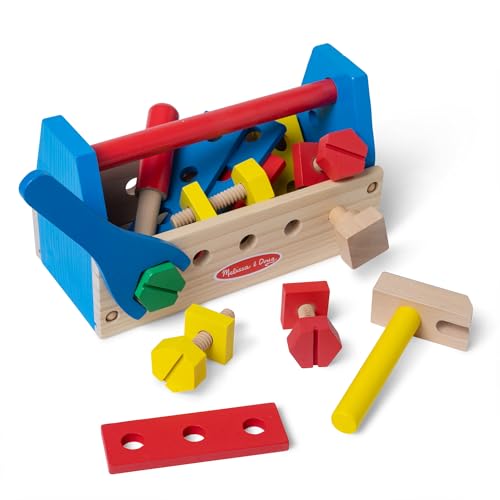
Melissa and Doug pairs a wooden hammer, saw, screwdriver and wrench with nuts, bolts and a building board, so children assemble something rather than just swinging tools. A wooden case holds every piece, which keeps small parts from migrating around the house. The tools weigh more than plastic equivalents, worth noting with an enthusiastic three year old.
Pros
- Encourages real building instead of pretend swinging
- Wooden case keeps every piece accounted for
- Solid wood resists cracking better than thin plastic
Cons
- Wooden pieces add weight for small hands
- Nuts and bolts count as small parts to track

Black and Decker Junior Power Tools Workshop
A standing bench, pegboard and battery powered toy drill give this set more presence than a boxed toolkit. The drill bit spins and the accessory count runs high, which sustains interest longer than a small case does. Assembly takes close to an hour, and the finished bench needs a dedicated corner of floor space.
Pros
- Working toy drill draws sustained attention
- Pegboard keeps loose accessories visible
- High accessory count supports varied play
Cons
- Bench requires meaningful floor space
- Adult assembly needed before first use
Battat Toolbox Take-Along Tool Kit
Battat scales its tools and bolts up in size for toddler hands, and the light carry case travels easily from room to room. Rounded edges and simple click connections skip the fine motor precision a wooden set demands. Children past about four often find the pieces too large and move on to detailed sets.
Pros
- Oversized pieces suit early fine motor skills
- Carry case is light enough for solo hauling
- Plastic surface wipes clean after outdoor play
Cons
- Simplicity limits appeal past age four
- Plastic tools feel less substantial than wood

Hape Master Workbench with Tools
Hape builds a vice, a storage shelf and wooden tools into a bench finished well enough to leave out in a living room. The painted wood resists dings better than typical toy plastic. No motorised drill is included, so children who chase sounds and lights may find it quieter than the plastic benches.
Pros
- Painted wood construction resists everyday knocks
- Working vice supports real building play
- Finish suits display in shared living spaces
Cons
- No powered sounds or lights included
- Priced above comparable plastic benches

VTech Drill and Learn Toolbox
VTech layers numbers, colours and shape prompts onto a toy drill that responds to different actions with sounds. Electronic feedback holds attention at the younger end of the age range, where wooden building boards ask for more focus than a toddler has yet. Batteries power the unit, and voice prompts repeat during longer play sessions.
Pros
- Electronic feedback engages younger toddlers quickly
- Prompts introduce numbers, colours and shapes
- Compact footprint compared with a full bench
Cons
- Voice prompts repeat during extended play
- Building is more limited than wooden sets offer

Theo Klein Bosch Tool Belt Set
A wearable belt turns tool play mobile, letting a child carry gear through the house or garden instead of staying at a bench. Theo Klein’s Bosch licensed tools look close to their real counterparts, scaled for small hands. No building pieces come with it, so it pairs best alongside a workbench or construction set.
Pros
- Belt design supports play away from a bench
- Bosch licensed styling looks close to real tools
- Adjustable strap fits a growing child
Cons
- No nuts, bolts or building board included
- Belt fabric frays under heavy daily use

STEAM Life Kids Tool Set with Electric Drill
This set stacks a high piece count and a battery powered toy drill at the lowest cost among the seven. Plastic runs thinner than premium brands, and the case latch is a frequently mentioned weak spot. It works well as a first set for testing whether interest lasts before buying a bench.
Pros
- High piece count for a modest outlay
- Battery toy drill included at this tier
- Case provides basic storage for pieces
Cons
- Plastic runs thinner than premium brands
- Case latch is a commonly reported weak point
Side by side
| # | Model | Material | Best for | Score | Price |
|---|---|---|---|---|---|
| 1 | Melissa and Doug Deluxe Wooden Toolbox Fill and Drill | Solid wood tools and case | Best overall | 9.4 | Check price |
| 2 | Black and Decker Junior Power Tools Workshop | Standing workbench with pegboard | Best workbench | 9.2 | Check price |
| 3 | Battat Toolbox Take-Along Tool Kit | Moulded plastic | Best for toddlers | 9.0 | Check price |
| 4 | Hape Master Workbench with Tools | Wood with painted finish | Best wooden workbench | 8.8 | Check price |
| 5 | VTech Drill and Learn Toolbox | Electronic learning toolbox | Best for early learning | 8.6 | Check price |
| 6 | Theo Klein Bosch Tool Belt Set | Wearable tool belt | Best tool belt | 8.3 | Check price |
| 7 | STEAM Life Kids Tool Set with Electric Drill | Tools, toy drill, screws and case | Best budget pick | 8.0 | Check price |
Questions worth asking
What age is a toy tool set suitable for?
Chunky toddler kits typically start around age two, standard pretend play sets from three, and detailed workbenches suit ages three through seven. Packaging ratings reflect small parts testing, not a guess at interest level.
Which is better, a wooden or plastic tool set?
Wooden sets last longer and often get passed down between siblings. Plastic sets stay lighter, cost less and are the only option with a motorised toy drill. For a toddler still swinging tools wildly, plastic is the gentler choice.
Do toy tool sets contain small parts?
Sets built around nuts, bolts and screws usually do. Kits aimed at children under three use oversized pieces specifically to avoid that risk. Check the printed age rating before buying if younger siblings share the home.
Is a toy workbench worth the floor space?
For a child with genuine interest, yes, since a bench becomes a repeat play destination rather than a box that gets opened once. It does need a dedicated spot and roughly an hour of adult assembly, so measure the space first.
Do toy drills actually spin and work?
Battery powered toy drills spin a plastic bit and usually add sound effects, and some drive the toy screws included in the set. They cannot cut or drill real materials. The spinning motion itself is the appeal, not any function.
How do you stop tool set pieces from going missing?
Choose a set with a case or pegboard, photograph the full contents when it arrives, and make tidying part of the end of play. Keeping the set confined to one room reduces loss more than any other single habit.
Can a toy tool set help with fine motor skills?
Threading nuts onto bolts, matching shapes and turning a screwdriver all build hand eye coordination, and pretend building supports sequencing and language too. Sets that require assembling something teach more than sets limited to loose tools.
Toy tool sets vs building blocks, which teaches more?
Tool sets focus on cause and effect and mechanical actions like turning and tightening, while building blocks emphasise spatial reasoning and open ended design. Many households use both, since the skills only partly overlap.
What is the best toy tool set for a gift?
For a two or three year old, a chunky kit with oversized pieces suits best. For four to six year olds, a workbench with a working toy drill has the biggest immediate impact. If floor space is tight, a wooden toolbox with a building board gives the most play per square foot.
Are toy tool belts worth buying separately?
A belt adds portable play away from a bench, letting a child carry tools through the house or garden. It has no building pieces of its own, so it works best paired with an existing toolbox or bench rather than as a standalone gift.
Our pick
Melissa and Doug’s Deluxe Wooden Toolbox gives most families the most play value, since children build with it rather than just wave tools around, and the case keeps every piece intact. Choose Black and Decker’s Junior Power Tools Workshop when floor space allows for a full bench experience, and reach for Battat’s Take-Along kit when toddlers are not yet ready for small parts.
Rachel Simmons
Rachel previously worked in child-product retail and brings a practical, detail-first eye to gear reviews, focusing on safety standards, ease of use and the fine print that matters most for new caregivers.


