Quietest and Strongest Tower Fans for Every Room
Dyson Purifier Cool TP07 leads this group by pairing bladeless airflow with HEPA filtration for cleaner air. Vornado 184 throws air farthest, suited to large open rooms. Honeywell QuietSet HYF290B stays quietest for bedrooms, with a sleep setting near 35 decibels. Pick based on room size and noise tolerance.
Dyson Purifier Cool TP07 suits households that want cooling and air purification in one machine. HEPA filtration and an app-based air quality readout set it apart. It costs far more than a standard tower fan, though, which rules it out for tight budgets.
Noise ratings, oscillation angles, and room-size claims often conflict across listings, which makes picking a tower fan trickier than it should be. We compared published specs and owner feedback against real use cases like bedrooms, open living rooms, and smart-home setups to narrow these seven down.
What matters most
What actually separates one tower fan from another Noise level, airflow reach, and oscillation angle matter more than the number of speed settings printed on the box. A fan rated near 60 dB on high will drown out conversation, while anything under 45 dB blends into background noise. Bladeless designs like the Dyson TP07 trade raw airflow for safety around kids and pets, plus easier cleaning since there’s no blade to dust. Bladed circulators such as the Vornado 184 push air farther for the same footprint, though exposed intake grilles collect dust over time.
Picking a tower fan for a bedroom Sleep-specific settings matter more here than max airflow. Honeywell QuietSet’s lowest setting stays near 35 dB, quiet enough to run overnight without waking light sleepers, and its remote avoids fumbling for controls in the dark. Look for a dedicated sleep or eco mode that gradually lowers speed, the way Dreo’s Cruiser Pro T1 does, rather than a single low setting that stays constant all night.
Cooling a large or open-plan living room Standard tower fans move air in a narrow column that struggles to fill rooms over 300 square feet. Vornado’s vortex circulators, including the 184, push air across a whole room instead of oscillating a thin stream back and forth. Placement matters too: a circulator angled toward the room’s center outperforms one pushed against a wall, regardless of rated output.
Budget tower fans: what you gain and give up Lasko’s T42951 and Levoit’s Core Tower Fan cost less than the Dyson or Dreo, but drop app control and HEPA filtration to get there. PELONIS adds a built-in ionizer at a similar price point, though its effectiveness is hard to verify without independent testing. Smart features like Dreo’s app and voice control add convenience, not cooling power, so a tight budget or spotty home Wi-Fi favors a remote-only model instead.
Our top picks

Dyson Purifier Cool TP07
Dyson’s bladeless Air Multiplier design pairs with a sealed HEPA H13 filter that captures allergens down to 0.1 microns. An onboard air quality sensor adjusts fan speed automatically and reports readings to the Dyson Link app. Ten airflow settings and a diffused mode let it double as a cooling fan or a quiet purifier.
Pros
- No exposed blades, safer around kids and pets
- HEPA H13 filtration removes allergens and odors
- Auto mode reacts to real-time air quality readings
Cons
- Costs significantly more than bladed tower fans
- Filter replacement adds an ongoing expense

Vornado 184 Whole Room Tower Air Circulator
Vornado’s vortex action pulls air from a wide area and pushes it in a concentrated stream across large rooms. Four speed settings and a top-mounted control panel keep operation simple, with no app or remote required. This circulator format prioritizes total room air movement over silent operation.
Pros
- Moves air noticeably farther than typical tower fans
- Simple analog controls with no app required
- Sturdy base resists tipping during high-speed use
Cons
- Runs louder than most tower fans on top speed
- No oscillation; airflow stays fixed and directional

Honeywell QuietSet Whole Room Tower Fan HYF290B
Five distinct noise settings range from a near-silent 35 dB sleep mode up to a stronger 56 dB cooling mode. Owners can pick noise level independently of airflow strength. A remote and 8-hour timer handle nightstand control without getting up, and 90-degree oscillation spreads coverage evenly across a bedroom.
Pros
- Dedicated sleep setting stays under 40 dB
- Remote control and timer suit nightstand use
- Five distinct noise levels, not just fan speeds
Cons
- Top speed moves less air than a Vornado circulator
- Plastic housing feels less premium than the price suggests

Dreo Cruiser Pro T1 Smart Tower Fan
The DreoLife app connects this fan to Alexa and Google Assistant for voice-activated speed changes and scheduling. Twelve speed settings and 90-degree oscillation give finer control than most tower fans offer. Sleep mode gradually lowers speed and noise overnight.
Pros
- Works with Alexa and Google Assistant for voice control
- Twelve speed settings allow precise airflow adjustment
- Schedule and sleep mode automate overnight use
Cons
- App setup adds a step compared to remote-only fans
- Wi-Fi outages can disable app and voice features
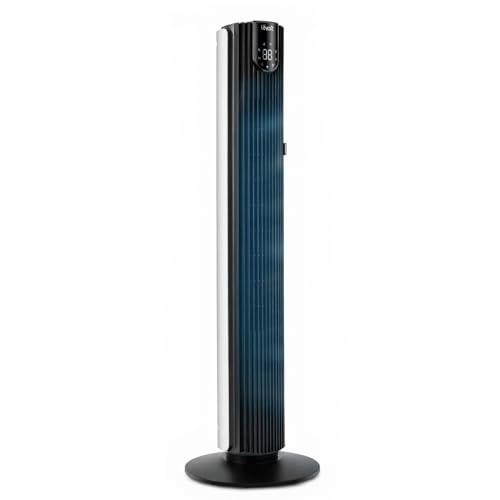
Levoit Core Tower Fan LTF-F422S
Three speeds, an 8-hour timer, and a sleep mode cover the basics without extra frills. At 36.4 inches tall, it runs shorter than most tower fans, which suits smaller rooms and desks. A simple remote and top-panel controls keep day-to-day operation straightforward.
Pros
- Low starting price for the feature set included
- Compact height fits smaller rooms and desks
- Sleep mode noticeably quieter than max speed
Cons
- Only 3 speeds versus 5 to 12 on pricier models
- No oscillation angle adjustment beyond a fixed sweep

Lasko T42951 Wind Curve Tower Fan
Three speeds and a built-in ionizer come at one of the lowest prices in this roundup. Curved housing and widescreen vents spread air across a room instead of a narrow, blast-like stream. A remote and electronic timer add convenience not typically found at this price point.
Pros
- Lowest price of any model in this comparison
- Ionizer option for owners who want it
- Remote and timer included despite the low cost
Cons
- Noticeably louder than the Honeywell or Levoit at similar speeds
- Plastic base feels less stable on hard floors
PELONIS 40 Inch Oscillating Tower Fan PFT40A2ABB
A 40-inch tower housing pairs with a fresh-air ionizer meant to cut dust and odors alongside cooling. Three speeds and 60-degree oscillation cover a bedroom or small living room adequately. A remote handles speed and timer changes from across the room.
Pros
- Ionizer runs independently of fan speed
- Quieter low setting than Lasko’s Wind Curve
- Remote control included at a budget price
Cons
- Narrower 60-degree oscillation than most competitors
- Ionizer effectiveness is hard to verify without lab testing
Side by side
| # | Model | Noise Level | Best for | Score | Price |
|---|---|---|---|---|---|
| 1 | Dyson Purifier Cool TP07 | 40 to 64 dB across 10 settings | Best overall | 9.4 | Check price |
| 2 | Vornado 184 Whole Room Tower Air Circulator | 45 to 61 dB across 4 speeds | Best for large rooms | 9.1 | Check price |
| 3 | Honeywell QuietSet Whole Room Tower Fan HYF290B | 35 to 56 dB across 5 settings | Best quiet/bedroom | 8.8 | Check price |
| 4 | Dreo Cruiser Pro T1 Smart Tower Fan | 30 to 56 dB across 12 speeds | Best smart/app-controlled | 8.5 | Check price |
| 5 | Levoit Core Tower Fan LTF-F422S | 28 to 55 dB across 3 speeds | Best value | 8.3 | Check price |
| 6 | Lasko T42951 Wind Curve Tower Fan | 50 to 60 dB across 3 speeds | Best budget | 8.1 | Check price |
| 7 | PELONIS 40 Inch Oscillating Tower Fan PFT40A2ABB | 35 to 55 dB across 3 speeds | Best with built-in ionizer | 8.0 | Check price |
Questions worth asking
How loud is too loud for a tower fan?
Anything above 60 dB on high speed competes with normal conversation. For background use, look for a low setting under 45 dB; for bedrooms, aim under 40 dB like Honeywell QuietSet’s sleep mode.
What is the best tower fan for a bedroom?
Honeywell QuietSet HYF290B is built for this, with a sleep setting near 35 dB and a remote for nighttime adjustments without getting out of bed.
Are bladeless tower fans actually better than bladed ones?
They’re safer around kids and pets and easier to clean since there’s no blade to dust, but bladed models like the Vornado 184 generally move more air for the same price.
Can a tower fan cool a large living room?
Standard tower fans struggle past 300 square feet. A vortex circulator such as the Vornado 184, rated to move air up to 70 feet, handles open floor plans better.
Is a tower fan worth it compared to a box fan?
Tower fans take up less floor space and often include oscillation, timers, and remotes that box fans lack, though box fans typically move more air per dollar spent.
Which tower fans work with Alexa or Google Assistant?
Dreo’s Cruiser Pro T1 connects to both through the DreoLife app, letting you change speed or set schedules by voice instead of the remote.
How much electricity does a tower fan use?
Most models here draw between 40 and 65 watts on high, similar to a few LED light bulbs, so running one overnight costs very little.
Tower fan vs pedestal fan: which cools a room better?
Pedestal fans often move more air for less money, but tower fans take up a smaller footprint and usually include more speed and timer options at the same price.
Do tower fans with an ionizer actually clean the air?
PELONIS and Lasko both include an ionizer, but their real-world effect on dust and odor is hard to verify without independent lab testing.
Final word
Dyson Purifier Cool TP07 remains the strongest overall pick for anyone who wants cooling and real HEPA filtration in one appliance, especially households dealing with allergies or pet dander. Its price is hard to justify for simple room cooling alone, so budget-focused buyers should look at the Lasko T42951 or Levoit Core Tower Fan instead. Both handle everyday cooling well without the purifier premium.
Dana Whitfield
Dana spent eight years buying and merchandising for a regional kitchenware retailer before moving into editorial work. She has handled thousands of SKUs across cookware, small appliances and kitchen organization, and focuses on the practical differences that matter once a product is actually in daily use.


