Tire Inflators for Cars, SUVs, and Roadside Emergencies
AstroAI’s digital gauge and auto-shutoff make it the top pick for most drivers, reaching 100 PSI through a 12V port. VacLife ATJ-1166 offers solid value for everyday car use, and Ryobi P737 delivers true cordless freedom for tires, bikes, and sports gear.
AstroAI’s Air Compressor tops this list for most drivers, combining a digital gauge with auto-shutoff and a compact build that reaches 100 PSI. VacLife’s ATJ-1166 trades some pressure range for a lower cost, and Ryobi’s P737 skips the cord entirely for cordless use anywhere.
Tire inflators vary more than the spec sheet suggests. A cheap unit can slow down or overheat before finishing all four tires, gauge accuracy differs enough that readings won’t always match your tire, and cordless convenience trades against battery runtime. We compared published inflation speed, gauge type, maximum pressure, power source, and duty-cycle notes against patterns in owner feedback about accuracy and heat.
The shortlist, ranked

AstroAI Air Compressor Tire Inflator
A digital gauge and preset auto-shutoff stop inflation right at your target PSI, without guesswork. Owners report accurate readings and steady output on cars and SUVs. Like most 12V units, it suits topping up tires rather than seating a large truck tire from flat.
Pros
- Accurate digital gauge with auto-shutoff
- Compact build with a built-in LED light
- Steady output across car and SUV tires
Cons
- Best for topping up, not large truck tires
- Corded 12V design limits placement

VacLife ATJ-1166 Tire Inflator
This 12V unit trades some maximum pressure for a lower price, topping out at 50 PSI rather than 100. A digital display makes readings easy to check mid-inflation. Owners report quick top-ups on passenger car tires and dependable performance for daily driving.
Pros
- Lower cost than most rival kits
- Fast top-ups on passenger tires
- Easy-to-read digital display
Cons
- Lower max pressure than higher-end rivals
- Not built for heavy, continuous use
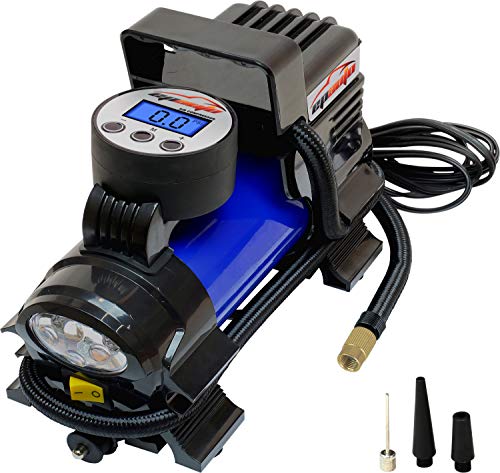
EPAuto 12V Tire Inflator
No app, no Bluetooth, just a straightforward digital readout and a cord that plugs into the power port. Owners report consistent results on routine top-ups across passenger tires. Max pressure caps at 70 PSI, enough for cars but short of what SUVs sometimes want.
Pros
- Simple, dependable operation
- Clear digital readout
- Includes multiple valve adapters
Cons
- Corded only, no battery option
- Basic feature set versus pricier models

Fortem Digital Tire Inflator
A longer hose and bright display target larger passenger vehicles that sit farther from the power port. Preset shutoff stops inflation automatically at 100 PSI. Owners report solid results on SUV tires, though the corded 12V design keeps it tethered to the vehicle.
Pros
- Handles SUV-sized tires well
- Preset shutoff improves accuracy
- Bright display and built-in light
Cons
- Corded 12V operation only
- Slower on very large tires

Ryobi P737 Cordless Inflator
Swapping the cord for an 18V ONE Plus battery means this inflator works away from any vehicle, useful for bikes and sports gear too. Maximum pressure reaches 150 PSI, well above what a car tire needs. Speed depends on which battery pack you have charged and ready.
Pros
- Fully cordless, works anywhere
- 150 PSI max suits bikes and balls too
- Auto-shutoff stops at your target PSI
Cons
- Battery sold separately on most listings
- Inflation speed varies by battery charge

DeWalt DXAEPI Inflator
Two hoses, one high-pressure and one high-volume, cover jobs from tires to larger inflatables in a single unit. Corded or 12V power options add flexibility a single-source inflator lacks. Owners describe it as a garage-and-road tool rather than something built for a glovebox.
Pros
- Corded and 12V power options
- Separate high-volume hose for larger items
- 160 PSI max pressure rating
Cons
- Larger and heavier than compact 12V units
- More capability than most drivers need

Avid Power Cordless Tire Inflator
A built-in rechargeable battery and USB charging keep this inflator ready without hunting for a power port. Owners report it handles car tires, bikes, and balls fine for quick jobs. Runtime per charge favors light top-ups over inflating several large tires back to back.
Pros
- Affordable way into cordless inflation
- USB rechargeable, no separate battery to buy
- Handy for bikes and sports gear
Cons
- Limited runtime per charge
- Better suited to light top-ups
How they stack up
| # | Model | Power | Best for | Score | Price |
|---|---|---|---|---|---|
| 1 | AstroAI Air Compressor Tire Inflator | 12V vehicle power port | Best overall | 9.4 | Check price |
| 2 | VacLife ATJ-1166 Tire Inflator | 12V vehicle power port | Best value | 9.2 | Check price |
| 3 | EPAuto 12V Tire Inflator | 12V vehicle power port | Best simple plug-in | 9.0 | Check price |
| 4 | Fortem Digital Tire Inflator | 12V vehicle power port | Best for SUVs | 8.8 | Check price |
| 5 | Ryobi P737 Cordless Inflator | 18V ONE Plus battery | Best cordless | 8.6 | Check price |
| 6 | DeWalt DXAEPI Inflator | Corded and 12V options | Best multi-power source | 8.3 | Check price |
| 7 | Avid Power Cordless Tire Inflator | Rechargeable built-in battery | Best budget cordless | 8.0 | Check price |
What matters most
Corded, cordless, or 12V: how tire inflators get power A 12V plug-in unit never runs out of charge but tethers you to the vehicle’s power port. Cordless models run on a battery, freeing you to inflate bike tires or sports gear away from any car. Owning a cordless tool platform already, such as Ryobi ONE Plus, means a matching inflator can share batteries you already have. Match the power source to where you’ll actually use the inflator most.
How accurate is the gauge, and does auto-shutoff matter Digital gauges read easier than analog dials and tend to stay consistent between uses. A preset auto-shutoff stops the pump right at your target PSI, cutting the risk of overinflation. Even so, readings vary slightly between units, so spot-checking against a separate trusted gauge is worth doing early on. Accuracy affects tire wear and safety more than raw fill speed does.
Inflation speed, max pressure, and duty cycle Most 12V inflators are built for topping up passenger tires, not seating a large flat truck tire from empty. Running a small unit continuously across several tires can cause it to overheat. Check the max PSI rating against what your tires actually need, and follow any duty-cycle guidance so the motor gets a rest between fills.
Best tire inflator for the trunk, bikes, or a home garage Size, hose length, and extras like an LED light or nozzle adapters decide how well an inflator fits your routine. A compact 12V unit stores easily for roadside emergencies. A larger multi-hose model like the DeWalt DXAEPI suits a garage where versatility beats pocketability. Decide between everyday carry convenience and maximum capability before choosing the form factor.
Questions worth asking
What PSI should my tires be?
Check the sticker inside the driver’s door jamb or the owner’s manual, not the number printed on the tire sidewall. Measure pressure when tires are cold for the most accurate reading.
Are digital tire inflators accurate?
Digital inflators read easily and stay fairly consistent, though accuracy still varies between units. Spot-check against a separate trusted gauge until you know how yours reads.
Can a tire inflator fill a completely flat tire?
Most portable inflators can, though it takes longer than a simple top-up. For large or run-flat tires, check the max pressure rating and duty cycle, and let the unit rest if it heats up.
How long does it take to inflate a tire?
A small top-up often takes a minute or two per tire. A fully flat tire takes longer, depending on the unit’s speed, tire size, and target pressure.
Corded or cordless tire inflator, which is better?
Corded 12V units never run out of charge but stay tethered to the car. Cordless models work anywhere with limited runtime. Pick based on which tradeoff matters more to you.
Can I use a tire inflator for bikes and sports gear?
Yes, most include nozzle adapters for bike tires, balls, and inflatables. Cordless units with higher max pressure, like the Ryobi P737, work especially well away from a vehicle.
Will a tire inflator overheat?
Small units can overheat when run continuously across several large tires. Follow duty-cycle guidance and let the unit rest between fills on bigger jobs.
Do I need auto-shutoff on a tire inflator?
It’s not essential, but a preset auto-shutoff stops inflation at your target PSI automatically, speeding up top-ups and reducing the chance of overfilling.
How do I store a portable tire inflator?
Keep it dry and away from extreme heat, coil the hose and cord neatly, and store cordless models charged. A carrying bag protects the unit and keeps adapters together.
What is the best tire inflator for SUVs?
The Fortem Digital reaches 100 PSI with a longer hose suited to SUV-sized tires, while the AstroAI Air Compressor works well across cars and SUVs alike.
Our take
AstroAI’s Air Compressor remains the strongest all-around pick, pairing an accurate digital gauge with a compact, reliable build. VacLife’s ATJ-1166 suits everyday car use on a tighter budget, and the Ryobi P737 is the one to grab for true cordless freedom across tires, bikes, and gear.
Tony Russo
Tony trained as an automotive technician and spent years in service and parts retail before moving into writing. He focuses on garage tools, car care products and accessories from a hands-on maintenance perspective.


