Tilt Shift Lenses That Keep Verticals Perfectly Straight
Canon’s TS-E 24mm f/3.5L II leads for architecture. It offers 12 mm of shift and tilt that rotates independently. Laowa’s 15mm f/4.5 Zero-D Shift frames wider and ships native to five mounts. Rokinon’s Tilt-Shift 24mm f/3.5 ED AS UMC matches the movement numbers for far less.
Canon’s TS-E 24mm f/3.5L II remains the architecture pick. Twelve millimetres of rise holds verticals parallel, and tilt rotates on its own axis so a level horizon survives an angled focus plane. Manual focus and 780 g of glass are the cost of entry. Sony, Nikon Z and L-mount owners without an adapter should go to the Laowa 15mm f/4.5 Zero-D Shift.
Tilt and shift solve unrelated problems, which is why spec sheets mislead first-time buyers. Shift fixes perspective. Tilt steers where sharpness falls. We compared published movement ranges, image circle diameters, native mount availability, filter threads and minimum focus distance. Owner reports on knob feel and corner quality at full extension settled the close calls.
What we recommend

Canon TS-E 24mm f/3.5L II
Twelve millimetres of rise or fall captures a rooftop without cropping a pixel later. Because tilt rotates separately from shift, you can hold a level horizon while swinging the focus plane into a foreground kerb or lawn. Corners stay usable at maximum extension, which is the entire reason to buy glass like this rather than a transform slider.
Pros
- Tilt and shift rotate on independent axes
- Corner detail holds up at full rise
- Standard 82 mm thread takes a polariser
Cons
- Manual focus only, with no autofocus fallback
- About 780 g, heavy on a gimbal or compact body

Venus Optics Laowa 15mm f/4.5 Zero-D Shift
A 65 mm image circle is what lets a 15 mm design shift 11 mm on full frame without darkening the corners. Zero-D describes its near-absent rectilinear distortion, which pays off when you stitch two opposite shifted frames into one wide file. Laowa sells native versions in Canon RF, Nikon Z, Sony E, L-mount and EF.
Pros
- Native mounts cover five current systems
- Straight lines stitch together without warping
- Front thread accepts ordinary screw-in filters
Cons
- Shift only, with no tilt movement at all
- Aperture is set by hand, with no electronic contacts

Nikon PC-E NIKKOR 24mm f/3.5D ED
Perspective control the Nikon way: 11.5 mm of shift, 8.5 degrees of tilt, and an electromagnetic diaphragm that meters correctly on current bodies. Early samples need a screwdriver to rotate the movements relative to each other, while later units do it tool-free. ED elements keep colour fringing in check out at the frame edges.
Pros
- Electromagnetic aperture meters on modern bodies
- ED glass limits fringing at the edges
- Mounts on Z cameras through the FTZ adapter
Cons
- Movement clearance is tight against some pro bodies
- Reorienting tilt against shift is fiddly on early copies

Canon TS-E 17mm f/4L
Seventeen millimetres plus 12 mm of rise frames an entire room from a doorway, which is why real estate shooters keep one in the bag. Its bulbous front element blocks screw-in filters, so a polariser means a bracket-mounted holder. Tilt tops out at 6.5 degrees, noticeably short of what the 24mm L offers.
Pros
- Captures a full room from one doorway position
- Distortion stays low for such a wide angle
- Matches the 24mm L at 12 mm of shift
Cons
- Curved front glass rules out threaded filters
- Roughly 820 g and awkward to pack

Canon TS-E 90mm f/2.8L Macro
Ten degrees of tilt lays the focus plane across a watch face or a plated dish without stopping down to f/22. Half life-size focusing handles small goods, while 11 mm of shift corrects keystone on tall bottles and boxes. Studio work rewards a geared head here, because a millimetre of movement shifts the framing a lot at 90 mm.
Pros
- Widest tilt in this group at 10 degrees
- Half life-size focusing suits jewellery and packaging
- f/2.8 helps framing under dim set lighting
Cons
- Heaviest lens here at roughly 915 g
- Far too long for interiors or facades

Rokinon Tilt-Shift 24mm f/3.5 ED AS UMC
On paper this matches Canon’s headline figures: 12 mm of shift and 8.5 degrees of tilt from an entirely manual barrel. Complaints from owners centre on inconsistent knob smoothness between samples rather than optics. Canon EF, Nikon F and Sony E versions exist, so it is not locked to one system.
Pros
- Movement range equals far costlier 24 mm options
- Sold in three widely used mounts
- Metal barrel with a long, precise focus throw
Cons
- No electronic contacts, so aperture is manual
- Knob feel varies noticeably between samples
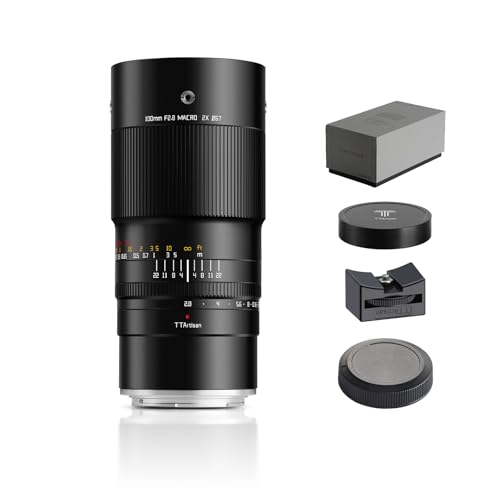
TTArtisan 100mm f/2.8 Tilt-Shift Macro 2x
Two times magnification paired with 8 degrees of tilt opens up selective-plane close-up work at the lowest entry point here. Movements fall short of the Canon 90mm, and every control including aperture is manual. Jewellery, food and hobby macro suit it best, particularly when you want one clean wedge of sharpness rather than a focus-stacked composite.
Pros
- Two times magnification beats most macro primes
- Available in Sony E, Nikon Z, Canon RF and L-mount
- Cheapest way into real tilt movement
Cons
- Shift range trails the L-series options
- Long extension at 2x makes handheld shooting impractical
How to choose
What tilt and shift each do Shift slides the optics parallel to the sensor. Your camera stays level, the frame still reaches the roofline, and verticals never lean inward. Tilt angles the optical axis instead, swinging the plane of focus away from parallel. Architecture and interiors rely on the first movement. Product, food and miniature-look work rely on the second. Plenty of buyers only ever need one, and a shift-only lens like the Laowa 15mm is a legitimate purchase.
Movement range, image circle and mount fit No lens shifts further than its image circle covers. Push past that and corners go dark and smeary. Laowa quotes 65 mm of coverage for its 15 mm lens, which is what supports the full 11 mm on full frame. Canon and Nikon 24 mm designs land between 11.5 mm and 12 mm. Read both figures together, because a large shift number means nothing without coverage behind it. Mount matters just as much: Canon TS-E and Nikon PC-E lenses need an EF-to-RF or FTZ adapter, while Laowa and TTArtisan ship native for mirrorless.
Best for architecture and real estate Interiors reward short focal lengths with generous rise. Fifteen and seventeen millimetre options frame a whole room from a doorway, whereas 24 mm handles facades from across a street. Filter support becomes a real constraint at the wide end, since the Canon 17mm accepts nothing threaded and needs a bracket for a polariser. One more trick pays off outdoors: shoot two frames at opposite shift extremes and stitch them for a wider file than any single lens gives you.
Best for product, food and tabletop work Close-up subjects need tilt far more than rise. Angling the plane of focus across a watch dial or a plated dish keeps detail sharp edge to edge at a moderate aperture, which protects sharpness from diffraction. Canon’s TS-E 90mm f/2.8L Macro tilts 10 degrees and reaches half life-size. TTArtisan’s 100mm pushes to 2x for smaller pieces at a much lower outlay. Avoid ultra-wide shift lenses here, since minimum focus distance and exaggerated perspective both work against you.
Side by side
| # | Model | Mount | Best for | Score | Price |
|---|---|---|---|---|---|
| 1 | Canon TS-E 24mm f/3.5L II | Canon EF | Best overall | 9.4 | Check price |
| 2 | Venus Optics Laowa 15mm f/4.5 Zero-D Shift | 15 mm | Best for wide interiors | 9.2 | Check price |
| 3 | Nikon PC-E NIKKOR 24mm f/3.5D ED | Nikon F | Best for Nikon bodies | 9.0 | Check price |
| 4 | Canon TS-E 17mm f/4L | 17 mm | Best for cramped rooms | 8.8 | Check price |
| 5 | Canon TS-E 90mm f/2.8L Macro | 90 mm | Best for product photography | 8.6 | Check price |
| 6 | Rokinon Tilt-Shift 24mm f/3.5 ED AS UMC | 12 mm each direction | Best value | 8.3 | Check price |
| 7 | TTArtisan 100mm f/2.8 Tilt-Shift Macro 2x | 100 mm | Best budget | 8.0 | Check price |
Frequently asked questions
What is a tilt shift lens used for?
Two separate jobs. Shift corrects converging verticals in architecture, interiors and real estate. Tilt rotates the focus plane, either widening sharpness across an angled subject or narrowing it to a thin band for the miniature look.
Which tilt shift lens is best for architecture?
Canon’s TS-E 24mm f/3.5L II covers most facade work, thanks to 12 mm of shift and independent rotation. Tight interiors are a different problem, and there the TS-E 17mm f/4L or Laowa 15mm f/4.5 Zero-D Shift fits more room into the frame from the same standing spot.
Can you autofocus with a tilt shift lens?
No. Every current model focuses by hand, because moving the optics off axis breaks the geometry autofocus depends on. Magnified live view works well, and focus peaking on mirrorless bodies makes it faster still.
Is a tilt shift lens worth it over correcting perspective in Lightroom?
Software transforms crop the frame and stretch pixels near the edges. Shifting captures that tall part of the scene at full resolution instead. Deliver large architectural files or shoot interiors weekly and the optical route holds detail no slider recovers.
Do tilt shift lenses work on mirrorless cameras?
Yes. Laowa and TTArtisan build native mounts for Sony E, Nikon Z, Canon RF and L-mount. Canon TS-E and Nikon PC-E glass adapts through EF-to-RF and FTZ with aperture control intact.
Tilt shift vs a wide angle lens, which comes first?
Wide angles gather more scene but lean verticals the moment you aim upward. Shift keeps the camera level and still includes the top of a building. Start with the wide angle for general work, then add a shift lens once perspective errors cost you delivered shots.
How much shift do I actually need?
Eight to twelve millimetres covers nearly every building and room. Owners report reaching for full rise mainly on tall facades shot from close range. Past that point, stitching two shifted exposures beats hunting for a bigger movement figure.
What is the best budget tilt shift lens?
Rokinon’s Tilt-Shift 24mm f/3.5 ED AS UMC delivers the same 12 mm shift and 8.5 degree tilt as premium 24 mm glass, in Canon EF, Nikon F and Sony E. Close-up shooters get better value from TTArtisan’s 100mm f/2.8 Tilt-Shift Macro 2x.
Does shifting a lens hurt image quality?
Only when you exceed what the image circle covers. Inside that limit, corner sharpness and vignetting stay close to centred performance on designs like the Canon 24mm L II. Stopping down one stop from wide open cleans up whatever softness remains at full extension.
The verdict
Take the Canon TS-E 24mm f/3.5L II if architecture or interiors pays the bills, since independent tilt rotation and clean corners at full rise solve problems clients actually notice. Mirrorless shooters who would rather skip an adapter should buy the Laowa 15mm f/4.5 Zero-D Shift, native to five mounts and built for stitching. Product and food work points somewhere else entirely: the Canon TS-E 90mm f/2.8L Macro, where 10 degrees of tilt matters far more than rise.
Marcus Chen
Marcus covered consumer electronics for enthusiast tech publications for six years before joining ChoiceCrest. He specializes in translating manufacturer spec sheets into plain-language buying advice, with a focus on audio, computing accessories and smart-home gear.
You might also need

Hanging Folders That Keep Your Files Straight

Portable Bubble Mailers That Keep Up With Your Shipping Habits

Business Card Holders for Home Office: Keep Your Desk Tidy
