Which Thermal Camera Actually Finds Hidden Leaks?
The FLIR C3-X is the overall pick for a standalone pocket camera with usable resolution and a clear touchscreen. The TOPDON TC001 gives phone users detector performance for far less, and the HIKMICRO Pocket2 offers higher resolution for trades doing survey work.
Most buyers should choose the FLIR C3-X, a self contained camera with a screen, a usable detector and no dependency on a phone staying charged. The TOPDON TC001 is the value route for anyone happy to plug into a phone. Trades producing survey reports get more detector pixels and on device annotation from the HIKMICRO Pocket2.
Thermal imaging is easy to buy badly because the marketing number is usually the screen resolution rather than the detector resolution, and those can differ by a factor of ten. A small detector interpolates a smooth image that hides the temperature differences you were trying to find. We compared detector resolution, stated sensitivity in millikelvin, temperature ranges, refresh rates, standalone versus phone attached designs and reporting features, then weighed those against what owners report about damp, insulation gaps and electrical inspection.
Before you buy
What resolution number actually matters Listings often lead with display resolution, which says nothing about what a camera can see. Look for the detector or sensor resolution, written as something like 160 by 120 or 256 by 192. Everything above that figure is interpolation, smoothing the image without adding real information. More detector pixels means you can stand further back and still resolve a small hot spot rather than averaging it away.
Why thermal sensitivity decides what shows up at all Sensitivity is quoted in millikelvin, and lower numbers are better. A camera rated below fifty millikelvin can separate the small differences that reveal a draught at a window seal or a slightly damp patch of plaster. A less sensitive detector shows a radiator or hot pipe clearly and misses subtle problems entirely. Weigh sensitivity above almost everything else if insulation and damp are the reason for buying.
Standalone or phone attached, which fits your use Phone attachments provide a large screen, plenty of storage and a familiar interface for lower cost, but they stop working when the phone is cold, wet or flat. Standalone cameras cost more and simply work, which counts in a loft, crawl space or on a ladder. Trades who image daily tend to end up with a standalone unit, while homeowners diagnosing one or two problems a year are well served by an attachment.
Emissivity and reflection can mislead a reading Thermal cameras read emitted infrared, and shiny surfaces such as bare metal, foil and glass emit poorly while reflecting the temperature of nearby objects, including you. A polished pipe can read far cooler than it actually is. Cameras with adjustable emissivity settings let you compensate, and a strip of matte tape on a shiny target gives a far more honest reading. Treat absolute temperature numbers as approximate unless emissivity has been controlled for.
The shortlist, ranked
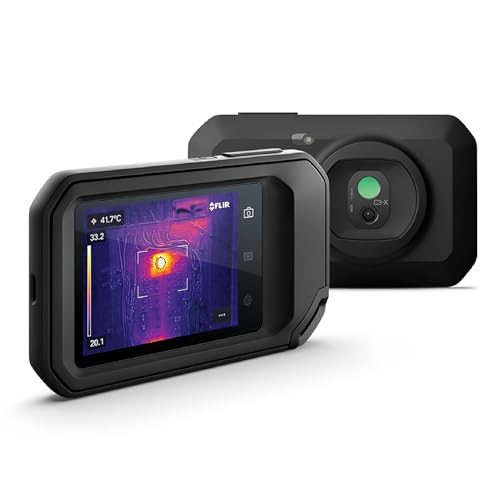
FLIR C3-X Compact Thermal Camera
This is a complete pocket camera rather than a phone accessory, powering up, imaging and storing without anything else in the loop, which matters on a ladder or in a loft. FLIR’s image blending overlays visible edges onto the thermal picture, turning a warm smudge into an identifiable pipe run or stud line. The detector is modest by professional standards, better at finding problems than measuring them precisely at distance.
Pros
- Works standalone with no phone required
- Visible edge blending makes images readable
- Pocket sized with a usable touchscreen
Cons
- Detector resolution is modest for survey work
- Costs more than phone attached rivals

TOPDON TC001 Thermal Imaging Camera
Plugging directly into a phone provides a large bright screen and processing power without paying for either, and the detector inside outperforms the price. It suits finding underfloor heating runs, missing insulation and overheating connections around a home. There is no battery to charge and no screen to break, though the phone it attaches to drains faster and the exposed connector needs care in a tool bag.
Pros
- Strong detector resolution for the outlay
- No separate battery to keep charged
- Uses your phone screen and storage
Cons
- Depends on a compatible charged phone
- Exposed connector needs protecting in a bag

HIKMICRO Pocket2 Thermal Camera
A higher pixel count detector pairs with a visible camera and a proper touchscreen, the combination that makes reportable images rather than merely suggestive ones. On device annotation and image fusion let a surveyor capture, mark and export without a laptop nearby. It runs chunkier than a phone attachment, and getting full value from the extra resolution means learning how emissivity settings change readings.
Pros
- Reportable image quality for professional use
- Annotation and fusion handled on the device
- Self contained with internal storage
Cons
- Bulkier than a phone attachment
- Emissivity settings take learning to use well
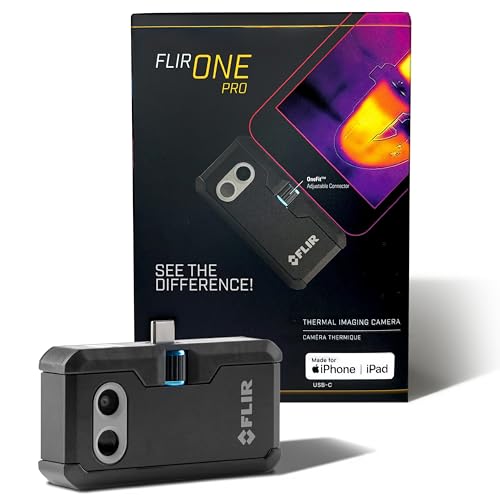
FLIR ONE Pro
The ONE Pro is the established phone attached option, sold in both Lightning and USB C versions with its own internal battery so it does not drain the phone it plugs into. Image quality benefits from FLIR’s visible blending, still the clearest way to identify what a scan is showing. An adjustable connector accommodates thicker cases, though owners report the small battery needs its own charging routine and the plastic housing is not built for site abuse.
Pros
- Available for both iPhone and Android
- Own battery so the phone is not drained
- Visible blending aids identification
Cons
- Small battery needs its own charging routine
- Housing is not built for rough site use

InfiRay P2 Pro Thermal Camera
An included macro lens is the reason to pick this one, letting you image individual components on a circuit board instead of a whole appliance, which is the difference between finding a fault and just confirming something feels warm. It stays small enough to live in a pocket permanently. A narrow default field of view means stepping back further for room scale work, and the software trails larger established brands.
Pros
- Macro lens enables board level inspection
- Very small and easy to carry always
- Good detector count for the size
Cons
- Narrow field of view for whole room scans
- App experience trails larger brands

Seek Thermal CompactPRO
Seek packs an unusually high pixel count into a phone attachment, which pays off when a target sits far away, such as a roof line or overhead cable run where every pixel covers more area. A manually adjustable lens sharpens focus on the actual subject instead of a fixed setting. The trade off is a slower refresh rate that lags when panning quickly, plus an app that owners report as functional rather than pleasant.
Pros
- Highest pixel count in this comparison
- Manual focus sharpens distant targets
- Pocket sized with protective case
Cons
- Low refresh rate lags when panning
- App is dated compared with rivals
HIKMICRO B20 Thermal Imaging Camera
Shaped like a tool rather than a gadget, the B20 has a pistol grip, a robust body and a screen sized to be read at arm’s length in poor light, suiting electrical and mechanical inspection rounds. A built in torch and laser pointer help identify which of several similar components has been highlighted. It runs the bulkiest option here by a distance, and that grip form makes casual carry awkward.
Pros
- Built for repeated site handling
- Large screen readable at arm’s length
- Torch and laser aid identification
Cons
- Far too bulky for pocket carry
- Overspecified for occasional home use
How they compare
| # | Model | Detector | Best for | Score | Price |
|---|---|---|---|---|---|
| 1 | FLIR C3-X Compact Thermal Camera | 128 by 96 thermal resolution | Best overall | 9.4 | Check price |
| 2 | TOPDON TC001 Thermal Imaging Camera | 256 by 192 thermal resolution | Best value | 9.2 | Check price |
| 3 | HIKMICRO Pocket2 Thermal Camera | 256 by 192 thermal resolution | Best for trade survey work | 9.0 | Check price |
| 4 | FLIR ONE Pro | 160 by 120 thermal resolution | Best for iPhone users | 8.7 | Check price |
| 5 | InfiRay P2 Pro Thermal Camera | 256 by 192 thermal resolution | Best for close inspection | 8.5 | Check price |
| 6 | Seek Thermal CompactPRO | 320 by 240 thermal resolution | Best for detail at distance | 8.2 | Check price |
| 7 | HIKMICRO B20 Thermal Imaging Camera | 256 by 192 thermal resolution | Best for site durability | 8.0 | Check price |
Frequently asked questions
Can a thermal camera see through walls?
No, it reads surface temperature only. What it shows is the effect of what sits behind a surface, so a cold stripe on a ceiling can reveal a joist with missing insulation beside it, and a warm line on a floor can trace a heating pipe. That is often just as useful.
Will a thermal camera find damp in a wall?
It finds temperature differences caused by evaporation, so damp areas usually read cooler than dry surroundings. It cannot confirm moisture alone, which is why surveyors follow up with a moisture meter. Used together, the camera finds where to test and the meter confirms it.
What resolution do I need for home inspections?
For draughts, insulation gaps and heating runs at close range, a detector around 160 by 120 is workable and 256 by 192 is comfortable. Go higher only for identifying small targets from a distance, such as connections in a live panel or components on a roof.
Why does my thermal camera click while imaging?
That is the shutter performing a non uniformity correction, recalibrating the detector against a known reference. The image briefly freezes during it. It is normal and necessary, and cameras that do it less often tend to drift more between corrections.
Are phone attached thermal cameras accurate enough?
For relative comparison, which covers most inspection work, yes. For absolute temperature measurement to report a specific figure, a standalone camera with adjustable emissivity and a documented accuracy specification is the more defensible choice.
What does refresh rate affect on a thermal camera?
It controls how smoothly the image updates while you move. Cameras limited to around nine frames per second smear when panning quickly, which is fine for static inspection and frustrating for scanning a large area. Export restrictions are the reason many consumer models sit at that limit.
Can I use a thermal camera to check an electrical panel?
You can look for connections running hotter than their neighbors, a common early sign of a loose termination. Opening a live panel is work for a qualified electrician, so leave cover removal and any remedial work to them and use the camera only where you are competent and safe.
Does outdoor temperature affect thermal survey results?
Considerably. Insulation and draught surveys work best with a meaningful difference between inside and outside, ideally around ten degrees or more, which is why heat loss surveys happen in cold weather. On a mild day, the contrast that reveals a problem simply is not there.
FLIR vs HIKMICRO, which brand is better for trade work?
FLIR’s C3-X wins on simplicity and standalone reliability, while HIKMICRO’s Pocket2 wins on raw detector resolution and on device reporting tools. A surveyor producing client reports daily leans HIKMICRO; someone doing occasional standalone checks leans FLIR.
Is a thermal camera worth it for a single home inspection?
For one off use, a phone attached model like the TOPDON TC001 covers most household diagnostics at a fraction of a standalone camera’s cost. Buy standalone only if imaging becomes a recurring task rather than a single project.
Our pick
For a camera that works on its own and produces images you can actually interpret, the FLIR C3-X is the sensible default. Anyone comfortable working through a phone gets more detector resolution for far less outlay from the TOPDON TC001, which covers most household diagnostics. Trades needing reportable images and on device annotation should step up to the HIKMICRO Pocket2.
Jake Monroe
Jake worked as a residential contractor for over a decade before shifting to full-time writing. He evaluates power tools, hand tools and workshop gear through the lens of someone who has actually used them on job sites, not just read the box.


