How Tang, Steel and Grind Shape a Survival Knife’s Toughness
Morakniv Garberg leads for its full tang and easy-to-sharpen scandi grind. ESEE 6P outperforms it for batoning and heavy chopping thanks to thick 1095 steel. Morakniv Companion Heavy Duty covers core camp tasks at the lowest cost, proving a three quarter tang still handles everyday cutting well.
Morakniv Garberg tops this roundup: a full tang plus a scandi grind gives it the best balance of strength and easy field sharpening. Reach for the ESEE 6P when batoning and splitting dominate a trip, since thicker 1095 steel absorbs more abuse. Budget shoppers still get real capability from the Morakniv Companion Heavy Duty, which trades tang length for a lower cost.
Picking a survival knife gets confusing once serrations, hollow handles and marketing language enter the picture. None of those details predict whether a blade survives a season of hard use. Tang construction decides how much lateral force a knife tolerates before it snaps. We compared blade steel composition and hardness, tang type, grind shape, sheath retention and what owners report about rust resistance and edge retention to rank the seven knives below.
Our top picks

Morakniv Garberg Full Tang Fixed Blade
Morakniv paired its classic scandi grind with a genuine full tang on the Garberg, something earlier Mora knives skipped. Sandvik 14C28N stainless resists corrosion in damp forest conditions, and a squared spine throws sparks off a ferro rod. Owners report it replaces the need for a second, heavier duty blade in general fieldwork.
Pros
- Full tang handles batoning and lateral prying loads
- Scandi grind resharpens easily with just a flat stone
- Squared spine strikes a ferro rod without a separate striker
Cons
- Scandi edge is not the best choice for fine slicing
- Sheath is basic polymer rather than leather or kydex

ESEE 6P Fixed Blade Knife
ESEE machines the 6P from thick 1095 carbon steel and backs it with an unconditional replacement warranty. Extra blade length adds real leverage for splitting wood and heavy camp chopping. A flat grind slices more cleanly than most survival blades this thick, though bare carbon steel needs regular oiling.
Pros
- Full tang and thick stock absorb batoning and prying abuse
- Flat grind slices better than typical thick survival blades
- Unconditional warranty covers breakage or defects
Cons
- 1095 carbon steel rusts quickly without maintenance
- Weight makes it a poor choice for lightweight backpacking

KA-BAR Becker BK2 Campanion
At a quarter inch thick, the BK2’s spine sits closer to a small hatchet than a typical knife blade. That mass splits kindling and processes firewood with fewer strikes. A Grivory handle fills the hand and stays grippy once wet, and owners report the extra weight is worth it for a base camp or vehicle knife.
Pros
- Thick spine takes serious batoning without flexing
- Grivory handle stays grippy in wet conditions
- Doubles as a light chopping tool around camp
Cons
- Heavy relative to its 5.25 inch blade length
- Thick edge geometry makes fine cutting awkward
Benchmade Bushcrafter 162
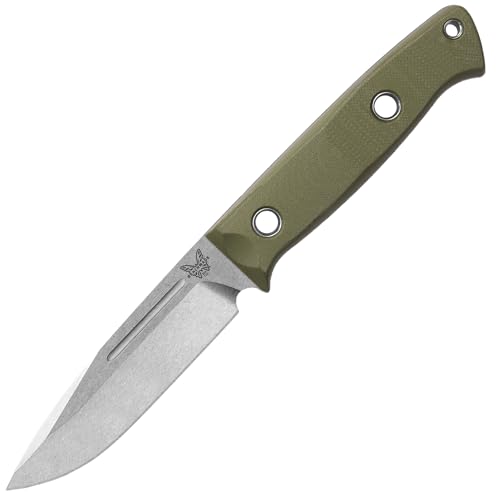
Benchmade grinds the Bushcrafter from CPM-S30V stainless in a high flat profile built for woodcraft precision. Edge retention and slicing ability both beat the tool steel blades on this list. A contoured G10 handle and drainage vented leather sheath round out a noticeably finer finish, and based on specifications the knife targets detail carving over rough abuse.
Pros
- CPM-S30V holds an edge longer than tool steel rivals
- Contoured G10 handle suits long carving sessions
- Leather sheath with drainage is included
Cons
- S30V needs proper stones to resharpen well
- Premium build asks for a bigger investment than the rest of this lineup

Gerber StrongArm Fixed Blade Knife
Gerber built the StrongArm’s sheath to mount horizontally, vertically or onto MOLLE webbing without extra hardware. That flexibility matters when the knife rides a pack rather than a belt. A rubberized diamond texture handle keeps grip secure with gloves on, and owners report the pommel sees regular use for breaking glass or driving tent stakes.
Pros
- Sheath mounts multiple ways without added parts
- Textured grip performs well wet or gloved
- Striking pommel adds real field utility
Cons
- 420HC steel dulls faster than the premium steels here
- Partial serration on some versions limits carving control

Schrade SCHF9 Extreme Survival Knife
Schrade builds the SCHF9 as a thick slab of 1095 with a nearly seven inch edge, trading refinement for extra chopping reach. Fit and finish trail the rest of this list, and the stock sheath is the weakest link. Owners report the blade itself absorbs heavy abuse and earns a permanent spot in a truck or bug-out bag.
Pros
- Length and mass deliver genuine chopping power
- Full tang construction handles hard use
- Strong capability for the size of blade offered
Cons
- Stock sheath retention is mediocre out of the box
- Size and weight make it unwieldy for detail work

Morakniv Companion Heavy Duty
A thicker spine than the standard Companion adds backbone for light batoning on small rounds, while the scandi grind stays easy to keep sharp. Rubber handle scales grip reliably in cold, wet weather. Owners report buying several: one for a pack, one for a car, one for the workshop.
Pros
- Excellent cutting performance for a simple, affordable knife
- Scandi grind resharpens easily on a basic stone
- Rubber handle performs well in cold and wet weather
Cons
- Three quarter tang is not built for hard prying
- Included plastic sheath lacks refinement
Side by side
| # | Model | Blade steel | Best for | Score | Price |
|---|---|---|---|---|---|
| 1 | Morakniv Garberg Full Tang Fixed Blade | Sandvik 14C28N stainless | Best overall | 9.4 | Check price |
| 2 | ESEE 6P Fixed Blade Knife | 1095 carbon steel | Best for batoning and heavy chores | 9.2 | Check price |
| 3 | KA-BAR Becker BK2 Campanion | 1095 Cro-Van carbon | Best for camp chopping | 9.0 | Check price |
| 4 | Benchmade Bushcrafter 162 | CPM-S30V stainless | Best for detailed bushcraft carving | 8.8 | Check price |
| 5 | Gerber StrongArm Fixed Blade Knife | 420HC stainless | Best modular sheath system | 8.6 | Check price |
| 6 | Schrade SCHF9 Extreme Survival Knife | 1095 high carbon | Best for maximum chopping reach | 8.3 | Check price |
| 7 | Morakniv Companion Heavy Duty | Carbon or stainless options | Best budget | 8.0 | Check price |
What to look for
What does full tang actually mean for a knife? Full tang steel runs the entire length of the handle in one piece. Riveted or bolted scales attach to that spine, not a thin rod. Whether a knife survives batoning or snaps under lateral force comes down to this spec. Avoid rat tail and narrow partial tangs if hard prying is on the agenda. Concentrated at the wrong point, a hollow handle storing matches or fishing line weakens exactly where strength matters most.
Carbon steel vs stainless: which lasts longer outdoors? 1095 carbon steel, found in the ESEE 6P and Schrade SCHF9, sharpens fast and throws sparks off a ferro rod. Left wet for even a day, though, it develops surface rust. Sandvik 14C28N and CPM-S30V trade some of that easy sharpening for real corrosion resistance. Coastal and humid climates favor stainless for exactly that reason. Owners who oil a carbon blade after each outing rarely see more than a stable gray patina.
Which grind is best for carving, slicing or chopping? Scandi grinds use one wide bevel that bites into wood and resharpens freehand on a flat stone. Flat grinds, like the Benchmade Bushcrafter’s, slice more cleanly through rope, cordage and food. For raw chopping power, a convex edge holds up best since it has no shoulder to chip. Which geometry wins depends on whether carving, slicing or chopping happens most often. No single grind covers every task equally well.
Is sheath quality something you should check first? A knife that slips loose on a hike is a knife you will lose. Look for positive click retention and a drainage hole so trapped water cannot pit the blade overnight. Backpackers who mount a knife on pack webbing need a MOLLE compatible design like the StrongArm’s. Truck and bug-out-bag knives, left in one spot, can get by with a simpler belt sheath. Kydex upgrades solve most retention complaints without replacing the whole knife.
Questions worth asking
What blade length works best for a survival knife?
Four to six inches suits most outdoor tasks. Shorter blades handle carving and food prep with more control. Longer blades add leverage for batoning and chopping. Past seven inches, weight and reduced fine control start to outweigh the extra reach.
Should a survival knife have serrations?
Plain edges are usually the better default. Serrations cut rope and fibrous material well but resist sharpening in the field. A full flat or scandi edge covers carving, food prep and general cutting without that trade-off. Carry a small saw separately if cordage cutting comes up often.
Is a full tang necessary for a survival knife?
For batoning or prying, yes, a full tang matters. Three quarter tang knives like the Morakniv Companion still handle everyday cutting and light kindling splitting well. Choose full tang only if hard leverage tasks are actually part of your plan. Otherwise a lighter partial tang saves weight without giving up much.
How do you keep a carbon steel blade from rusting?
Dry the blade immediately after use, especially after cutting anything acidic. Apply a thin coat of mineral oil or a dedicated blade oil before storing it. Avoid leaving a carbon blade inside a damp leather sheath overnight. A stable gray patina that forms over weeks actually adds some rust protection.
Which steel holds an edge the longest?
Based on specifications, CPM-S30V in the Benchmade Bushcrafter outlasts the rest of this group at the edge. Sandvik 14C28N in the Garberg comes next, with strong corrosion resistance too. Tool steels like 1095 dull sooner but return to sharp with just a basic stone. That trade-off matters more the farther you are from a sharpening kit.
Can you baton wood safely with these knives?
Full tang models here, including the Garberg, ESEE 6P, BK2, Bushcrafter, StrongArm and SCHF9, are built for batoning. Strike the spine, not the edge, and keep hands clear of the swing path. The Companion Heavy Duty handles light batoning on small rounds only. Repeatedly splitting large logs is not what its three quarter tang was designed for.
How often should a survival knife be sharpened?
Touch up the edge as soon as it stops catching a fingernail or slicing paper smoothly. Regular weekend use might call for a light strop every few outings. Frequent, light maintenance takes less effort than restoring a fully dulled edge later. Scandi grinds especially reward this little and often approach.
Are fixed blade knives legal to carry?
Rules differ by country, state and sometimes city, so no single answer applies everywhere. Many jurisdictions separate lawful outdoor transport from everyday concealed carry. Blade length limits and locking mechanisms often factor into local law too. Check current regulations for your area and any place you plan to travel before packing one.
What is the difference between a scandi grind and a flat grind?
A scandi grind uses one wide bevel running straight to the edge, which resharpens easily freehand. A flat grind tapers from the spine to the edge in a single slope, cutting more cleanly through rope and food. Scandi suits wood carving and bushcraft tasks best. Flat grinds trade some of that wood biting bite for smoother all-purpose slicing.
Final word
Morakniv Garberg remains the knife most people should buy first, since a full tang, corrosion resistant steel and an easy to maintain edge cover nearly every survival task. Choose the ESEE 6P instead if batoning and heavy camp chores dominate your trips, or the Benchmade Bushcrafter 162 for detailed bushcraft carving with premium steel. Morakniv Companion Heavy Duty confirms that real capability does not require a full tang or premium materials.
Sierra Daniels
Sierra's background is in landscape design and nursery retail. She focuses on lawn and garden equipment, outdoor furniture and gear durability, weighing published specs against how materials actually hold up outside.