How to Choose a Subwoofer That Matches Your Room Size
Klipsch’s R-120SW leads this lineup with a 12-inch driver and 400-watt amplifier that pressurizes medium to large rooms. The SVS SB-1000 Pro follows for sealed-cabinet accuracy suited to music, while the Polk Audio PSW10 remains the smartest pick for smaller rooms and first-time buyers on a modest budget.
Most buyers want one number: which subwoofer to buy. For most rooms, that is the Klipsch R-120SW, thanks to its 12-inch driver and 400-watt amplifier. Tighter budgets and smaller rooms point toward the Polk Audio PSW10, while listeners who prioritize musical accuracy over raw slam should look at the SVS SB-1000 Pro.
Specs alone rarely predict how a subwoofer performs, since amplifier power, cabinet size, and port tuning all interact with the room it sits in. We compared published specifications across all seven models, matched driver size and enclosure type to realistic room sizes, and cross-checked long-term owner feedback on reliability and output consistency rather than relying on marketing copy.
The shortlist, ranked

Klipsch R-120SW
A 12-inch copper-spun driver pairs with a 400-watt amplifier to move serious air in medium and large rooms. Front-firing ported design keeps setup simple near a wall or in an open cabinet. Owners report it stays controlled even when pushed loud during action scenes.
Pros
- Deep low end reaches down to 29 Hz for full-range movie effects
- 400-watt amplifier stays clean at high volume, per owner feedback
- Front-firing port simplifies placement in a cabinet or against a wall
Cons
- Cabinet size demands real floor space in smaller rooms
- Ported tuning can sound heavy in rooms under 150 square feet

SVS SB-1000 Pro
This sealed 12-inch sub trades raw slam for speed and control, which favors basslines and acoustic detail. A companion app adjusts EQ and room correction from a phone or tablet. According to the listing, the amplifier delivers 325 watts continuous power, well above typical sealed subs its size.
Pros
- Sealed cabinet delivers tight, well-controlled bass for music
- App-based DSP tuning corrects for room modes without extra gear
- Compact footprint fits bookshelf systems and smaller listening rooms
Cons
- Sealed design reaches less deep than similarly priced ported subs
- App setup adds a step that ported models skip entirely
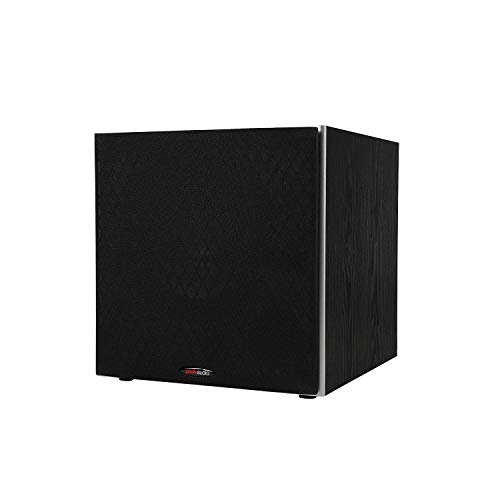
Polk Audio PSW10
A 10-inch driver and 100-watt amplifier add noticeable depth to a modest stereo or surround setup. Front-firing ported cabinet keeps the footprint small enough for an apartment corner. Long-term owners frequently mention it still runs reliably years after purchase.
Pros
- Compact 10-inch cabinet suits apartments and small living rooms
- Reliable long-term performance according to owner reviews
- Simple single-cable hookup for beginners
Cons
- Output tops out earlier than 12-inch alternatives
- Frequency response stops at 40 Hz, short of true low-bass extension
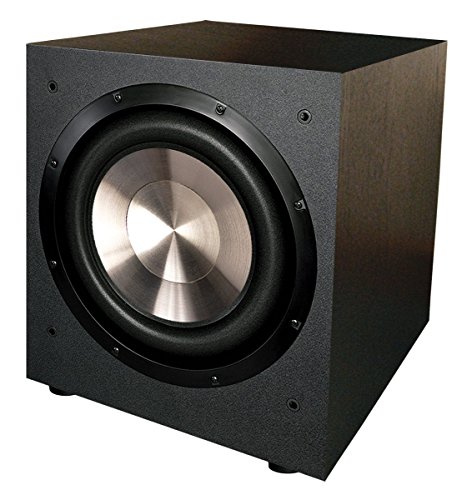
BIC America F12
An oversized 12-inch driver and 475-watt peak amplifier push serious volume into open floor plans. Adjustable crossover and phase controls help tune output to a specific listening position. Enthusiast forums frequently cite it as strong value for the sheer output it generates.
Pros
- 475-watt peak amplifier pressurizes rooms over 300 square feet
- Adjustable phase control smooths bass at the main seating position
- Wide 25 to 200 Hz frequency response covers movies and music
Cons
- Large cabinet is hard to hide in an open room
- Loose tuning without careful placement, according to owner reports

Klipsch R-100SW
A 10-inch driver keeps the Klipsch house sound in a smaller cabinet than the R-120SW. Peak amplifier power reaches 300 watts, enough for punchy bass without demanding the floor space a 12-inch sub needs. It suits mid-size rooms where a full 12-inch model would feel oversized.
Pros
- Smaller cabinet than the R-120SW fits tighter room layouts
- 300-watt peak amplifier still delivers punchy, energetic bass
- Front-firing port allows placement near furniture or a wall
Cons
- Frequency response tops out at 120 Hz, same ceiling as its bigger sibling
- Less low-end extension than 12-inch models in the lineup

Yamaha NS-SW100
An 8-inch driver and Twisted Flare Port cut airflow noise at moderate volumes, which matters behind shared walls. Its 100-watt amplifier adds low-end weight without needing to run loud. Yamaha designed the low-profile cabinet to slide under furniture in tight living rooms.
Pros
- Twisted Flare Port design reduces chuffing noise at low volume
- Low-profile cabinet fits under furniture in small apartments
- Quiet operation suits shared walls and late-night listening
Cons
- 8-inch driver limits maximum output compared to 10- or 12-inch subs
- Not built for large rooms or loud home theater use
Sony SACS9
A 10-inch driver and 115-watt amplifier round out an entry-level surround or stereo system. Single-cable RCA hookup keeps setup approachable for a first subwoofer purchase. Owners note it forgives imperfect placement better than pricier, more particular models.
Pros
- Straightforward RCA connection suits a first home theater system
- 10-inch driver adds noticeable bass without a steep price jump
- Forgiving of imperfect placement, per owner feedback
Cons
- Output ceiling is modest for demanding action scenes
- Lacks the tuning controls found on pricier models
How to pick the right one
How to size a subwoofer for your room Room volume drives this decision more than any spec sheet. Small rooms under 150 square feet usually do well with an 8- or 10-inch driver, since a bigger sub can overload the space. Medium and large rooms benefit from a 12-inch driver paired with 300 watts or more, which pressurizes the air without straining. Oversizing rarely hurts sound quality, but an undersized sub almost always leaves listeners turning the volume knob past its comfort zone.
Sealed vs ported subwoofers: which fits your listening habits Sealed cabinets, like the SVS SB-1000 Pro, produce tighter and more controlled bass that suits basslines and acoustic detail. Ported cabinets move more air, which adds output and lower reach that many people prefer for movie soundtracks. Neither type wins across every use case. Match the choice to what you play most and how loud you typically listen, then accept the trade-off between precision and raw impact.
Placement and tuning tips for smoother, less boomy bass Even a well-built subwoofer can sound uneven in the wrong spot. Corners increase output but often add boom, while pulling the cabinet a foot or two from the wall usually smooths the response. Phase, crossover, and app-based tuning controls, where available, deserve real adjustment time from the main seating position. Owners across multiple brands report that placement changes improve results more than swapping to a bigger sub.
Matching subwoofer connections to your receiver or soundbar Most home subwoofers connect through a single line-level RCA or LFE input from an AV receiver, which is the simplest setup path. Stereo amplifiers without a dedicated subwoofer output require a sub that also accepts speaker-level inputs instead. Soundbars complicate the picture further, since many only pair with a matching wireless sub rather than a standalone model. Checking these connection details before ordering avoids a mismatch on setup day.
Compared at a glance
| # | Model | Driver size | Best for | Score | Price |
|---|---|---|---|---|---|
| 1 | Klipsch R-120SW | 12 inches | Best overall | 9.4 | Check price |
| 2 | SVS SB-1000 Pro | 12 inches | Best for music accuracy | 9.2 | Check price |
| 3 | Polk Audio PSW10 | 10 inches | Best budget | 8.9 | Check price |
| 4 | BIC America F12 | 12 inches | Best for large rooms | 8.7 | Check price |
| 5 | Klipsch R-100SW | 10 inches | Best compact 10-inch | 8.5 | Check price |
| 6 | Yamaha NS-SW100 | 8 inches | Best for apartments | 8.2 | Check price |
| 7 | Sony SACS9 | 10 inches | Best for beginners | 8.0 | Check price |
Good to know
What size subwoofer do I need for my room?
Match driver size to floor area more than personal preference. An 8- or 10-inch driver suits rooms under about 150 square feet, while a 12-inch driver with 300 watts or more handles larger or open-plan spaces better.
Is a sealed or ported subwoofer better for movies?
Ported subwoofers generally win for movies because they move more air and reach lower frequencies at higher output. Sealed models trade some of that slam for tighter, more accurate bass that favors music.
How many watts does a good subwoofer amplifier need?
Small rooms rarely need more than 100 watts of continuous power. Rooms over 300 square feet benefit from 300 watts or more so the amplifier stays clean instead of straining at higher volumes.
Where is the best place to put a subwoofer?
Start near the front of the room, close to the main speakers. Corners raise output but can sound boomy, so pulling the cabinet away from walls often produces smoother, more even bass.
Can one subwoofer fill a large room by itself?
A 12-inch sub with a strong amplifier, like the BIC America F12, can pressurize most large rooms alone. Very big or irregularly shaped rooms sometimes need two subs for even bass across every seat.
Do I need a receiver with a subwoofer output to use one?
It is the simplest route, since most subwoofers accept a single RCA cable from a receiver’s LFE output. Stereo amplifiers without that output need a sub that also accepts speaker-level connections.
Klipsch R-120SW vs SVS SB-1000 Pro: which is the better choice?
The R-120SW moves more air and reaches lower for home theater impact, while the SB-1000 Pro delivers tighter, more accurate bass suited to music. Pick based on whether movies or music get more listening time.
Are expensive subwoofers actually worth it?
Not automatically. Pricier models often add app-based tuning, sealed cabinets, and refined amplifiers, but a budget option like the Polk Audio PSW10 can outperform the need in a small room where extreme output goes unused.
Why does my subwoofer sound boomy?
Boomy bass usually traces back to corner placement or an over-boosted level setting. Move the cabinet away from corners, lower the gain slightly, and set the crossover to match your main speakers’ low-frequency limit.
Do subwoofers work with a soundbar?
Many soundbars only pair with their matching wireless subwoofer rather than a standalone model. Adding a separate home-theater sub usually requires a receiver or a soundbar with a compatible line-level output.
The bottom line
Room size and listening habits decide this choice more than any single spec. The Klipsch R-120SW covers most homes with room-filling output, the SVS SB-1000 Pro rewards listeners who prioritize musical accuracy, and the Polk Audio PSW10 remains the practical pick for smaller rooms and first subwoofer purchases.
Marcus Chen
Marcus covered consumer electronics for enthusiast tech publications for six years before joining ChoiceCrest. He specializes in translating manufacturer spec sheets into plain-language buying advice, with a focus on audio, computing accessories and smart-home gear.
You might also need
How to Choose a Laptop Stand for All Day Typing
How to Choose a Gaming Headset for Your Setup
How to Troubleshoot Wireless Earbuds That Keep Cutting Out
