Spice Drawer Inserts for Finding Jars at a Glance
The YouCopia SpiceSteps Drawer Organizer suits most standard drawers, angling jars upward in tiers so labels stay visible from above. Buyers remodeling cabinetry do better with the Rev-A-Shelf wood insert, while anyone on a budget fits well with the mDesign expandable tray.
The YouCopia SpiceSteps Drawer Organizer leads this list because its stepped tiers angle every jar label toward the ceiling, so opening the drawer shows every spice at once instead of just the top row. Its main limitation is a shallow design, which needs a drawer with enough depth to stack the tiers properly.
We compared tier design, drawer depth requirements and jar capacity across product listings and owner feedback rather than installing each insert in our own kitchen.
How to pick the right one
What to look for in a spice drawer insert Drawer depth decides whether a stepped, tiered design will fit at all, since shallow drawers need a flatter tray instead. Jar capacity matters for anyone with a large spice collection, where a dense grid layout fits more jars than a slim two-tier insert. Material affects both durability and cost, with wood inserts built for remodels costing more than plastic drop-in trays.
Stepped tiers versus flat grid layouts A stepped insert, like YouCopia’s SpiceSteps, angles every label toward the person opening the drawer for faster scanning. A flat grid, such as the SpiceLiner or Spectrum Diversified design, trades that angled visibility for fitting more jars or a shallower drawer. Combining both traits, as the OXO expandable tiered organizer does, suits a drawer with mixed jar heights that need some angle without full depth.
Fitting narrow, shallow or custom drawer sizes Narrow drawers do better with a slim two-tier insert like Lynk’s rather than a wide multi-row tray built for standard widths. Shallow drawers need a flat design like the SpiceLiner, since stepped tiers require clearance a shallow drawer cannot provide. Expandable organizers, including mDesign’s and OXO’s, adjust to a range of widths without needing an exact custom measurement first.
Drop-in trays versus built-in cabinetry inserts A plastic drop-in tray works in an existing drawer without any installation, suited to renters or anyone not remodeling. A wood insert like Rev-A-Shelf’s installs into the drawer box itself during a kitchen remodel, giving a permanent built-in look. Choosing between the two comes down to whether the drawer itself is being replaced or just organized as-is.
Our top picks

YouCopia SpiceSteps Drawer Organizer
Stepped tiers raise the back row of jars higher than the front row, angling every label toward the person opening the drawer. The plastic tray holds a mix of standard spice jar sizes without needing uniform containers. A non-slip base keeps the tray from sliding forward every time the drawer opens.
Pros
- Stepped tiers keep every jar label visible from above
- Holds mixed jar sizes without requiring matching containers
- Non-slip base resists sliding when the drawer opens
Cons
- Needs a reasonably deep drawer to fit the stepped height
- Fixed tier spacing does not adjust for unusually tall jars
YouCopia SpiceLiner Spice Drawer Organizer
A flat, non-stepped layout fits inside a shallow drawer where a tiered organizer would not close properly. Individual compartments hold jars upright in a grid rather than angled rows. The low profile trades some visibility for fitting drawers that other inserts on this list cannot.
Pros
- Low profile fits shallow drawers that tiered inserts cannot
- Grid compartments keep jars from tipping over when sliding open
- Simple design works with most standard spice jar diameters
Cons
- Flat layout does not angle labels for visibility like stepped designs
- Finding a specific jar still takes some searching by eye

Lynk Spice Rack Drawer Organizer
A slim two-tier layout fits narrower drawers where wider multi-row organizers would not leave room to slide open fully. The angled upper tier gives partial label visibility without needing the drawer depth a full stepped design requires. Metal and plastic construction keeps the structure sturdy under the weight of full glass jars.
Pros
- Slim width fits narrower drawers other inserts cannot use
- Two-tier angle gives some label visibility without extra depth
- Sturdy metal frame supports the weight of glass jars
Cons
- Lower jar capacity than wider stepped organizers
- Metal frame edges need careful handling to avoid scratching the drawer

Rev-A-Shelf Wood Spice Drawer Insert
Solid wood construction matches the build quality expected in a kitchen remodel rather than a drop-in plastic tray. The insert is designed to be installed into a cabinet drawer box during construction, not simply placed inside an existing drawer. Rows are spaced for standard spice jar diameters with enough clearance to lift jars out easily.
Pros
- Solid wood matches cabinetry quality in a kitchen remodel
- Fixed rows give a finished, built-in look rather than a drop-in tray
- Durable construction holds up over many years of use
Cons
- Requires installation into a cabinet drawer box, not just a drop-in placement
- Costs considerably more than a plastic drop-in organizer

mDesign Expandable Spice Drawer Organizer
An expandable frame stretches to fit a range of drawer widths instead of locking into one fixed size. Flat rows hold jars upright without a stepped angle, keeping the design simple and the cost lower. The plastic construction is light enough to lift out entirely for a quick wipe-down.
Pros
- Expandable width fits a range of drawer sizes without custom cutting
- Lower cost than wood or stepped premium organizers
- Lightweight tray lifts out easily for cleaning
Cons
- Flat rows do not angle labels upward for easier scanning
- Expandable joints can loosen slightly after repeated adjustment
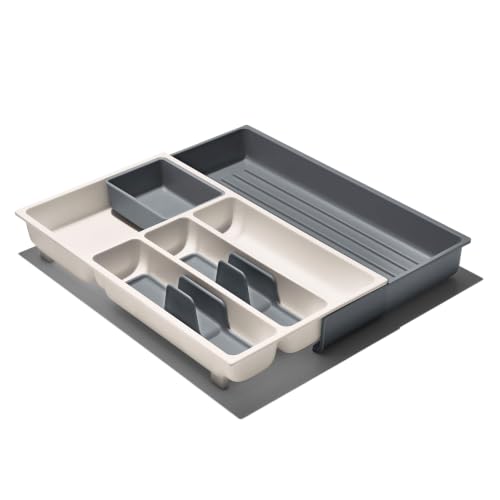
OXO Good Grips Expandable Tiered Drawer Organizer
Expandable tiered rows combine adjustable width with a stepped angle, suited to a drawer holding jars of noticeably different heights. The tray’s edges are rounded, reducing the chance of a scraped knuckle while reaching toward the back row. Expansion joints lock into set positions rather than sliding loosely once adjusted.
Pros
- Combines adjustable width with a tiered, label-forward angle
- Rounded edges reduce scraped knuckles reaching for back jars
- Locking expansion joints stay in place once set
Cons
- Costs more than flat, non-tiered expandable organizers
- Still needs moderate drawer depth to accommodate the tiers
Spectrum Diversified Deluxe Spice Rack Drawer Organizer
A multi-row layout packs in more jars per square inch than slimmer two-tier inserts, suited to a large spice collection. Rows run in a consistent flat grid, prioritizing capacity over the angled visibility stepped designs offer. The tray’s firm plastic walls keep jars from drifting sideways when the drawer slides shut quickly.
Pros
- High jar capacity suits a large spice collection in one tray
- Firm walls keep jars from sliding sideways during drawer use
- Consistent grid layout is easy to reorganize alphabetically
Cons
- Flat grid does not angle labels upward like stepped designs
- Dense layout can feel cramped for larger specialty jars
How they compare
| # | Model | Material | Best for | Score | Price |
|---|---|---|---|---|---|
| 1 | YouCopia SpiceSteps Drawer Organizer | Plastic | Best Overall | 9.0 | Check price |
| 2 | YouCopia SpiceLiner Spice Drawer Organizer | Plastic | Best for Shallow Drawers | 8.6 | Check price |
| 3 | Lynk Spice Rack Drawer Organizer | Metal and plastic | Best for Narrow Drawers | 8.4 | Check price |
| 4 | Rev-A-Shelf Wood Spice Drawer Insert | Solid wood | Best for Cabinetry Remodels | 8.7 | Check price |
| 5 | mDesign Expandable Spice Drawer Organizer | Plastic | Best Value Pick | 8.3 | Check price |
| 6 | OXO Good Grips Expandable Tiered Drawer Organizer | Plastic | Best for Mixed Jar Heights | 8.5 | Check price |
| 7 | Spectrum Diversified Deluxe Spice Rack Drawer Organizer | Plastic | Best for Large Jar Collections | 8.4 | Check price |
Questions worth asking
What is the best spice drawer insert overall?
The YouCopia SpiceSteps Drawer Organizer works well overall because its stepped tiers keep every jar label visible from above.
Do spice drawer inserts fit all drawer sizes?
Not all of them, since stepped tiered inserts need more depth than flat trays like the SpiceLiner design require.
What insert works best for a narrow drawer?
The Lynk Spice Rack Drawer Organizer uses a slim two-tier design built for narrower drawer widths.
Can a spice drawer insert be installed permanently?
Yes, a wood insert like the Rev-A-Shelf model installs into the cabinet drawer box during a kitchen remodel.
How many spice jars fit in a typical drawer insert?
Capacity varies, with slimmer two-tier trays holding around 14 to 18 jars and dense grids holding 25 or more.
Do expandable spice drawer organizers work in any drawer?
They adjust to a range of widths, like the mDesign and OXO models, though very narrow or wide drawers may exceed their range.
Is a stepped or flat spice drawer insert better?
A stepped insert shows labels more clearly, while a flat insert fits shallower drawers and often holds more jars.
What material are spice drawer inserts usually made from?
Most are plastic, though wood inserts like Rev-A-Shelf’s are built specifically for permanent cabinetry installation.
Our take
For most standard kitchen drawers, the YouCopia SpiceSteps Drawer Organizer offers the clearest view of a spice collection thanks to its stepped, label-forward tiers. Anyone remodeling cabinetry from scratch should choose the Rev-A-Shelf wood insert instead, since it installs permanently into the drawer box itself. Buyers on a tighter budget can skip premium stepped designs and pick the mDesign expandable tray for a lower cost that still adjusts to fit the drawer.
Dana Whitfield
Dana spent eight years buying and merchandising for a regional kitchenware retailer before moving into editorial work. She has handled thousands of SKUs across cookware, small appliances and kitchen organization, and focuses on the practical differences that matter once a product is actually in daily use.
You might also need

Zafit 4-Pocket Bedside Caddy: A $7.99 Fix for Nightstand Clutter?

Great Bay Home Reversible Recliner Cover: One Cover, Two Looks for $21.00?

Haute Decor 16-Inch Green Twist Ties (6-Pack): Worth It Over Plain Wire?