Which Fish Spatula Slides Under a Delicate Fillet?
The Wusthof Gourmet Fish Spatula leads for a thin, precisely flexed blade that slides under skin without tearing it. The Mercer Culinary Hell’s Handle turner is the heat resistant workhorse, and the OXO Good Grips Fish Turner is the value pick for everyday use.
Delicate fillets call for the Wusthof Gourmet Fish Spatula, high heat work suits the Mercer Culinary Hell’s Handle turner, and everyday cooking is covered for less by the OXO Good Grips Fish Turner.
A fish spatula lives or dies by its leading edge: too thick and it pushes the fillet instead of sliding under it, too stiff and it cannot follow the curve of a pan. Slot spacing, offset angle and whether the blade will scratch your pans are the other deciding factors. We compared blade specifications, materials and cook reports across seven current turners.
The shortlist, ranked

Wusthof Gourmet Fish Spatula
A properly thin leading edge tapers into a flex profile where the tip yields while the body stays supportive. That combination lets it get under crisp skin without tearing the fillet apart. A full tang handle balances the blade so the tool feels controlled rather than floppy.
Pros
- Leading edge slides under skin cleanly
- Flex profile balances control and give
- Well balanced in the hand
Cons
- Metal blade will scratch nonstick coatings
- Handle rivets need drying to avoid water marks
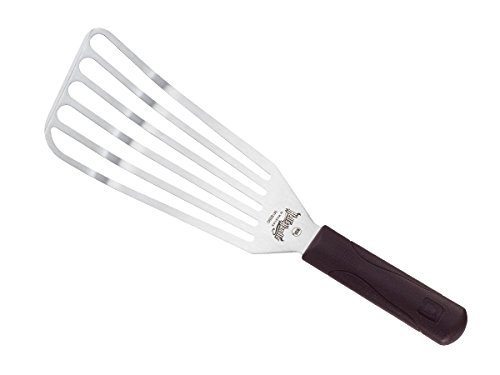
Mercer Culinary Hell’s Handle Heat Resistant Fish Turner
Oven and grill temperatures that would soften a standard composite handle are exactly what the Hell’s Handle grip is rated to withstand. A thin, offset and slotted blade matches proper commercial kitchen turners, built for volume rather than looks. Resting on a hot grill or heading into an oven is where this handle earns its keep.
Pros
- Handle tolerates grill and oven heat
- Commercial grade blade geometry
- Textured grip stays secure with wet hands
Cons
- Not suitable for nonstick pans
- Utilitarian appearance

OXO Good Grips Fish Turner
A thin flexible stainless blade pairs with the cushioned grip OXO is known for, reducing hand fatigue when turning a pan full of fillets. The offset lifts your knuckles clear of the rim. Refinement at the leading edge trails the Wusthof, but it does the job at a fraction of the fuss.
Pros
- Comfortable grip even when wet
- Good flex for the price
- Dishwasher safe
Cons
- Leading edge is thicker than premium blades
- Metal edge is unsafe for nonstick

Victorinox Fibrox Pro Fish Turner
Textured, slightly tacky Fibrox material, the same handle Victorinox uses on its professional knives, stays secure with oily or wet hands better than smooth composites. Generous flex and wide slots on the blade drain oil quickly. Balance sits slightly toward the handle, which some cooks prefer.
Pros
- Best grip security with oily hands
- Wide slots drain fat fast
- Proven professional handle material
Cons
- Blade flex is softer than some cooks like
- Handle heavy balance takes adjustment

Dexter-Russell Sani-Safe S286 Fish Turner
Restaurant kitchens are the target for the Sani-Safe line, with a moulded handle that seals to the blade so there is no seam to trap food. Thin and wide, the blade stays stiff enough to support a large fillet. Based on specifications, hygiene and durability take priority over refinement at the edge.
Pros
- Sealed handle joint is hygienic
- Wide blade supports large fillets
- Built to survive commercial use
Cons
- Stiffer than dedicated fish spatulas
- Plain handle offers little cushioning

Winco TN719 Blade Turner
This is the plain restaurant supply turner that sits in commercial kitchens everywhere, and it does the core job well for very little money. A thin, slotted blade pairs with a simple wooden or composite handle. Expect no ergonomic refinement and no premium finish.
Pros
- Excellent blade for a very low outlay
- Easy to replace if damaged
- Widely available
Cons
- Basic handle comfort
- Riveted joint traps residue if not cleaned well

Di Oro Chef Series Silicone Turner
A metal blade is the wrong tool for a coated pan no matter how good the edge is, which is why this turner pairs a stainless core for support with a heat resistant silicone skin that will not mark a coating. The edge cannot get as thin as steel, so it suits skinless fillets better than crisped skin. Dishwasher safety keeps cleanup simple.
Pros
- Will not scratch coated pans
- Steel core keeps it from flopping
- Dishwasher safe and easy to clean
Cons
- Edge cannot get as thin as steel
- Struggles to lift crisply stuck skin
Compared at a glance
| # | Model | Blade | Best for | Score | Price |
|---|---|---|---|---|---|
| 1 | Wusthof Gourmet Fish Spatula | Stamped stainless, thin leading edge | Best overall | 9.4 | Check price |
| 2 | Mercer Culinary Hell’s Handle Heat Resistant Fish Turner | Stamped stainless slotted | Best for high heat | 9.2 | Check price |
| 3 | OXO Good Grips Fish Turner | Flexible stainless, slotted | Best value | 9.0 | Check price |
| 4 | Victorinox Fibrox Pro Fish Turner | Flexible stainless slotted | Best grip security | 8.8 | Check price |
| 5 | Dexter-Russell Sani-Safe S286 Fish Turner | Wide stainless, slotted | Best for commercial use | 8.6 | Check price |
| 6 | Winco TN719 Blade Turner | Thin slotted stainless | Best budget | 8.3 | Check price |
| 7 | Di Oro Chef Series Silicone Turner | Steel core with silicone coating | Best for nonstick pans | 8.0 | Check price |
What matters most
What makes a fish spatula different from a regular turner? A very thin, slightly bevelled leading edge that can wedge between the fish and the pan sets these apart from ordinary turners. A thick edge pushes the fillet forward and breaks it. When comparing two spatulas, check the blade edge on: thinner wins almost every time.
How much blade flex is right for fish? Following the curve of a pan requires a blade that gives at the tip, but it needs enough firmness through the body to carry the weight of a fillet. Too much flex and a large piece of fish folds and breaks in the middle. Tapering the flex, rather than making the whole blade soft, is how the Wusthof gets this balance right.
Why do slots and offset matter more than you’d expect? Angled slots let hot fat drain back into the pan instead of onto the plate, and they reduce the surface area sticking to the fish. Offset, meaning how far the handle rises above the blade, keeps your knuckles off the pan rim. Both are small details that make a spatula pleasant rather than merely functional.
Should you match the spatula material to your pans? The thinnest edge and the best results with skin on fish come from steel blades, ideal in stainless or cast iron. A steel edge will eventually damage coated nonstick surfaces, so a silicone coated turner like the Di Oro is the right compromise there. Many cooks keep one of each rather than trying to make a single tool work everywhere.
Frequently asked questions
What makes a fish spatula different from a regular spatula?
A thinner, more flexible slotted blade with an angled leading edge, usually set at a steeper offset. The design is built to slide under delicate food rather than to scrape or press.
Can a fish spatula be used on nonstick pans?
Not a metal one. Steel edges will scratch coatings over time. Use a silicone coated turner such as the Di Oro Chef Series in nonstick pans.
Are fish spatulas left or right handed?
Most have an asymmetric bevel, and versions exist for both hands. Left-handed cooks should check the listing, since a right handed bevel works against you when sliding under a fillet.
How do you stop fish from sticking in the first place?
Get the pan properly hot before adding oil, dry the fish thoroughly, and leave it alone until it releases on its own. A good spatula helps, but a fillet that is not ready to turn will tear no matter what you use.
Are fish spatulas only useful for fish?
No. The thin flexible blade works well for eggs, pancakes, cookies and anything delicate. Many cooks report it becomes their default turner for everything.
Can fish spatulas go in the dishwasher?
Many can, including the OXO and Victorinox models. Full tang riveted handles like the Wusthof last longer with hand washing, mainly because of the handle rather than the blade.
What blade width works best?
A blade around three inches wide handles most home fillets. Wider blades support large pieces better but are harder to manoeuvre in a small or crowded pan.
Is a heat resistant handle necessary?
Only if the tool will rest on a grill or go into an oven. Stovetop use is fine with a standard composite or riveted wooden handle, while the Mercer Hell’s Handle targets those hotter scenarios.
Which fish spatula suits a home cook on a budget?
The Winco TN719 delivers a genuinely thin, slotted blade for a very low outlay, though it skips the ergonomic handle upgrades found on the OXO and Wusthof.
How is a fish spatula different from a fish slice or a general turner?
Fish slice is another name for the same tool in some regions. A general turner has a thicker, stiffer blade meant for burgers and pancakes, not for sliding under delicate skin without tearing it.
Our take
The Wusthof Gourmet Fish Spatula is the turner we would reach for with any delicate fillet, because its thin edge and tapered flex do the one thing that matters: getting under the fish without breaking it. Choose the Mercer Culinary Hell’s Handle for grill and oven work, and keep a silicone Di Oro turner alongside it if you cook fish in coated pans.
Dana Whitfield
Dana spent eight years buying and merchandising for a regional kitchenware retailer before moving into editorial work. She has handled thousands of SKUs across cookware, small appliances and kitchen organization, and focuses on the practical differences that matter once a product is actually in daily use.
You might also need

Vollum 8 Liter Insulated Beverage Dispenser Review: Does the Spigot Design Deliver?

JH JIEMEI HOME Ramen Bowl Set Review: Real Donburi Bowls or Just Pretty Glaze?
Breaking Bad Los Pollos Hermanos Apron Review: Fun Fan Gear, But How Functional?