RV Battery Monitors That Track Solar Charging Accurately
Victron’s SmartShunt delivers the most accurate state of charge readings for RV solar setups, pairing over Bluetooth without extra hardware. Renogy One Core fits owners already running Renogy solar gear, combining data in one app. Bogart’s wired TriMetric TM-2030 remains the reliable choice for larger multi-battery banks.
RV owners running solar setups get the most accurate readings from Victron’s SmartShunt, since its shunt based measurement tracks amp hours instead of estimating from voltage alone. Bluetooth pairs it straight to a phone app, though you still need a phone or tablet nearby to check the charge level.
Comparing these monitors is tricky since some read voltage only while others measure current directly through a shunt, and that difference changes accuracy significantly. We compared listed measurement methods, lithium compatibility and owner feedback on installation across all seven models.
Our top picks

Victron SmartShunt
A shunt sits in the negative battery cable and measures actual current flow, rather than estimating charge from voltage alone. Bluetooth connects the shunt straight to a phone app, so no wired display is required for basic monitoring.
Pros
- Shunt based sensing gives precise amp hour tracking
- Bluetooth app removes the need for a wired display
- Works with lithium, AGM and lead-acid battery banks
Cons
- Needs a phone or tablet nearby to check readings
- A dedicated display costs extra if you want one

Renogy One Core
This monitor pulls data directly from Renogy charge controllers and inverters into a single app. Owners running an all-Renogy setup skip juggling separate apps for solar output and battery status.
Pros
- Combines solar and battery data inside one app
- Fits naturally into an existing Renogy solar setup
- Tracks lithium battery banks alongside lead-acid
Cons
- Offers less value if your solar gear is a different brand
- App navigation takes longer to learn than single purpose monitors
Bogart Engineering TriMetric TM-2030
A wired panel mount display suits the bigger house battery banks found in larger RVs and skoolies. It skips Bluetooth entirely but carries a long track record among owners running multi-battery lithium or lead-acid systems.
Pros
- Dedicated screen stays readable without a phone nearby
- Long track record on large lithium battery banks
- Panel mount keeps the display visible at all times
Cons
- Lacks Bluetooth or app connectivity
- Installation means running wire out to a mounted panel
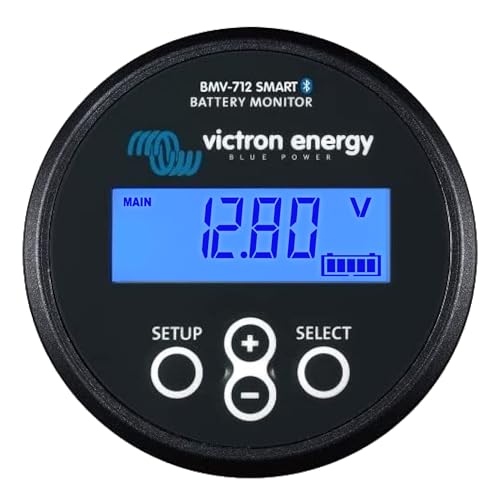
Victron BMV-712 Smart
A second input on this monitor tracks starter battery voltage alongside the main house bank. Historical logging of charge cycles helps owners spot battery health trends across months of use.
Pros
- Monitors the starter battery alongside the house bank
- Historical data reveals gradual battery degradation early
- Bluetooth range covers most RV interiors reliably
Cons
- Costs more than single battery monitors
- Setup menu involves more configuration than basic models

AiLi Battery Monitor
A small LCD screen displays voltage, current and remaining capacity from this basic shunt based monitor. It covers the essentials for smaller solar setups without the cost of app connected alternatives.
Pros
- Costs less than app connected monitors
- Shunt measurement still delivers accurate readings
- Simple LCD needs no phone pairing to operate
Cons
- Skips app and Bluetooth connectivity entirely
- Small screen is harder to read from a distance

Xantrex LinkLite
This monitor centers on lead-acid and AGM battery banks, keeping its menu simpler than lithium focused competitors. RV owners running a traditional battery setup avoid lithium specific settings they do not need.
Pros
- Simple menu suits lead-acid and AGM banks well
- Panel display stays visible without pairing to a phone
- Setup stays straightforward for non-lithium systems
Cons
- Offers limited lithium specific configuration
- Lacks Bluetooth or app support

Magnum Energy ME-BMK
A no-frills shunt monitor pairs naturally with Magnum inverter systems already common in some RVs. It handles basic voltage and amp hour tracking without extra features found on pricier monitors.
Pros
- Lower cost entry into shunt based monitoring
- Integrates smoothly with existing Magnum inverter setups
- Covers both lithium and lead-acid compatibility
Cons
- Offers fewer display features than premium monitors
- Skips wireless connectivity entirely
Before you buy
What to look for in a solar RV battery monitor Shunt based measurement outweighs every other spec, since it tracks actual current flow instead of estimating from voltage. Voltage only monitors can misjudge a battery’s real charge state under load. Lithium compatibility is a separate checkbox, since lead-acid focused monitors can misread lithium’s flatter discharge curve.
Which monitor fits owners already using one solar brand Matching your monitor to an existing solar controller brand, as Renogy One Core does, folds all data into a single app instead of running two systems side by side. This matters most for anyone who already owns charge controllers or inverters from that same manufacturer.
Best battery monitor for large battery banks and bigger rigs Larger house battery banks in bigger RVs or converted buses benefit from a dedicated wired panel like the Bogart TriMetric, which stays visible without a phone nearby. Wired panel monitors also tend to carry a longer track record on multi-battery lithium setups.
How to track battery health over time A monitor with historical data logging, such as the Victron BMV-712, helps catch gradual battery degradation across months of seasonal use. This matters most for anyone storing an RV part of the year and wanting to spot a failing battery before a trip.
Side by side
| # | Model | Measurement type | Best for | Score | Price |
|---|---|---|---|---|---|
| 1 | Victron SmartShunt | Shunt-based current sensing | Best overall | 9.4 | Check price |
| 2 | Renogy One Core | Shunt-based current sensing | Best for Renogy solar systems | 9.0 | Check price |
| 3 | Bogart Engineering TriMetric TM-2030 | Shunt-based current sensing | Best for large battery banks | 8.8 | Check price |
| 4 | Victron BMV-712 Smart | Shunt-based current sensing | Best for detailed battery history | 8.6 | Check price |
| 5 | AiLi Battery Monitor | Shunt-based current sensing | Best value | 8.3 | Check price |
| 6 | Xantrex LinkLite | Shunt-based current sensing | Best for simple lead-acid setups | 8.1 | Check price |
| 7 | Magnum Energy ME-BMK | Shunt-based current sensing | Best budget | 8.0 | Check price |
Frequently asked questions
What is the difference between a shunt monitor and a voltage-only monitor?
A shunt monitor measures actual current passing through it, giving a precise amp hour count. A voltage-only monitor estimates charge state from voltage, which loses accuracy under load.
Do RV battery monitors work with lithium batteries?
Most current models, including the Victron SmartShunt and Renogy One Core, list lithium compatibility. Older or budget models may support lead-acid only.
Can a battery monitor connect to a phone app?
Bluetooth models like the Victron SmartShunt and BMV-712 pair directly with a phone app. Wired panel monitors like the Bogart TriMetric need a dedicated display instead.
Which battery monitor works best for a large house battery bank?
The Bogart TriMetric TM-2030 has a long track record among owners running larger lithium or lead-acid banks in bigger rigs.
Is Bluetooth range a problem inside an RV?
Owner reports suggest Bluetooth range from monitors like the Victron BMV-712 covers most RV interiors without dropouts, though metal cabinetry can weaken the signal in some layouts.
Do I need a separate display if my monitor already has Bluetooth?
Not necessarily. Bluetooth monitors like the SmartShunt work through a phone app alone, though some owners add an optional display for a permanent, always visible readout.
Solar battery monitor vs a built-in RV battery gauge, what actually differs?
A built-in RV gauge usually reads voltage only and gives rough estimates. A dedicated shunt based monitor gives a precise amp hour count and tracks real solar charging performance.
How hard is it to install an RV battery monitor?
Shunt based monitors require wiring the shunt into the negative battery cable, a job most owners handle themselves. Larger battery banks or multiple batteries can add wiring complexity.
Which battery monitor suits a budget solar setup?
AiLi’s monitor and the Magnum ME-BMK both keep costs down while still using shunt based measurement for accurate readings.
The bottom line
Victron’s SmartShunt is the strongest all-around pick for tracking solar charge accurately on most RVs, thanks to its shunt based measurement and Bluetooth app. Owners already running Renogy solar equipment should choose the Renogy One Core instead for combined system data, and anyone with a large multi-battery bank is better served by the wired Bogart TriMetric TM-2030.
Tony Russo
Tony trained as an automotive technician and spent years in service and parts retail before moving into writing. He focuses on garage tools, car care products and accessories from a hands-on maintenance perspective.