Solar Chargers for Keeping Devices Alive Off-Grid
The BigBlue 28W 3-Port USB Solar Charger leads this comparison with enough output to charge multiple devices while folding down to backpack size. The Goal Zero Nomad 10 suits backpackers who want proven reliability, while the Hiluckey 25000mAh Solar Power Bank fits anyone who wants a built-in battery instead of relying on direct sun.
The BigBlue 28W 3-Port USB Solar Charger stands out because its SunPower monocrystalline cells convert sunlight efficiently enough to charge multiple devices from three USB ports at once. Its main limitation is output consistency, since like all direct solar chargers it slows down under clouds or shade.
We compared published wattage, panel type, port count and weight across each charger rather than running our own sunlight output tests.
What we recommend

BigBlue 28W 3-Port USB Solar Charger
SunPower monocrystalline cells convert sunlight more efficiently than lower-grade polycrystalline panels found on cheaper chargers. Three USB ports let it charge multiple devices at once in direct sun. A four-panel foldable design packs down small enough to clip onto a backpack.
Pros
- SunPower cells convert sunlight more efficiently than budget panels
- Three USB ports charge multiple devices simultaneously
- Foldable design clips easily onto a backpack
Cons
- Output drops noticeably under cloud cover like all direct solar chargers
- No built-in battery for storing power for later use
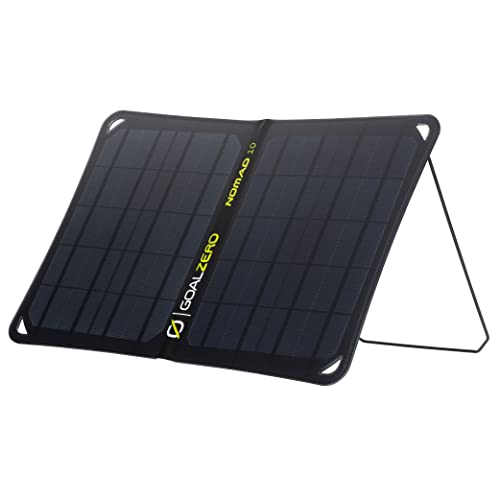
Goal Zero Nomad 10
A monocrystalline panel rated at 10 watts suits slower, steady charging for a single device on a multi-day trip. A built-in kickstand angles the panel toward the sun without needing to prop it against a rock or pack. Its simpler single-panel design holds up to repeated folding better than chargers with more hinge points.
Pros
- Kickstand design angles the panel without extra gear
- Simpler single-panel build resists hinge wear over time
- Steady output suits slow, reliable device charging
Cons
- Lower wattage than multi-panel chargers like the BigBlue 28W
- Fewer USB ports limit it to charging one device at a time efficiently
RAVPower 16W Solar Charger
A two-panel foldable design keeps the price below higher-wattage chargers while still offering two USB ports. Lightweight construction keeps it near 1.1 pounds, easing the load on a hike. Its 16 watt output charges a phone steadily in direct sun, though slower than higher-wattage options.
Pros
- Lower price than higher-wattage multi-panel chargers
- Lightweight build eases carrying on a hike
- Two USB ports cover basic multi-device charging
Cons
- Lower wattage charges devices more slowly than the BigBlue 28W
- Fewer ports than three-port chargers for group charging

Nekteck 24W Solar Charger
SunPower cells across three foldable panels bring output to 24 watts, close to premium chargers at a lower price. Three USB ports support charging multiple devices at once, similar to pricier competitors. A foldable design with reinforced grommets lets it attach to a pack or tent for hands-free charging.
Pros
- SunPower cells at a lower price than premium competitors
- Three USB ports support multi-device charging
- Reinforced grommets allow hands-free pack or tent attachment
Cons
- Slightly lower output than the BigBlue 28W at full sun
- No built-in battery for storing charge

Hiluckey 25000mAh Solar Power Bank
A built-in 25000mAh battery stores power ahead of time, removing dependence on direct sunlight the way panel-only chargers require. Four small solar panels trickle-charge the battery as a backup rather than a primary charging method. A built-in flashlight adds utility beyond device charging.
Pros
- Built-in battery provides power without needing direct sun first
- Flashlight adds utility beyond charging devices
- High battery capacity covers multiple device charges
Cons
- Solar panels charge the battery slowly compared to dedicated panel chargers
- Heavier than panel-only chargers of similar size
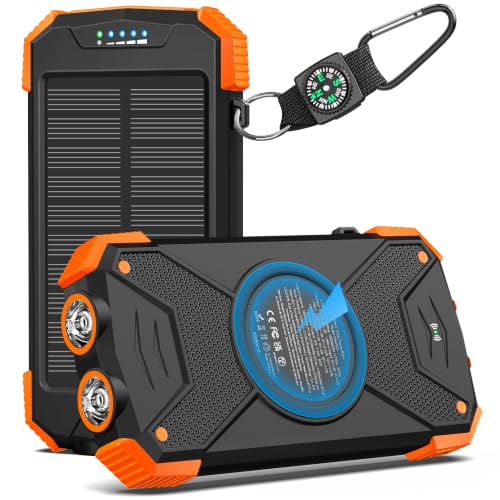
BLAVOR Solar Charger Power Bank
A 10000mAh built-in battery keeps this charger smaller and lighter than higher-capacity solar power banks. A built-in compass and flashlight add outdoor utility in a single compact device. Its solar panel works best as a slow backup charging method rather than the primary power source.
Pros
- Compact size suits everyday carry better than larger power banks
- Built-in compass adds navigation utility outdoors
- Lighter than higher-capacity solar power banks
Cons
- Lower battery capacity than the Hiluckey 25000mAh
- Solar panel charges the battery slowly on its own

X-DRAGON 40W Foldable Solar Charger
Four SunPower panels combine for 40 watts of output, the highest wattage among the chargers compared here. Four USB ports let an entire group charge devices at once rather than sharing fewer ports. The larger folded size reflects the added panel area needed to reach that output.
Pros
- Highest output among the chargers compared here
- Four USB ports support charging an entire group
- SunPower cells maximize efficiency at this wattage
Cons
- Larger folded size than lower-wattage chargers like the RAVPower 16W
- Heaviest charger among those compared here
How to choose
What to look for in a solar charger Wattage determines charging speed, with higher-wattage chargers like the X-DRAGON 40W charging faster than lower-wattage options like the RAVPower 16W. Panel type affects efficiency in less than ideal sun, with SunPower monocrystalline cells generally converting more sunlight than lower grades. USB port count decides how many devices can charge at once without taking turns.
Panel-only chargers versus power bank hybrids Panel-only chargers, like the BigBlue 28W and Nekteck 24W, charge devices directly but stop working once the sun sets or clouds roll in. Power bank hybrids, like the Hiluckey 25000mAh and BLAVOR, store power in a battery that can be used after dark, though their solar panels charge that battery slowly. Anyone needing reliable overnight power should prioritize a hybrid over a panel-only charger.
Matching wattage to the number of devices A single device, like a phone on a short hike, charges fine from a lower-wattage charger like the Goal Zero Nomad 10 or RAVPower 16W. Groups or multiple devices need higher wattage and more ports, which the X-DRAGON 40W and BigBlue 28W both provide. Charging speed scales with available sunlight, so even a high-wattage charger slows down significantly under cloud cover.
Weight and portability tradeoffs Backpackers counting ounces benefit from a lighter charger like the RAVPower 16W or BLAVOR power bank, both under 1.2 pounds. Higher-output chargers like the X-DRAGON 40W add weight in exchange for faster, group-friendly charging. Vehicle-based camping trips care less about weight, making higher-wattage options a more practical default.
How they stack up
| # | Model | Output | Best for | Score | Price |
|---|---|---|---|---|---|
| 1 | BigBlue 28W 3-Port USB Solar Charger | 28 watts | Best Overall | 8.9 | Check price |
| 2 | Goal Zero Nomad 10 | 10 watts | Best for Backpacking Reliability | 8.7 | Check price |
| 3 | RAVPower 16W Solar Charger | 16 watts | Best Budget | 8.1 | Check price |
| 4 | Nekteck 24W Solar Charger | 24 watts | Best Value Multi-Device | 8.4 | Check price |
| 5 | Hiluckey 25000mAh Solar Power Bank | 25000mAh | Best Power Bank Combo | 8.3 | Check price |
| 6 | BLAVOR Solar Charger Power Bank | 10000mAh | Best Compact EDC | 8.0 | Check price |
| 7 | X-DRAGON 40W Foldable Solar Charger | 40 watts | Best for High-Output Group Use | 8.6 | Check price |
Good to know
How many watts does a solar charger need to charge a phone?
Around 10 to 16 watts, as offered by the Goal Zero Nomad 10 or RAVPower 16W, charges a phone steadily in direct sun.
Do solar chargers work through clouds?
Output drops noticeably under cloud cover for any panel-only charger, including the BigBlue 28W and Nekteck 24W.
What is the difference between a solar charger and a solar power bank?
A solar charger like the BigBlue 28W charges devices directly from panels, while a solar power bank like the Hiluckey 25000mAh stores power in a battery first.
How many USB ports does a solar charger need?
Two to four ports, found on chargers like the Nekteck 24W and X-DRAGON 40W, let multiple devices charge at once instead of sharing one port.
Are SunPower solar cells better than standard cells?
SunPower monocrystalline cells, used on the BigBlue 28W and Nekteck 24W, generally convert sunlight more efficiently than lower-grade panels.
Can a solar charger power a device at night?
Only with a built-in battery, like the Hiluckey 25000mAh or BLAVOR power bank. Panel-only chargers need direct sunlight to work.
What is the lightest solar charger available?
Among those compared here, the BLAVOR Solar Charger Power Bank and RAVPower 16W are among the lightest options.
How fast does a 40 watt solar charger charge devices?
The X-DRAGON 40W charges faster than lower-wattage chargers in full sun, though speed still depends on sunlight conditions.
Do solar chargers include a flashlight?
Some do. The Hiluckey 25000mAh and BLAVOR power banks both include a built-in flashlight for added outdoor utility.
Final word
Most hikers get the best overall balance from the BigBlue 28W 3-Port USB Solar Charger, which charges multiple devices efficiently without excess weight. Backpackers who prioritize long-term reliability should choose the Goal Zero Nomad 10 instead, since its simple single-panel design resists wear. Anyone needing power after dark should skip panel-only chargers and pick the Hiluckey 25000mAh Solar Power Bank.
Sierra Daniels
Sierra's background is in landscape design and nursery retail. She focuses on lawn and garden equipment, outdoor furniture and gear durability, weighing published specs against how materials actually hold up outside.
You might also need

Minikey Solar Bird Feeder Camera: Is the AI Bird ID Worth the Subscription?

Refresh Sports Glider Ray Pool Torpedo: A Good Pick for Underwater Pool Play?

Sweet Home Collection Patio Chair Cushions: Enough Padding for Daily Outdoor Use?
