Which Smith Machine Actually Fits Your Home Gym?
Body-Solid’s GS348Q Series 7 Smith Gym ranks best overall, built around a counterbalanced bar and a commercial-grade frame. Marcy’s SM-4033 wins on space savings for tight rooms, while Titan Fitness’s T-3 Series Smith Machine delivers the best value for lifters wanting cage attachments included.
Safety, footprint, and cost all pull in different directions once a Smith machine has to fit inside a home rather than a commercial gym. Counterbalanced bars, folding frames, and cage combos each answer a different piece of that puzzle. Ceiling height and floor space usually decide the shortlist before price even enters the picture.
Specs like weight capacity and rail length rarely sit side by side on a single listing, which is what makes this comparison tricky. Frame steel gauge, counterbalance mechanism, footprint dimensions, and owner feedback across seven current Amazon listings shaped the ranking below. Cage attachments and pulley stations counted as bonus value, not baseline requirements.
What we recommend

Body-Solid GS348Q Series 7 Smith Gym
A counterbalanced Smith bar pairs with a full weight stack and cage uprights on one commercial-grade frame. Linear bearings on hardened steel rails keep bar travel smooth, according to owner reports. Its footprint suits a dedicated garage gym rather than a shared living space.
Pros
- Counterbalanced bar reduces effective starting weight
- Weight stack adds functional trainer exercises
- Commercial-grade steel handles daily heavy use
Cons
- Large footprint needs a dedicated room
- Assembly takes more time than single-station machines
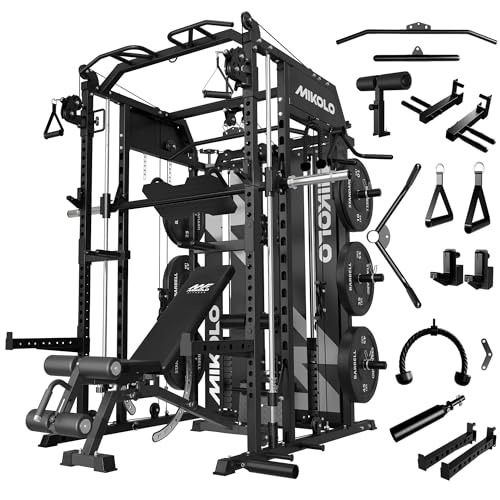
Force USA G3 All-In-One Trainer
Smith machine, power cage, and dual-function cable pulley all fold into one rack with the G3. Squats, cable flys, and pull-ups happen without moving equipment between sets. An extensive accessory catalog lets this rack expand toward a full home gym over time.
Pros
- Combines three training stations in one frame
- Accessory ecosystem lets the rack grow with a lifter
- Dual cable pulleys support functional and isolation work
Cons
- Higher upfront cost than a stand-alone Smith machine
- Needs more ceiling height than compact folding models

Titan Fitness T-3 Series Smith Machine
A half-cage front joins the Smith bar on Titan’s T-3 Series, adding squat and bench safety catches in one footprint. Bolt-together 11-gauge steel construction matches the rest of Titan’s rack lineup. Guide rods run the full vertical travel for consistent bar tracking.
Pros
- Half cage adds squat and bench safety catches
- Guide rods keep the bar tracking straight through the lift
- Compatible with other Titan rack accessories
Cons
- Bolt-together assembly requires more hardware and time
- No counterbalance, so full bar weight loads from the first rep

Valor Fitness BD-62 Leverage Smith Machine
A cam-based counterbalance lightens the bar noticeably off the rack on the BD-62. Fixed pivot arms guide the bar path instead of vertical rails, which some owners find easier on the shoulders. A weight horn on the base holds plates for the counter-lever system.
Pros
- Cam counterbalance makes light warm-up sets easier
- Pivot arm path reduces strain reported by some shoulders
- Plate-loaded base keeps cost down versus stacked machines
Cons
- Arc bar path differs from a true vertical Smith track
- Weight horn adds width to the sides of the base

Fitness Reality X-Class Light Commercial Smith Machine
Strength-focused lifters get a wider rated weight capacity with the X-Class than most home units offer. Thicker upright tubing and a reinforced base resist flex under maximal loads. Adjustable safety catches sit inside the frame for solo squat sessions.
Pros
- Reinforced base resists flex during heavy squats
- Adjustable safety catches support solo lifting
- Wider tubing adds stability versus lighter-duty models
Cons
- Bulkier frame than folding or compact options
- Higher weight capacity adds shipping weight and cost

Marcy Smith Cage Workout Machine SM-4033
A Smith bar, weight storage pegs, and a low pulley station all fit into one compact cage with the SM-4033. Its footprint suits apartments and garage corners better than full power rack combos. Linear bearings guide the bar along fixed vertical rails.
Pros
- Compact cage suits apartments and small garages
- Built-in weight pegs keep plates organized nearby
- Low pulley station adds rows and curls in one unit
Cons
- Smaller frame limits taller users’ bar path range
- No counterbalance system on the Smith bar

Titan Fitness Folding Wall-Mounted Smith Machine
Folded flat against the wall between sessions, this design frees floor space for other equipment entirely. Owners bolt the frame to a stud wall instead of anchoring a free-standing base. Some stability headroom gets traded away for the smallest footprint in this lineup.
Pros
- Folds flat to reclaim floor space between sessions
- Wall mounting skips a bulky free-standing base
- Smallest footprint of the compared models
Cons
- Requires a solid stud wall for installation
- Lower weight capacity than free-standing combo racks
How to pick the right one
What to Check Before Buying a Home Smith Machine Footprint decides whether a Smith machine fits a garage corner or needs its own room. Weight capacity matters just as much once plates start stacking on the bar. Counterbalance systems change how heavy an empty bar feels during warm-up sets. Cage or pulley attachments add squat safety catches and cable exercises without buying separate equipment. Ceiling height deserves a measurement before ordering, since taller frames need more vertical clearance.
Counterbalanced vs Plate-Loaded: Which Bar System Fits Your Training? Cables or cams offset part of the bar’s own weight on counterbalanced systems. Warm-up sets and rehab work get easier for beginners or lifters returning from injury as a result. Valor’s BD-62 relies on a cam and pivot arm rather than straight vertical rails for that effect. Plate-loaded, non-counterbalanced machines like Titan’s T-3 Series load full bar weight from the first rep instead. Neither system wins outright; training goals and joint comfort decide which fits better.
Best Smith Machines for Small Apartments and Garages Compact and folding designs solve the space problem in different ways. Titan’s folding wall-mounted frame collapses flat between workouts, freeing an entire wall section. Marcy’s SM-4033 keeps a small footprint while still adding a pulley station and weight pegs. Renters and apartment owners often prioritize these over larger cage combos for that reason. Base width still matters even in a smaller unit, so checking bolt-down stability before buying pays off.
Smith Machines Built for Heavy Squats and Serious Lifters A frame rated well above current working weight matters more as loads increase. Fitness Reality’s X-Class targets that group with reinforced uprights and a wider base. Combo racks such as the Force USA G3 add a cage for safety bar catches during unassisted squats. Bolt-together frames from Titan and Body-Solid also hold up under repeated heavy loading. Checking rated weight capacity against realistic training goals avoids outgrowing the machine within a year.
How they stack up
| # | Model | Frame | Best for | Score | Price |
|---|---|---|---|---|---|
| 1 | Body-Solid GS348Q Series 7 Smith Gym | 11-gauge steel | Best overall home Smith machine | 9.4 | Check price |
| 2 | Force USA G3 All-In-One Trainer | Smith, cage, cable pulley | Best combo attachments | 9.2 | Check price |
| 3 | Titan Fitness T-3 Series Smith Machine | Half cage with safety arms | Best value full cage combo | 9.0 | Check price |
| 4 | Valor Fitness BD-62 Leverage Smith Machine | Cam and pivot arm | Best counterbalance mechanism | 8.8 | Check price |
| 5 | Fitness Reality X-Class Light Commercial Smith Machine | Rated for heavy plate loading | Best for heavy loading | 8.5 | Check price |
| 6 | Marcy Smith Cage Workout Machine SM-4033 | Compact single-cage design | Best for small spaces | 8.3 | Check price |
| 7 | Titan Fitness Folding Wall-Mounted Smith Machine | Wall-mounted, stud-bolted | Best footprint for tight rooms | 8.0 | Check price |
Frequently asked questions
What is a Smith machine used for at home?
A home Smith machine lets users squat, bench press, and shoulder press with a fixed bar path and built-in safety catches. It suits solo training without a spotter. Many models add cage or pulley attachments for extra exercises.
How much weight capacity does a home Smith machine need?
Casual lifters usually cover their needs with a 300 to 400 pound rated bar. Serious strength training calls for a reinforced frame like the Fitness Reality X-Class. Checking rated capacity against realistic future goals avoids outgrowing the machine.
Is a counterbalanced Smith machine better than a plate-loaded one?
Counterbalanced bars feel lighter during warm-ups, which helps beginners and rehab lifters. Plate-loaded Smith machines without counterbalance load full bar weight immediately. Neither type wins universally; it depends on training experience and joint comfort.
Can a Smith machine replace a power rack for squats?
A Smith machine offers a fixed, guided bar path, unlike a power rack’s free bar movement. Combo units such as the Force USA G3 add cage safety arms to bridge that gap. Serious powerlifters still prefer a free bar for competition-specific training.
Which Smith machine is best for small apartments?
Compact units like the Marcy SM-4033 or a wall-mounted folding frame from Titan Fitness fit tighter spaces. Both skip the wide footprint of full cage combo racks. Measuring floor space and ceiling height first prevents fitment surprises.
Smith machine vs power cage: what is the difference?
A Smith machine guides the bar along fixed vertical or arced rails for added safety. A power cage leaves the bar free, relying on adjustable safety pins instead. Combo frames like the Titan T-3 Series and Force USA G3 include both in one unit.
How much space does a home Smith machine require?
Compact folding models can fit against a single wall section. Full cage combos typically need 80 or more inches of length plus clearance for loading plates. Ceiling height should also allow for the tallest planned exercise, like an overhead press.
Is a folding Smith machine worth it for a garage gym?
A folding, wall-mounted Smith machine frees floor space between workouts in a shared garage. It trades some stability and weight capacity for that flexibility. Owners splitting a garage with vehicles or storage often find the tradeoff worthwhile.
Best Smith machine for beginners doing squats and bench press at home?
A counterbalanced model like the Body-Solid GS348Q lightens the bar for early warm-up sets. That makes learning proper bar path easier before adding real weight. Fixed safety catches also reduce the risk of solo training without a spotter.
Do Smith machines with cage attachments cost more than standalone ones?
Combo units like the Force USA G3 and Titan T-3 Series carry a higher price than a bare Smith frame. The added cost buys squat safety arms and extra cable stations in the same footprint. Standalone Smith machines suit buyers who already own separate squat racks.
Our take
A counterbalanced, cage-equipped Smith machine like the Body-Solid GS348Q or Titan Fitness T-3 Series suits most home lifters best. Space-limited buyers should look at Marcy’s SM-4033 or Titan’s folding wall-mounted frame instead. Matching weight capacity and footprint to the actual room, not just the workout goal, prevents a costly return.
Derek Holt
Derek has a background coaching recreational and amateur athletes and has worked the sales floor at specialty fitness retailers. He focuses on equipment durability, ergonomics and realistic use cases rather than marketing claims.


