Which Smart Tire Inflator Actually Stops on Target?
For most drivers, the Fanttik X8 ApexPro pairs tight 0.5 PSI shut-off accuracy with a bright touchscreen. AstroAI’s inflator handles the same basic job for less, without the touchscreen. Ryobi’s 18V Cordless Inflator makes sense mainly for owners who already own that battery platform.
Fanttik’s X8 ApexPro targets a set PSI and cuts power within a stated 0.5 PSI margin, tighter than most budget units manage. AstroAI’s inflator gets that same auto shut-off right at a lower price, just without the extra display features. Skipping the cord entirely, Ryobi’s 18V model only makes sense if you already own their battery tools.
Smart, on these devices, usually means a digital PSI target with auto shut-off rather than app connectivity, so specs differ more in accuracy and power source than in features. We compared stated shut-off tolerance, corded versus battery operation, and how quickly each one fills a standard passenger tire from empty.
What matters most
What makes a tire inflator smart Smart, in this category, usually means a digital PSI target with auto shut-off rather than smartphone app control. Set a target pressure and the compressor stops on its own instead of requiring a watched needle gauge. Stated shut-off accuracy varies by roughly 0.5 to 1 PSI between the models here.
Corded vs battery-powered inflators Corded 12V models like the AstroAI plug into a running vehicle and never need charging, but they tie you to the car. Battery-powered units, including the Ryobi and Milwaukee, work away from the vehicle and suit job sites, at the cost of managing a charge and a compatible battery.
Matching max PSI to your tires Passenger car tires typically need 30 to 35 PSI, well within any inflator on this list. Towing setups or truck tires can call for 60 to 80 PSI, while sports equipment like basketballs needs far less. Checking the max PSI rating against your highest-pressure use case matters more than chasing a bigger number.
Why shut-off accuracy matters more than top speed Overinflating by even a few PSI increases center-tread wear and reduces grip in wet conditions, according to tire manufacturer guidance. A slower inflator that stops within 0.5 PSI, like the Fanttik X8 ApexPro, protects tire life better than a fast unit that overshoots by 2 or 3 PSI.
The shortlist, ranked

Fanttik X8 ApexPro Smart Tire Inflator
A color touchscreen pairs with a stated 0.5 PSI shut-off accuracy, tighter than inflators that round to the nearest whole PSI. A built-in rechargeable battery allows cordless use away from the vehicle outlet. Inflating multiple vehicles is where owners cite the display clarity and stop accuracy as the real upgrade over basic pumps.
Pros
- Tighter shut-off accuracy than most rivals
- Cordless battery operation available
- Bright, easy to read display
Cons
- Higher cost than basic corded inflators
- Battery needs periodic recharging when idle

AstroAI Smart Tire Inflator Portable Air Compressor
A digital display and preset PSI shut-off cover the core job without extra features raising the price. Plugging into a 12V outlet means no battery ever needs charging. Checking tires a few times a month, owners find the accuracy plenty good enough without paying for touchscreen extras.
Pros
- Accurate auto shut-off for the price
- Simple, reliable corded operation
- Compact size for glovebox storage
Cons
- Corded only, needs a running vehicle outlet
- LCD lacks touchscreen convenience

Ryobi ONE+ 18V Cordless Tire Inflator
Running on Ryobi’s ONE+ 18V battery line means anyone with existing Ryobi tools skips buying a dedicated inflator battery. A backlit gauge sets a target PSI with the same auto shut-off logic as pricier units. Already owning Ryobi drills or saws is the deciding factor owners mention over a standalone inflator.
Pros
- Shares battery with other Ryobi ONE+ tools
- Fully cordless, no vehicle outlet needed
- Backlit gauge readable at night
Cons
- Battery and charger sold separately from tool-only version
- Slower fill rate than corded high-flow models

VacLife Tire Inflator Portable Air Compressor
A small footprint fits a trunk emergency kit alongside included adapter tips for bikes and sports balls. Auto shut-off stops at a set PSI with no manual watching required. Kept as backup equipment, this is where owners value the compact size over raw inflation speed.
Pros
- Compact enough for glovebox storage
- Includes multiple valve adapters
- Dependable auto shut-off
Cons
- Slower fill rate than larger units
- Cord length limits reach around larger vehicles
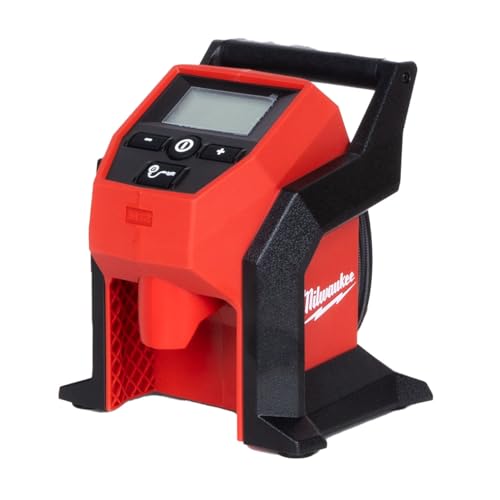
Milwaukee M12 Inflator
Built to Milwaukee’s M12 tool standard, the housing takes job-site drops and dust better than typical consumer inflators. It shares the same M12 batteries as Milwaukee’s drills and lights. Contractors who already carry M12 tools describe this as the natural inflator choice over a separate brand.
Pros
- Rugged construction suited to job sites
- Shares battery with M12 tool lineup
- Reliable auto shut-off
Cons
- Battery sold separately raises entry cost
- Overkill for occasional home use only

Kensun AC/DC Digital Tire Inflator
AC and DC power options mean it runs from a home wall outlet or a vehicle’s 12V port. A higher flow rate than most portable units fills a flat tire noticeably faster. Keeping one at home and one in the car is common, and owners point to the dual power input as the practical edge.
Pros
- Works from home AC power or vehicle DC
- Faster fill rate than typical portables
- Long cord reaches around most vehicles
Cons
- Lower max PSI than dedicated 12V units
- Bulkier housing than compact glovebox models

Craftsman Tire Inflator Portable Air Compressor
A straightforward digital gauge and single-button operation keep this accessible for drivers who just want correct tire pressure without extra settings. Power draws from a standard 12V outlet, nothing more. A lower price is reasonable, owners note, for a unit that only needs to inflate and shut off correctly.
Pros
- Lower cost than most digital inflators
- Simple single-button operation
- Compact storage size
Cons
- Fewer extra features like adapter tips
- Cord length shorter than premium models
Compared at a glance
| # | Model | Power source | Best for | Score | Price |
|---|---|---|---|---|---|
| 1 | Fanttik X8 ApexPro Smart Tire Inflator | Built-in rechargeable battery and DC cord | Best overall | 9.3 | Check price |
| 2 | AstroAI Smart Tire Inflator Portable Air Compressor | 12V DC vehicle outlet | Best value | 9.0 | Check price |
| 3 | Ryobi ONE+ 18V Cordless Tire Inflator | Ryobi ONE+ 18V battery, sold separately | Best for existing Ryobi battery owners | 8.8 | Check price |
| 4 | VacLife Tire Inflator Portable Air Compressor | 12V DC vehicle outlet | Best for emergency kits | 8.6 | Check price |
| 5 | Milwaukee M12 Inflator | Milwaukee M12 battery, sold separately | Best for durability | 8.4 | Check price |
| 6 | Kensun AC/DC Digital Tire Inflator | AC wall outlet or 12V DC | Best fill speed | 8.2 | Check price |
| 7 | Craftsman Tire Inflator Portable Air Compressor | 12V DC vehicle outlet | Best budget | 8.0 | Check price |
Questions worth asking
How accurate are digital tire inflators?
Most portable digital inflators shut off within 1 PSI of the target pressure. Higher-end models like the Fanttik X8 ApexPro state tighter tolerances around 0.5 PSI, useful for anyone who monitors pressure closely for performance driving.
Can a tire inflator run without the car on?
Corded 12V inflators typically need the engine running, or the vehicle battery will drain over extended use. Battery-powered models like the Ryobi or Milwaukee run independently of the vehicle entirely.
What PSI should I inflate my tires to?
Check the sticker inside the driver’s door frame or the owner’s manual, not the number printed on the tire sidewall, which is a maximum rating rather than the recommended pressure.
Is a cordless or corded tire inflator better?
Corded units are simpler and never need charging, which suits inflating only near the vehicle. Cordless units add flexibility for job sites or items away from a car, provided the battery stays charged.
How long does it take to inflate a flat tire?
A fully flat passenger tire typically takes 5 to 10 minutes with a portable inflator, depending on flow rate. Higher-flow units like the Kensun AC/DC finish faster than compact glovebox models.
Do smart tire inflators work on bike tires?
Most include a needle or presta valve adapter for bikes and sports equipment, though the auto shut-off PSI range is calibrated more for vehicle tires. Checking included adapters first avoids assuming full compatibility.
Can overinflating damage my tires?
Yes. Overinflation increases center-tread wear and reduces the tire’s contact patch, which can reduce grip, according to tire manufacturer guidance. A tighter shut-off accuracy inflator helps avoid this.
What is the difference between max PSI and shut-off accuracy?
Max PSI is the highest pressure the pump can physically reach, relevant mainly for truck tires. Shut-off accuracy is how close it stops to a chosen target, which matters more for everyday passenger car use.
Which tire inflator is best for job sites?
The Milwaukee M12 Inflator and Ryobi ONE+ 18V both run on batteries shared with those brands’ tool lines, which suits contractors who already carry that platform.
Our take
Go with the Fanttik X8 ApexPro if shut-off accuracy and display clarity matter most. For occasional use, the AstroAI inflator covers the same core job reliably at a lower cost. Owners already invested in Ryobi or Milwaukee battery tools should match that platform instead of adding a new one.
Tony Russo
Tony trained as an automotive technician and spent years in service and parts retail before moving into writing. He focuses on garage tools, car care products and accessories from a hands-on maintenance perspective.



