Smart Soundbars That Skip the Receiver and Speaker Wires
The Sonos Arc is the top overall pick for its app-based room tuning and wide multi-room ecosystem, while Samsung’s HW-Q990D adds the most complete wireless surround package. Bose’s Smart Soundbar 900 suits buyers who prioritize dialogue clarity for TV and movies over bass-heavy music playback.
Sonos’ Arc leads this group for its Trueplay room tuning and the widest multi-room speaker ecosystem of any soundbar here. It lacks a built-in subwoofer, so bass-heavy listeners need to add Sonos’ separate Sub. Buyers who want a full wireless surround kit out of the box should look at Samsung’s HW-Q990D instead.
We compared Dolby Atmos and DTS:X support, voice assistant compatibility, included surround speakers, and app-based tuning features across current listings, then weighed that against patterns in owner feedback for dialogue clarity and bass response.
What we recommend

Sonos Arc
Sonos built the Arc around its Trueplay feature, which uses a phone’s microphone to calibrate sound for the specific room it sits in. It joins Sonos’ wider multi-room system, so speakers in other rooms can play the same audio or different sources entirely. No subwoofer comes bundled, which keeps the upfront unit smaller but pushes deep bass response onto an optional add-on.
Pros
- Trueplay tuning adjusts sound automatically to room acoustics
- Expands into a full multi-room system with other Sonos speakers
- Built-in Alexa and Google Assistant without an external smart speaker
Cons
- No subwoofer included, so bass relies on a separate purchase
- Setup and tuning require Sonos’ app and a stable Wi-Fi connection

Samsung HW-Q990D
Samsung ships the Q990D with a wireless subwoofer and matching rear surround speakers, covering a full 11.1.4 channel layout without running speaker wire across the room. Its channel count is the highest in this comparison, aimed at buyers chasing a home theater feel. Samsung TVs pair with additional features like Q-Symphony, which blends the TV’s own speakers with the soundbar.
Pros
- Full wireless surround kit included, no speaker wire needed
- Highest channel count in this comparison for immersive Atmos mixes
- Q-Symphony adds extra speaker output when paired with a compatible Samsung TV
Cons
- Largest and heaviest setup in this group, with four total pieces
- Highest price point among the soundbars compared here

Bose Smart Soundbar 900
Bose includes a dedicated dialogue mode that pushes spoken audio forward in the mix, which owners watching dialogue-heavy shows or news often prefer over bass-forward presets. Height channels are created virtually rather than through physical upward-firing drivers, a design choice that keeps the bar slimmer. A separate bass module is available but not required for basic use.
Pros
- Dedicated dialogue mode improves speech clarity without raising overall volume
- Slim cabinet fits more easily below wall-mounted TVs
- Built-in voice assistants skip the need for a separate smart speaker
Cons
- Virtual height channels sound less distinct than physical upward-firing drivers
- No bundled subwoofer, so deep bass again depends on an optional purchase
Sony HT-A7000
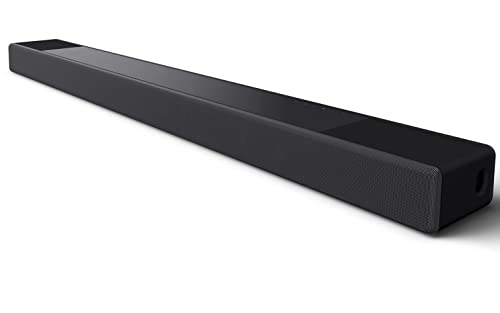
Sony’s 360 Spatial Sound Mapping measures the room’s layout to place sound effects more precisely around the listening area, aimed squarely at movie watching over music. Seven physical channels, plus two upward-firing height channels, give a wider front soundstage than Bose’s virtual height approach. Expanding to a full surround setup requires Sony’s separate rear speakers and subwoofer, sold apart from the bar itself.
Pros
- 360 Spatial Sound Mapping tailors audio placement to the specific room
- Physical height channels generally sound more precise than virtual height processing
- Chromecast built-in simplifies streaming from a phone or tablet
Cons
- Full surround setup requires buying Sony’s rear speakers and subwoofer separately
- Setup process for spatial mapping takes longer than simpler soundbars

LG S95QR
LG bundles a wireless subwoofer and rear speakers with up-firing drivers, giving a 9.1.5 channel layout at a lower cost than Samsung’s comparable Q990D package. Rear speakers include their own upward-firing drivers for height effects from the back of the room, not just the front bar. WOW Orchestra syncs the soundbar with a compatible LG TV’s speakers for added output, similar to Samsung’s Q-Symphony.
Pros
- Wireless subwoofer and rear speakers included at a lower cost than Samsung’s equivalent kit
- Rear speakers add their own height channels, not just front-firing height
- WOW Orchestra adds TV speaker output when paired with a compatible LG television
Cons
- Fewer total channels than Samsung’s Q990D flagship package
- Voice assistant support runs through the app rather than a built-in microphone

JBL Bar 1300X
JBL’s rear surround speakers detach from the main soundbar body and run on a rechargeable battery, so they can move around the room or even outside without staying wired to the main unit. Chromecast built-in lets the system join a wider multi-room audio group alongside other Chromecast speakers in the house. Matching Samsung’s channel count, the Bar 1300X aims at the same home theater audience with a different speaker design.
Pros
- Detachable battery-powered rear speakers add placement flexibility other kits lack
- Chromecast built-in extends into a broader multi-room speaker group
- Matches the highest channel count in this comparison
Cons
- Detachable speaker batteries need separate charging and monitoring
- Bulkier main soundbar than slimmer competitors like Bose’s model

Vizio Elevate
Vizio’s Elevate includes front-firing drivers that physically rotate upward when Atmos content plays, then return to forward-facing for standard stereo audio. That mechanical approach is unique in this group, where most competitors rely on fixed upward-firing drivers or virtual processing instead. A wireless subwoofer ships included, though rear surround speakers are a separate purchase.
Pros
- Rotating drivers adapt automatically between Atmos and standard stereo content
- Wireless subwoofer included without an extra purchase
- Distinct mechanical design stands apart from fixed-driver competitors
Cons
- Rear surround speakers are sold separately, unlike Samsung’s or LG’s bundled kits
- Moving parts in the rotating drivers add a long-term reliability question fixed drivers don’t have
What to look for
What a smart soundbar adds over a basic one A smart soundbar adds a voice assistant, app-based control, or both, on top of the basic job of playing TV and movie audio. Some, like Sonos’ Arc, use a phone’s microphone to tune sound output to the room automatically. Others sync with a matching smart TV for extra speaker output, as Samsung’s Q-Symphony and LG’s WOW Orchestra both do. None of these features change the core audio hardware, so channel count and driver design still matter just as much as the smart extras.
Built-in height channels versus virtual height processing Dolby Atmos height effects come from either physical upward-firing drivers or software-based virtual processing. Sony’s HT-A7000 and Vizio’s Elevate use physical drivers, which generally place overhead sound more precisely. Bose’s Smart Soundbar 900 relies on virtual height processing instead, trading some precision for a slimmer cabinet. Samsung’s Q990D and LG’s S95QR go further by adding height drivers to their rear surround speakers too, not just the front bar.
Best for home theater versus everyday TV watching Home theater setups benefit most from full surround kits like Samsung’s Q990D or LG’s S95QR, which include wireless rear speakers out of the box. Everyday TV watching, including news and dialogue-heavy shows, leans more on clarity than channel count, which is where Bose’s dedicated dialogue mode stands out. Buyers who mostly stream music benefit more from Sonos’ multi-room ecosystem than from a high channel count built for movies.
Do I need a separate subwoofer? Several soundbars in this comparison include a subwoofer, while others sell one separately. Sonos’ Arc and Bose’s Smart Soundbar 900 both require an added purchase for deep bass, which raises their effective cost. Samsung’s Q990D, LG’s S95QR, Sony’s HT-A7000 kit, JBL’s Bar 1300X, and Vizio’s Elevate all include a wireless subwoofer in the base package. A bundled subwoofer usually costs less than buying the soundbar and a matching sub separately later.
Compared at a glance
| # | Model | Channels | Best for | Score | Price |
|---|---|---|---|---|---|
| 1 | Sonos Arc | 5.0.2 with Dolby Atmos | Best Overall | 9.3 | Check price |
| 2 | Samsung HW-Q990D | 11.1.4 with Dolby Atmos | Best for Dolby Atmos | 9.4 | Check price |
| 3 | Bose Smart Soundbar 900 | 3.1.2 with Dolby Atmos (virtual height) | Best for Dialogue Clarity | 9.0 | Check price |
| 4 | Sony HT-A7000 | 7.1.2 with Dolby Atmos | Best for Movie Nights | 9.1 | Check price |
| 5 | LG S95QR | 9.1.5 with Dolby Atmos | Best Value Atmos | 8.9 | Check price |
| 6 | JBL Bar 1300X | 11.1.4 with Dolby Atmos | Best for Multi-Room | 8.8 | Check price |
| 7 | Vizio Elevate | 5.1.4 with Dolby Atmos | Best for Flexible Placement | 8.6 | Check price |
Questions worth asking
What does smart mean on a soundbar?
It usually means a built-in voice assistant, app-based control, or automatic room tuning, on top of standard audio playback.
Do smart soundbars need a subwoofer?
Not strictly, but bass response improves noticeably with one. Sonos’ Arc and Bose’s Smart Soundbar 900 sell their subwoofers separately, while Samsung’s and LG’s kits include one.
Is Dolby Atmos worth it on a soundbar?
Yes, for movies and shows mixed in Atmos specifically, since height channels add a sense of overhead sound that standard stereo cannot reproduce.
What is the difference between physical and virtual height channels?
Physical upward-firing drivers, used by Sony and Vizio, bounce sound off the ceiling directly. Virtual height, used by Bose, processes standard drivers to simulate the same effect.
Can a smart soundbar work with Alexa or Google Assistant?
Most in this group do, either through a built-in microphone, like Sonos’ Arc, or through app-based integration, like LG’s S95QR.
Which smart soundbar is best for dialogue in TV shows?
Bose’s Smart Soundbar 900 includes a dedicated dialogue mode built specifically to push speech forward in the mix.
Do smart soundbars support multi-room audio?
Sonos’ Arc and JBL’s Bar 1300X both connect into wider multi-room systems, Sonos through its own ecosystem and JBL through Chromecast built-in.
How many channels does a good home theater soundbar need?
Soundbars with included surround speakers, like Samsung’s 11.1.4 Q990D or LG’s 9.1.5 S95QR, come closest to a traditional home theater channel count.
Are wireless surround speakers as good as wired ones?
They are generally close in performance for home use, and the convenience of skipping speaker wire across a room outweighs the small difference for most buyers.
What is Q-Symphony on a Samsung soundbar?
It lets a compatible Samsung TV’s built-in speakers play alongside the soundbar at the same time, adding extra output rather than switching audio sources entirely.
The bottom line
The Sonos Arc is the best choice for buyers who already use or plan to build a multi-room speaker system, even though its subwoofer is a separate purchase. Samsung’s HW-Q990D is the better pick for a complete home theater setup straight out of the box, with wireless surround speakers included. Anyone focused mainly on TV dialogue over movie spectacle should choose Bose’s Smart Soundbar 900 instead.
Marcus Chen
Marcus covered consumer electronics for enthusiast tech publications for six years before joining ChoiceCrest. He specializes in translating manufacturer spec sheets into plain-language buying advice, with a focus on audio, computing accessories and smart-home gear.