RV Battery Monitors That Replace Guesswork With Real Data
Victron’s SmartShunt 500A delivers the most accurate state of charge readings across lithium and lead acid batteries alike. Renogy’s One Core suits RVs already running Renogy solar gear, combining both data feeds in one app. Budget minded owners get reliable basic tracking from the AiLi Battery Monitor.
Victron’s SmartShunt 500A gives the most accurate state of charge readings across lithium and lead acid batteries, though its Bluetooth signal weakens through metal RV siding. Renogy’s One Core folds battery and solar data into a single app, a real advantage for RVs already running Renogy solar gear. AiLi’s Battery Monitor covers basic voltage and current tracking at a lower cost, without any app connectivity.
A dashboard voltage light reveals almost nothing about real battery capacity, since voltage sags under load no matter how much charge remains. Measuring actual current flow with a shunt is the only reliable way to know true state of charge. We compared shunt amperage rating, app connectivity range, supported battery chemistries and install steps, then checked owner reports of Bluetooth dropouts and calibration drift over months of use.
How to choose
Why voltage alone does not reveal battery charge Voltage sags under load and recovers at rest, making a quick glance at a dashboard reading unreliable. A shunt measures actual current flowing in and out of the battery, integrating it over time to calculate true remaining capacity, which is why every monitor in this comparison relies on shunt technology.
Matching a monitor to your battery chemistry Lithium batteries discharge on a different curve than lead acid or AGM, so a monitor needs the correct chemistry preset to read accurately. Most current monitors, including the Victron SmartShunt and Renogy units, support multiple presets, while older wired displays sometimes need manual configuration for lithium.
App based versus wired display monitors Bluetooth app monitors let owners check battery status from inside the RV or a short distance outside, without walking to a panel. Wired displays skip connectivity dropouts from metal siding or thick walls but require checking a fixed screen. Pick based on how often remote access matters versus reliable local readings.
Installing a shunt based battery monitor The shunt wires into the negative battery cable, positioned between the battery and every load and charging source so all current passes through it for accurate measurement. Most kits include cable lugs and instructions, and the job typically takes under an hour with basic hand tools and a multimeter to verify wiring.
Our top picks

Victron SmartShunt 500A
Built in Bluetooth on this 500 amp shunt reports state of charge, voltage, current and time remaining straight to a phone, skipping a separate display module entirely. VictronConnect app supports lithium, AGM and flooded battery presets. Wiring the shunt into the negative battery cable is a task most RV owners handle with basic tools in under an hour.
Pros
- Accurate state of charge readings across battery types
- Skips the need for a separate display module
- App logs detailed history and configurable alarms
Cons
- Bluetooth range shortens through metal RV walls
- Priced above basic voltage only monitors
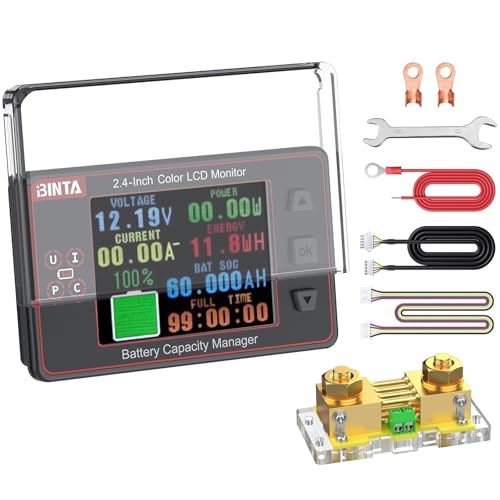
Renogy One Core Battery Monitor
Pairing with existing Renogy solar charge controllers, One Core shows battery and solar data in a single app instead of running two separate systems. Its shunt handles up to 500 amps and supports lithium and lead acid presets. RVs without Renogy solar gear still get full battery monitoring on their own, no solar hardware required.
Pros
- Combines battery and solar data in one app
- Supports a wide range of battery chemistries
- Pairs easily with existing Renogy solar gear
Cons
- Offers less value without other Renogy components
- App has a steeper learning curve than Victron’s

AiLi Battery Monitor with Shunt
A 100 amp shunt paired with a small LCD screen covers basic voltage, current and capacity tracking for smaller RV electrical systems. No app connectivity exists here, readings appear directly on the included display instead. Owners who just want a clear number without a phone app get simplicity and a lower price.
Pros
- Costs less than app based monitors
- Requires no app setup or phone pairing
- LCD readout is simple and easy to read
Cons
- Offers no remote monitoring away from the panel
- Lower amp rating limits larger battery banks
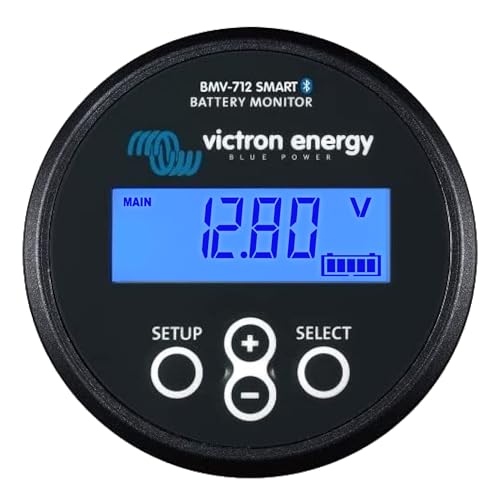
Victron BMV-712 Smart Battery Monitor
A second voltage input on the BMV-712 lets owners track both a starter battery and a house battery bank from one unit. Its physical display mounts on a wall alongside the Bluetooth app option. Historical data logging helps spot a battery bank degrading gradually across multiple camping seasons.
Pros
- Monitors two separate battery banks at once
- Physical display works without a phone nearby
- Long term data logging tracks battery health over time
Cons
- Costs more than single bank monitors
- Wall mounted display adds an extra install step
Bogart Engineering TriMetric TM-2030-RV
Owners chasing deep diagnostic data, amp hours used, days since full charge, charge efficiency percentages, get all three from the TriMetric. A dedicated wired display replaces a phone app, which suits RVs with unreliable Bluetooth reception near thick walls or metal siding. Configuring it for different battery chemistries takes more effort than app based rivals.
Pros
- Delivers diagnostic data beyond basic monitors
- Wired display avoids Bluetooth reception issues
- Configurable across various battery chemistries
Cons
- Has no smartphone app for remote viewing
- Setup menu is less intuitive than app based units

Xantrex LinkLite Battery Monitor
Installation stays simple with the LinkLite, a compact wired display and single shunt that skips app pairing steps entirely. Voltage, current and remaining capacity all show clearly on its screen. Owners upgrading from a basic voltmeter get more data here without adopting a full smart system.
Pros
- Sets up without any app pairing
- Panel display shows readings clearly
- Makes a solid upgrade from a plain voltmeter
Cons
- Lacks lithium specific charge profiles
- Provides no remote app access away from the panel
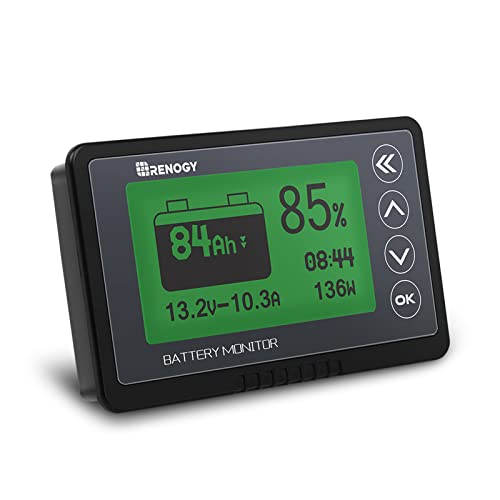
Renogy 500A Battery Monitor with Shunt
Entry level pricing pairs a 500 amp shunt with basic Bluetooth app support here, undercutting the One Core system in cost. Coverage sticks to essentials, voltage, current and state of charge, without solar integration or advanced diagnostics. Smaller RVs wanting app access on a budget fit this monitor well.
Pros
- Provides Bluetooth app access at a lower price
- 500 amp shunt suits most RV battery banks
- Offers simple setup for first time smart monitor users
Cons
- App lacks solar integration features
- Provides fewer diagnostic details than premium monitors
Side by side
| # | Model | Shunt rating | Best for | Score | Price |
|---|---|---|---|---|---|
| 1 | Victron SmartShunt 500A | 500 amps | Best overall | 9.4 | Check price |
| 2 | Renogy One Core Battery Monitor | 500 amps | Best for solar RVs | 9.1 | Check price |
| 3 | AiLi Battery Monitor with Shunt | 100 amps | Best value | 8.7 | Check price |
| 4 | Victron BMV-712 Smart Battery Monitor | 500 amps | Best for dual battery banks | 8.9 | Check price |
| 5 | Bogart Engineering TriMetric TM-2030-RV | 500 amps | Best for detailed diagnostics | 8.5 | Check price |
| 6 | Xantrex LinkLite Battery Monitor | 500 amps | Best for simple installs | 8.2 | Check price |
| 7 | Renogy 500A Battery Monitor with Shunt | 500 amps | Best budget with app | 8.0 | Check price |
Common questions
How does a smart RV battery monitor work?
It uses a shunt wired into the negative battery cable to measure current flowing in and out. Software integrates that current over time to calculate remaining capacity, far more accurate than reading voltage alone.
What is the difference between a shunt monitor and a voltage monitor?
A voltage monitor only shows battery voltage, which fluctuates under load and does not reflect true remaining capacity. A shunt monitor tracks actual current flow, giving a more accurate state of charge percentage.
Can I monitor RV battery levels from my phone?
Yes, Bluetooth enabled monitors like the Victron SmartShunt or Renogy One Core pair with a phone app to show real time voltage, current and state of charge without walking to a physical panel.
Do I need a special monitor for lithium RV batteries?
Lithium batteries benefit from a monitor with a lithium specific preset, since their voltage curve differs from lead acid. Most current shunt monitors, including the models compared here, support lithium settings.
How accurate are RV battery monitors?
Shunt based monitors read accurately within a few percentage points when properly calibrated, though drift creeps in over time and benefits from an occasional full charge to recalibrate.
Where should a battery monitor shunt be installed?
The shunt installs in the negative battery cable, positioned so all loads and charging sources connect on one side and the battery negative terminal on the other, ensuring every amp gets measured.
Why does my Bluetooth battery monitor lose connection?
Metal RV siding, thick walls and distance between the shunt and phone all weaken Bluetooth signal. Wired display monitors avoid this issue entirely by skipping wireless connectivity.
Can one monitor track two battery banks in an RV?
Some monitors, like the Victron BMV-712, include a second voltage input built specifically for tracking a starter battery alongside a house battery bank from a single unit.
Is a wired display or a Bluetooth app better for an RV battery monitor?
Wired displays like the TriMetric or LinkLite stay reliable near metal siding that weakens Bluetooth, while app based monitors like the Victron SmartShunt add convenient remote checks from inside the RV or a campsite chair.
Our take
Victron’s SmartShunt 500A remains the strongest all around choice, balancing accuracy, app usability and broad battery chemistry support. Owners already running Renogy solar equipment should pick the Renogy One Core instead, unifying battery and solar data in one app. Budget minded owners without app needs get dependable basic readings from the AiLi Battery Monitor, though anyone tracking two battery banks should look at the Victron BMV-712 instead.
Tony Russo
Tony trained as an automotive technician and spent years in service and parts retail before moving into writing. He focuses on garage tools, car care products and accessories from a hands-on maintenance perspective.

