How to Pick a Smart Pet Door Your Cat or Dog Will Use
PetSafe’s Electronic SmartDoor suits most households, using a reliable collar key with four locking modes. SureFlap’s Microchip Pet Door Connect skips the collar entirely and sends phone alerts through its hub. Power Pet’s PX-1 slides a motorized panel open, helping dogs that refuse to push a flap.
PetSafe’s Electronic SmartDoor covers most households with a dependable collar key and four locking modes. SureFlap’s Connect model reads an existing microchip and adds phone alerts, while Power Pet’s PX-1 opens a motorized panel for dogs that will not push a flap.
Selective entry can rely on a collar key, a microchip reader or a motion sensor, and each method fails differently. We compared published specifications, sealing quality and what owners report about battery life, false triggers and installation effort.
The top picks, ranked
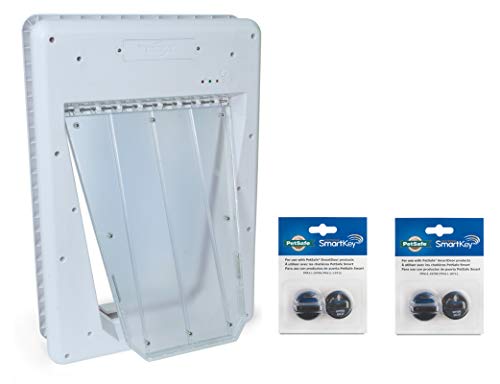
PetSafe Electronic SmartDoor PPA11-10711
A small collar key unlocks this door, so unregistered neighborhood cats and wildlife stay outside. Four locking modes cover in only, out only, both directions or fully locked. Owners report the sensor responds reliably even when pets approach at a trot.
Pros
- Four locking modes handle daily schedule changes
- Collar key responds quickly at normal approach speeds
- Installs in a door or a wall using a mounting kit
Cons
- Collar key can be misplaced or forgotten
- Battery needs periodic replacement

SureFlap Microchip Pet Door Connect
This door reads a pet’s existing microchip, so cats prone to losing collars need no extra tag. A separate hub links the door to the Sure Petcare app for entry and exit alerts. Based on specifications, memory holds up to 32 registered pets.
Pros
- No collar accessory required for entry
- App logs every entry and exit event
- Curfew mode locks the door on a schedule
Cons
- Hub sold separately for app features
- Chip reading can lag with some tag types

Power Pet Electronic Pet Door PX-1
Rather than a flap, this door slides a rigid panel open when it senses the collar transmitter. Timid or arthritic pets never have to push anything. The sealed panel blocks drafts better than any flap design in this lineup.
Pros
- No pushing required for entry
- Seals tightly against wind and cold
- Detection range is adjustable per pet
Cons
- Installation takes more time than a flap
- Motor makes an audible sound when opening

PetSafe Passport Pet Access Smart Door
Passport assigns separate permissions to each pet wearing its own collar key. One dog can go outside while a housemate stays locked in. Programming happens at the door itself, with no app required.
Pros
- Individual access rules per pet
- Handles mixed indoor and outdoor households
- Frame construction holds up to daily use
Cons
- No smartphone app for remote control
- Each additional pet needs its own key

SureFlap DualScan Microchip Cat Flap
DualScan checks a cat’s microchip going out as well as coming in. That two way scan is the only dependable way to let one cat roam while a housemate stays inside. Owners report batteries lasting months between changes.
Pros
- Controls exits and entries separately
- Battery life stretches across months
- Flap movement stays quiet
Cons
- Opening fits cats only, not small dogs
- Glass installation needs a separate adaptor

Power Pet Electronic Pet Door PX-2 Large
This large format panel suits retrievers and similar breeds too big for a standard flap. Seal quality stays tight even at this size, which matters through cold winters. Expect a sizable cutout in the door or wall during installation.
Pros
- Opening size fits large dog breeds
- Seal performance holds up at scale
- No flap for a big dog to push
Cons
- Cutout required is substantial
- Unit is heavy for one person to install
PetSafe SmartDoor Connected Pet Door PPA19-16145
A collar key pairs with a Bluetooth app on this model, adding schedules and status checks from a phone. Setup fits a standard exterior door without a wall kit. Owners report the app stays basic but stable for daily scheduling.
Pros
- Lowest cost route to app connected control
- Schedule setup takes only a few taps
- Fits standard door thickness without extra kit
Cons
- Bluetooth range drops beyond nearby rooms
- Flap seal lets in more draft in high wind
How to choose
How does a smart pet door decide who gets in? Collar keys unlock fast and cost little, but a pet can lose the tag or slip the collar. Microchip readers use the chip already implanted in most cats and dogs, so nothing external can go missing. Recognition takes a fraction of a second longer, and a few older chip formats read poorly. Motion sensing doors open for any warm body nearby, so they only suit a fully fenced yard.
What size opening does your pet actually need? Measure shoulder width at the widest point rather than guessing from breed averages. Add roughly two inches of clearance on width for comfortable passage. Step over height matters too, measured from the floor to the top of the chest. Set the bottom of the opening level with or slightly below that height, since undersizing is the most common buying mistake.
How much heat does a pet door let out? Any cut hole in an exterior wall or door loses warmth in winter. Rigid motorized panels seal tighter than flexible flaps because they close flush against a frame. Double or triple flap layers beat a single flap for draft control. Magnetic closures and a weather strip matter more than any app feature in cold or windy regions.
Which smart pet door works best for multiple pets or large dogs? Households with one escape prone pet and one homebody need individual permissions, not a single shared key. Passport style systems solve that by linking rules to each collar separately. Large breeds need a wider, taller cutout than a standard flap provides, and a rigid motorized panel holds its seal better at that size. Wall installation for either case needs a tunnel kit and attention to studs and wiring.
The lineup, side by side
| # | Model | Entry method | Best for | Score | Price |
|---|---|---|---|---|---|
| 1 | PetSafe Electronic SmartDoor PPA11-10711 | Collar key transmitter | Best overall | 9.4 | Check price |
| 2 | SureFlap Microchip Pet Door Connect | Existing microchip or RFID collar tag | Best for microchip entry and app alerts | 9.2 | Check price |
| 3 | Power Pet Electronic Pet Door PX-1 | Ultrasonic collar transmitter | Best for dogs that refuse to push a flap | 9.0 | Check price |
| 4 | PetSafe Passport Pet Access Smart Door | Passport collar key | Best for multiple pets | 8.8 | Check price |
| 5 | SureFlap DualScan Microchip Cat Flap | Bidirectional microchip reading | Best for indoor and outdoor cats | 8.6 | Check price |
| 6 | Power Pet Electronic Pet Door PX-2 Large | Roughly 12 by 16 inches | Best for large dogs | 8.3 | Check price |
| 7 | PetSafe SmartDoor Connected Pet Door PPA19-16145 | Collar key with app control | Best budget smart option | 8.0 | Check price |
Common questions
Do microchip pet doors read every chip brand?
Most units read the common 15 digit FDX-B chips used worldwide plus several older formats. Check your pet’s chip number length with a vet first, since a handful of older chip types are not supported.
Can a smart pet door keep raccoons out?
Selective entry will not unlock for an animal without the matching key or chip, which blocks most wildlife. A determined raccoon can still force a poorly latched flap, so pick a model with a real locking mechanism rather than magnets alone.
How long do batteries last in a smart pet door?
Owners report several months of typical use on most battery powered models, shorter in cold weather or high traffic homes. Motorized doors run on mains power and use batteries only as a backup during outages.
Will my dog or cat learn to use an automatic door?
Most pets learn within a few days when the door is propped open at first and treats are placed on both sides. Motorized panels take slightly longer to learn because the opening sound is new, but nervous pets often prefer them once trained.
Can smart pet doors be installed in glass?
Some models support glass fitting with a specific adaptor and a professionally cut hole. Metal window frames can interfere with microchip readers, so check clearance guidance from the manufacturer before ordering the adaptor.
Is a smart pet door safe from a break in?
Cat sized openings are too small to be a realistic entry point for a person. Large dog doors deserve more thought, which is why locking modes and a rigid panel matter most on a ground floor installation.
What is the difference between a collar key and a microchip door?
A collar key is a small transmitter attached to the collar that the door detects at close range. A microchip reader instead scans the identification chip already implanted under the skin, so there is nothing extra to attach or lose.
Do smart pet doors work during a power outage?
Battery powered doors keep working without any change. Motorized models include a battery backup so the panel still opens, and most can be locked shut manually if that backup runs low.
Which smart pet door suits a multi pet household?
Passport style systems assign separate rules to each pet’s own collar key, so one animal can go out while another stays locked in. DualScan microchip flaps work similarly for households with more than one cat.
The bottom line
PetSafe’s Electronic SmartDoor fits most households, pairing dependable collar key entry with locking modes that are easy to change day to day. Choose the SureFlap Connect for microchip entry and phone alerts without adding anything to the collar, the Power Pet PX-1 for a pet that will not push a flap, or the Passport system for a household juggling more than one pet’s routine.
Olivia Hartley
Olivia spent several years working at an animal shelter and a pet-supply retailer before joining the editorial team. She researches pet gear with an emphasis on safety, comfort and the fine print that owners often miss.


