Can a Smart Garage Door Controller Replace Your Old Remote?
Chamberlain’s MyQ Smart Garage Hub clips onto the widest range of existing garage door openers, and the Meross MSG200HK is the strongest pick for native Apple HomeKit support. Three-car garages fit better with the Tailwind iQ3, which manages up to three doors from a single Matter-certified controller.
An unmonitored garage door is a common entry point for break-ins, and the Chamberlain MyQ Smart Garage Hub closes that gap for the broadest range of existing openers. Apple households get native support instead from the Meross MSG200HK. Three-car garages consolidate control with the Tailwind iQ3, which runs up to three doors from one Matter-certified unit.
Ecosystem lock-in varies more than most buyers expect: Chamberlain has restricted some third-party Alexa routines in past firmware updates, while newer Matter-certified units avoid that dependency entirely. We compared each model’s installation method, confirmed hub and app compatibility, and cross-checked owner reports about missed door-position alerts before ranking these seven listings.
What we recommend
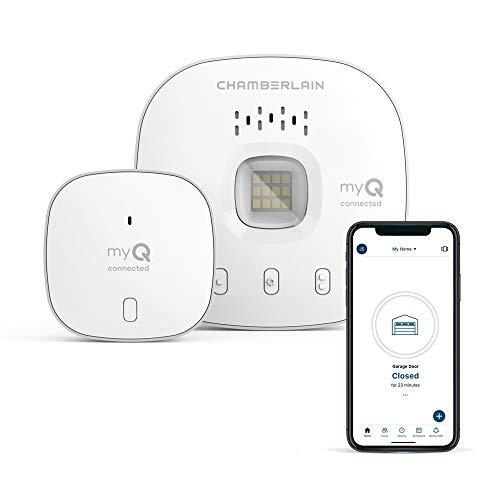
Chamberlain MyQ Smart Garage Hub
This hub clips onto most garage door openers made after 1993, skipping any motor replacement. Open and close alerts land in the MyQ app, and Google Assistant voice commands work through Google’s official integration. Chamberlain has scaled back some third-party Alexa routines in past updates, so voice control depth shifts with firmware version.
Pros
- Clips onto most openers made since 1993
- Wide device support through an established app
- Simple clip-on setup skips opener rewiring
Cons
- No native Apple HomeKit support
- Some third-party Alexa routines are restricted by Chamberlain

Meross Smart Garage Door Opener MSG200HK
Apple’s HomeKit certification comes built in, so this opener appears in the Home app without a separate bridge accessory. Alexa and Google Assistant also respond to it through the Meross app. Installation wires into the opener’s control terminals rather than clipping onto an existing remote.
Pros
- Native HomeKit certification without a bridge device
- Alexa and Google Assistant supported in the same app
- Magnetic sensor confirms actual door position
Cons
- Requires wiring into the opener’s control terminals
- 2.4GHz-only WiFi can complicate dual-band router setup
Tailwind iQ3 Smart Garage Controller
One unit manages up to three garage doors, useful for multi-car garages running separate openers. Matter certification lets it join Apple Home, Google Home or SmartThings without a dedicated skill for each platform. A built-in Thread radio adds mesh reliability alongside WiFi, according to the listing.
Pros
- Manages up to three doors from a single controller
- Matter certification unifies multiple smart home ecosystems
- Thread radio strengthens mesh network reliability
Cons
- Costs more than single-door competitors
- Multi-door wiring takes longer to install
GoGogate2 Smart Garage Door Opener
SmartThings integration runs as an official direct connection, not a workaround, which suits owners already running a SmartThings hub. IFTTT support extends automation beyond the app’s built-in routines. Apple HomeKit needs a separate bridge device here, unlike competitors with native certification.
Pros
- Official direct SmartThings integration
- Broad IFTTT automation support
- Expandable to a second door with an add-on kit
Cons
- HomeKit needs a separate third-party bridge
- App interface feels dated next to newer competitors
Nexx Garage NXG-200
Setup clips onto the existing wall-mounted control button instead of wiring into the opener motor, cutting install time to minutes. The companion app charges no subscription fee for open, close and status alerts. HomeKit support is absent, so Apple-only households need a workaround.
Pros
- No-wiring clip-on installation
- No subscription required for core features
- Works with both Alexa and Google Assistant
Cons
- No native Apple HomeKit support
- Fewer third-party integrations than SmartThings-focused competitors
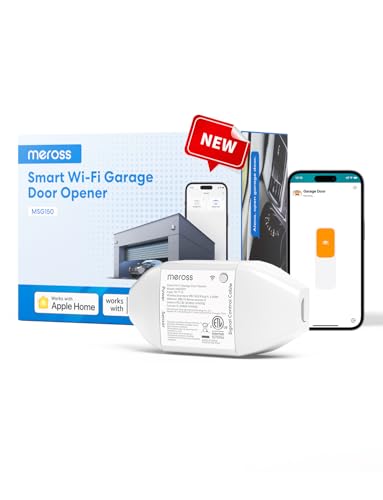
Meross Smart WiFi Garage Door Opener MSG100
This lower-cost sibling of the MSG200HK drops HomeKit certification to reach a lower price point. Scheduling, remote status and shared household access run through the same Meross app. A magnetic sensor still ships with it, so the app reports true door position instead of just the last command sent.
Pros
- Costs less than the HomeKit-certified MSG200HK
- Includes a physical door position sensor
- Supports Alexa, Google Assistant and SmartThings
Cons
- No Apple HomeKit support on this model
- Limited to 2.4GHz-only WiFi

Konnected Smart Garage Door Controller Pro
A documented local API and Home Assistant support suit owners already comfortable with self-hosted smart home setups. HomeKit access runs through Homebridge rather than native certification, so it needs an always-on Homebridge server. Local control keeps the garage door responsive even without an internet connection.
Pros
- Works without cloud dependency once configured locally
- Documented API suits Home Assistant and Homebridge setups
- Wide range of self-hosted integration options
Cons
- HomeKit needs a self-hosted Homebridge server
- Setup is more technical than plug-and-play competitors
Compared at a glance
| # | Model | Connectivity | Best for | Score | Price |
|---|---|---|---|---|---|
| 1 | Chamberlain MyQ Smart Garage Hub | WiFi, bridges to existing opener | Best overall | 9.4 | Check price |
| 2 | Meross Smart Garage Door Opener MSG200HK | WiFi 2.4GHz | Best for Apple HomeKit | 9.1 | Check price |
| 3 | Tailwind iQ3 Smart Garage Controller | Up to 3 from one unit | Best for multi-door garages | 8.8 | Check price |
| 4 | GoGogate2 Smart Garage Door Opener | WiFi | Best for SmartThings | 8.6 | Check price |
| 5 | Nexx Garage NXG-200 | WiFi | Best value | 8.3 | Check price |
| 6 | Meross Smart WiFi Garage Door Opener MSG100 | WiFi 2.4GHz | Best budget | 8.1 | Check price |
| 7 | Konnected Smart Garage Door Controller Pro | WiFi | Best for DIY and Homebridge integration | 8.0 | Check price |
How to choose
How does a smart garage door controller work? Most units either clip onto the existing wall-mounted control button or wire directly into the opener’s control terminals. A magnetic door position sensor confirms whether the door sits open or closed, rather than just logging the last command sent. The paired app relays that status and accepts remote commands over WiFi. Without a position sensor, the app can only guess the door’s state from command history alone.
Which smart home ecosystem fits your garage controller? Apple HomeKit needs either native certification, like the Meross MSG200HK carries, or a bridge such as Homebridge for models like the Konnected controller. Alexa and Google Assistant support spans nearly the whole category, though Chamberlain has scaled back some third-party Alexa routines in past firmware updates. Matter certification, found on the Tailwind iQ3, lets one controller join Apple Home, Google Home and SmartThings without a separate integration for each. SmartThings households get an official direct link from GoGogate2 instead of a third-party workaround.
Is a wired or clip-on garage controller easier to install? Clip-on models such as the Nexx Garage NXG-200 attach to the existing wall button and skip opener wiring, cutting install time to minutes. Wired models, including most Meross and Tailwind units, connect straight to the opener’s control terminals for a steadier connection and typically include a dedicated position sensor. Renters and anyone wary of opening the opener housing tend to prefer clip-on units. Permanent installations lean toward wired units for the added sensor accuracy.
Which controller works best for multi-door garages or DIY smart home setups? Three-car garages consolidate onto a single Tailwind iQ3 instead of running three separate controllers. Home Assistant or Homebridge users get local, cloud-independent control from the Konnected Smart Garage Door Controller Pro. Budget-focused buyers can skip HomeKit altogether with the Nexx NXG-200 or the Meross MSG100 and still keep app-based scheduling. SmartThings-first households benefit from GoGogate2’s official integration rather than a third-party workaround.
Common questions
Do smart garage door openers work with Apple HomeKit?
Some do natively, like the Meross MSG200HK, which carries HomeKit certification without a separate bridge. Others, including Chamberlain’s MyQ Smart Garage Hub, skip HomeKit support entirely. Bridge-dependent options such as the Konnected controller reach HomeKit through Homebridge instead.
Can I control my garage door with Alexa?
Most controllers in this category support Alexa voice commands and routines, including MyQ, Meross, Nexx and Tailwind models. Chamberlain has restricted some third-party Alexa routine types in past firmware updates. Current MyQ documentation lists the exact supported commands.
What’s the difference between MyQ and a universal smart garage controller?
MyQ is Chamberlain’s own system, built primarily for Chamberlain and LiftMaster openers, though it clips onto many other brands too. Universal controllers like Meross or Nexx models stay brand-agnostic and often add HomeKit or SmartThings support that MyQ lacks.
Do smart garage controllers need wiring, or can they just clip on?
Both types exist in this lineup. Clip-on units like the Nexx NXG-200 attach to the existing wall control button. Wired units like the Meross and Tailwind controllers connect directly to the opener’s control terminals, which usually enables a dedicated position sensor.
Is Matter support worth it for a garage door controller?
Yes, for households not locked into one ecosystem, since a Matter controller like the Tailwind iQ3 joins Apple Home, Google Home and SmartThings without separate setups for each. It matters less if you already use a single ecosystem and have no plans to switch.
Which smart garage controller works best for multiple garage doors?
The Tailwind iQ3 manages up to three doors from one controller. GoGogate2 supports a second door with an add-on sensor kit sold separately. Most other models in this lineup handle only one door per unit.
Can a smart garage controller work without WiFi or internet?
Most need WiFi for remote app control and voice assistant integration, since they report status to a cloud service. Locally-controlled options like the Konnected Smart Garage Door Controller Pro can run on a local network without internet once configured. Initial setup on these still typically needs a connection.
SmartThings vs Google Home for garage door control, which integrates better?
GoGogate2 offers an official direct SmartThings integration, which suits SmartThings-first households. Google Home support runs broader across the category, including MyQ, Meross, Nexx and Tailwind models. That breadth makes Google Home the safer default for mixed-device homes.
Is a door position sensor necessary on a smart garage controller?
A position sensor confirms whether the door is truly open or closed, not just that a command was sent. Models like the Meross MSG200HK and MSG100 include a magnetic sensor standard. Skipping a position sensor means the app can only infer status from command history, which can be wrong if the door jams.
Our pick
Households running a mix of Alexa and Google devices do well with the Chamberlain MyQ Smart Garage Hub, given its broad opener compatibility. Apple HomeKit users should reach for the Meross MSG200HK instead, since it skips the bridge device entirely. Multi-door garages get the most value from the Tailwind iQ3, which folds up to three doors and several ecosystems into one controller.
Marcus Chen
Marcus covered consumer electronics for enthusiast tech publications for six years before joining ChoiceCrest. He specializes in translating manufacturer spec sheets into plain-language buying advice, with a focus on audio, computing accessories and smart-home gear.