Ski Goggles That Keep Up When Visibility Drops
The Smith I/O MAG leads this comparison with a magnetic lens swap system and ChromaPop lens technology for sharp contrast in changing light. The Anon M4 Toric suits skiers who also want a magnetic facemask attachment, while the Spy Optic Marshall fits anyone who wears prescription glasses under their goggles.
The Smith I/O MAG stands out because its magnetic lens system lets a skier swap lenses in seconds when light conditions shift from bright sun to flat overcast. Its main limitation is price, since magnetic lens systems cost more than goggles with a standard clip-in lens.
We compared published lens technology, field of view, lens swap mechanism and frame fit across each goggle rather than running our own slope tests.
Our top picks

Smith I/O MAG
A magnetic lens attachment system swaps lenses in seconds without unclipping a frame by hand. ChromaPop lens technology boosts contrast and detail in flat or changing light better than a standard tinted lens. Triple-layer face foam adds comfort during long days on the slope.
Pros
- Magnetic lenses swap faster than clip-in systems
- ChromaPop technology improves contrast in flat light
- Triple-layer foam adds comfort on long ski days
Cons
- Costs more than goggles with a standard lens system
- Magnetic lenses add weight compared to lighter minimalist goggles

Oakley Flight Deck M
A large frame size extends the Prizm lens further toward the edges of vision than smaller goggle frames allow. The toric lens shape reduces distortion compared to flat lens designs. An over-the-glasses compatible fit accommodates skiers who wear prescription eyewear.
Pros
- Larger frame extends peripheral vision over smaller goggles
- Toric lens shape reduces distortion versus flat lenses
- OTG compatible fit works over prescription glasses
Cons
- Larger frame feels bulkier than compact goggle designs
- No magnetic lens swap system like the Smith I/O MAG
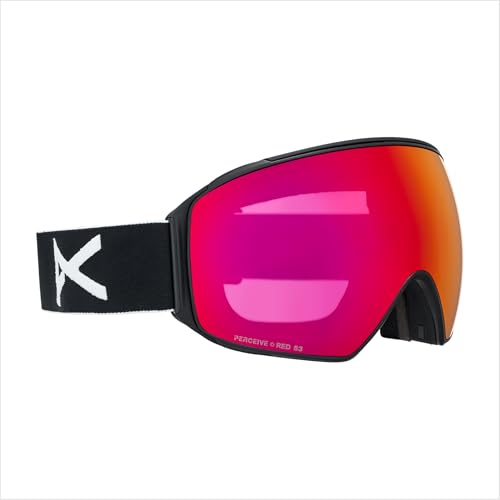
Anon M4 Toric
A magnetic lens and facemask system lets skiers swap both the lens and an attachable facemask without separate buckles or clips. The toric lens shape curves horizontally and vertically for a wider, less distorted field of view. Compatibility with Anon’s MFI helmet system streamlines pairing goggles and a helmet from the same brand.
Pros
- Magnetic facemask attachment adds versatility beyond lens swapping
- Toric lens shape reduces distortion at the edges
- MFI compatibility simplifies pairing with an Anon helmet
Cons
- Premium price similar to the Smith I/O MAG
- Facemask accessory sold separately from the base goggle

Giro Axis
A spherical EXV lens keeps the price below magnetic lens goggles while still offering a wide field of view. An OTG compatible frame fits over most prescription glasses. Standard clip-in lens changes take longer than magnetic systems but keep manufacturing cost down.
Pros
- Lower price than magnetic lens goggles like the Smith I/O MAG
- Spherical lens still offers a wide field of view
- OTG compatible fit works over glasses
Cons
- Clip-in lens changes take longer than magnetic systems
- Fewer premium lens tint options than higher-end goggles

Dragon PXV
A panoramic lens shape extends further toward the edges of the frame than standard spherical lenses, widening the field of view. Lumalens technology adjusts contrast for specific light conditions depending on the tint chosen. A low-profile frame design reduces bulk compared to larger goggles.
Pros
- Panoramic shape widens field of view over standard spherical lenses
- Lumalens tints target specific light conditions
- Low-profile frame reduces bulk on the face
Cons
- No magnetic lens swap system like the Smith I/O MAG or Anon M4
- Panoramic shape fits fewer helmet brands seamlessly than standard shapes

POC Fovea Clarity
Clarity lens technology, developed with Zeiss, sharpens detail and contrast across varying light conditions. A spherical lens shape maintains a natural field of view without the distortion flat lenses introduce. An anti-fog coating on the inner lens surface resists fogging during high-exertion skiing.
Pros
- Clarity lens technology sharpens detail across light conditions
- Anti-fog coating resists fogging during active skiing
- Spherical shape avoids the distortion of flat lenses
Cons
- Fewer interchangeable lens tint options than the Smith I/O MAG
- Dual-layer foam offers less cushioning than triple-layer designs

Spy Optic Marshall
A Happy Lens technology tint is tuned to boost mood-related light wavelengths on overcast days. A deep scoop vent design pulls more airflow through the goggle than standard vents. An OTG compatible frame leaves extra room inside for prescription glasses without pressing against the lenses.
Pros
- Extra interior room fits prescription glasses comfortably
- Deep scoop vents improve airflow over standard venting
- Happy Lens tint targets overcast light conditions
Cons
- No magnetic lens system like the Smith I/O MAG or Anon M4
- Narrower lens shape than panoramic designs like the Dragon PXV
How they stack up
| # | Model | Lens Change System | Best for | Score | Price |
|---|---|---|---|---|---|
| 1 | Smith I/O MAG | Magnetic | Best Overall | 9.1 | Check price |
| 2 | Oakley Flight Deck M | Prizm | Best for Peripheral Vision | 8.9 | Check price |
| 3 | Anon M4 Toric | Magnetic, lens and facemask | Best for Magnetic Accessories | 9.0 | Check price |
| 4 | Giro Axis | EXV | Best Budget | 8.2 | Check price |
| 5 | Dragon PXV | Panoramic | Best Panoramic Field of View | 8.8 | Check price |
| 6 | POC Fovea Clarity | Clarity, developed with Zeiss | Best Lens Clarity | 8.7 | Check price |
| 7 | Spy Optic Marshall | Happy Lens | Best for Glasses Wearers | 8.4 | Check price |
What matters most
What to look for in a ski goggle Lens technology affects how well detail and contrast show up in flat or changing light, which matters more on overcast days than sunny ones. Field of view depends on both lens shape and frame size, with larger frames and curved lenses extending vision toward the edges. Lens change systems range from simple clip-in designs to magnetic systems that swap lenses in seconds.
Magnetic versus clip-in lens systems Magnetic systems, used on the Smith I/O MAG and Anon M4 Toric, let a skier swap lenses quickly between runs as light conditions change. Clip-in systems, like the one on the Giro Axis, take longer to swap but keep the goggle’s price lower. Skiers who rarely change lenses mid-day may not need to pay extra for a magnetic system.
Fitting goggles over prescription glasses OTG, or over-the-glasses, goggles leave extra interior room so prescription frames do not press uncomfortably against the face. The Oakley Flight Deck M, Giro Axis and Spy Optic Marshall all offer this compatibility. Skiers who wear glasses daily should confirm OTG compatibility before choosing a goggle that was not designed with that extra room.
Matching lens tint to light conditions Bright, sunny days call for a darker lens tint to cut glare, while flat or overcast conditions benefit from a lighter tint that boosts contrast, as with the Dragon PXV’s Lumalens or Spy Optic Marshall’s Happy Lens options. Skiers who ride in variable weather benefit most from a magnetic lens system like the Smith I/O MAG, since swapping tints takes only seconds. One fixed lens tint rarely performs well across every condition a ski season brings.
Good to know
What is the fastest way to swap ski goggle lenses?
Magnetic lens systems, used on the Smith I/O MAG and Anon M4 Toric, swap lenses in seconds compared to clip-in designs like the Giro Axis.
Can ski goggles fit over prescription glasses?
Yes. OTG compatible designs like the Oakley Flight Deck M, Giro Axis and Spy Optic Marshall leave extra interior room for glasses.
What ski goggle has the widest field of view?
The Dragon PXV uses a panoramic lens shape that extends further toward the frame edges than standard spherical lenses.
What is ChromaPop lens technology?
ChromaPop, used on the Smith I/O MAG, is a lens technology that boosts contrast and detail, especially in flat or changing light.
Do ski goggles need anti-fog coating?
It helps during active skiing. The POC Fovea Clarity includes an anti-fog coating on the inner lens surface to resist fogging.
What is a toric ski goggle lens?
A toric lens, used on the Anon M4 and Oakley Flight Deck M, curves both horizontally and vertically to reduce distortion at the edges.
Are magnetic ski goggles worth the extra cost?
For skiers who change lenses often during the day, yes. The Smith I/O MAG and Anon M4 Toric swap lenses faster than clip-in goggles.
What lens tint works best for overcast skiing?
Lighter tints designed for low light, like the Dragon PXV’s Lumalens or Spy Optic Marshall’s Happy Lens, improve contrast on overcast days.
Can a budget ski goggle still perform well?
Yes. The Giro Axis uses a spherical EXV lens and OTG compatible fit at a lower price than magnetic lens goggles.
Final word
Most skiers get the best overall versatility from the Smith I/O MAG, which swaps lenses quickly as light conditions change throughout the day. Skiers who also want a magnetic facemask should choose the Anon M4 Toric instead, since it adds that accessory compatibility. Anyone skiing in prescription glasses on a budget should skip premium magnetic goggles and pick the Giro Axis or Spy Optic Marshall.
Sierra Daniels
Sierra's background is in landscape design and nursery retail. She focuses on lawn and garden equipment, outdoor furniture and gear durability, weighing published specs against how materials actually hold up outside.


