9 Shop Vacs Worth Considering for Garage and Job Site Cleanup
Ridgid’s NXT 14-gallon wet/dry vac leads this lineup for its high airflow and rugged steel drum. Craftsman’s 12-gallon model matches much of that power at a lower cost. For tight spaces, the Armor All 2.5-gallon fits under a car seat or in a hall closet.
Sawdust, spilled paint, or a flooded basement all call for the same tool: a wet/dry shop vac. Ridgid’s NXT 14-gallon tops this list for airflow and build quality, with Craftsman’s 12-gallon as the value pick and the Armor All 2.5-gallon for cars and closets. Each model below fits a distinct use case rather than one universal best.
Horsepower ratings printed on the box rarely match real cleaning power, which makes shop vacs harder to compare than they look. We based these rankings on published airflow and tank specifications, filter type, hose diameter, and how owners describe durability after months of use.
What to look for
What to look for in a wet/dry shop vac Airflow, not motor horsepower, determines how fast a shop vac clears debris. Ratings printed on the box measure peak horsepower under lab conditions a plugged-in vac never reaches. Cubic feet per minute and sealed suction come closer to real-world performance. Match a wide hose to that airflow, since a narrow hose chokes a powerful motor.
How much tank capacity do you actually need A woodworking shop or contractor who empties debris daily benefits from a 12 to 14 gallon tank. Home garages rarely need more than 5 to 6 gallons for routine sweeping and spills. Compact 2 to 3 gallon units suit car interiors, stairwells, and closets where storage space is tight. Bigger tanks add weight, so balance capacity against how often you move the vac.
Which filter type stops fine dust Standard cartridge filters clog fast on drywall dust, sanding residue, and concrete powder. A two-stage filter or a dedicated fine-dust bag traps those particles before they reach the motor. Foam filters and cartridge combos work fine for general debris but load up quickly on powder-fine material. Clogged filters cut suction and shorten motor life, so match filtration to your typical mess.
Best shop vac for job sites versus the home garage Job site vacs need a rugged housing, a short hose for tight spaces, and a size that fits in a truck bed. A rubberized shell and low center of gravity survive drops on concrete better than a standard drum. Garage and shop vacs can trade that ruggedness for locking casters and a longer hose that reaches across a two-car bay. Noise matters more indoors, so a quieter motor is worth seeking out for home use.
Our top picks
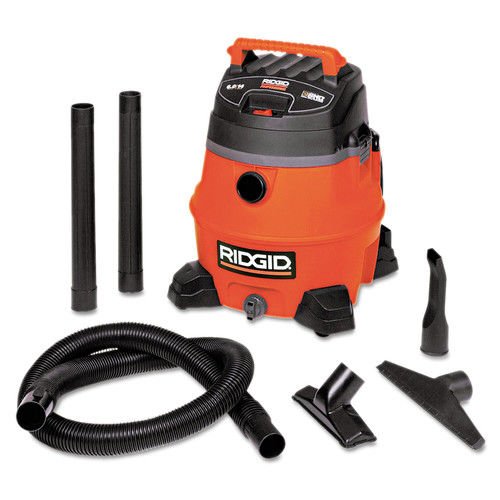
Ridgid NXT 14 Gallon Wet/Dry Vac
Ridgid’s NXT drum holds 14 gallons, letting a busy shop run for hours before emptying. A 6.0 peak HP motor drives a 2.5-inch hose that resists clogging on wood chips and gravel. Locking casters and onboard accessory storage keep the unit steady and organized.
Pros
- Large 14-gallon tank cuts trips to empty
- 2.5-inch hose handles bulky debris without clogging
- Locking casters keep the vac steady on rough floors
Cons
- Bulky footprint takes up shop corner space
- Runs loud at full suction

Craftsman 12 Gallon Wet/Dry Vac
Craftsman’s 12-gallon tank and 5.5 peak HP motor cover most shop tasks without the premium price of the Ridgid. A reusable dry filter swaps out fast for wet pickup. Owners report the included accessory kit covers most jobs without extra purchases.
Pros
- Strong capacity to power ratio for the price
- Comes with a full accessory kit
- Quick swap between wet and dry filtering
Cons
- Casters feel undersized for a full 12-gallon tank
- Standard filter clogs faster on fine sanding dust
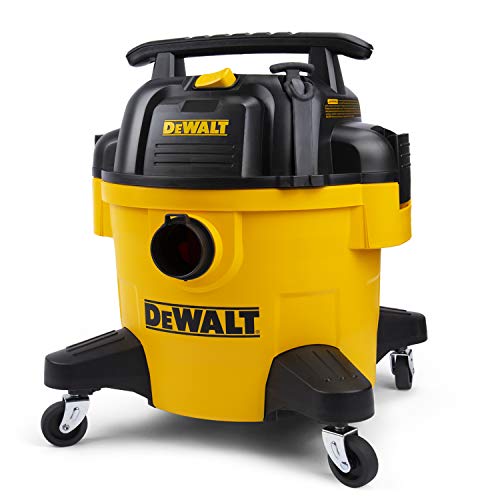
DEWALT DXV06P 6 Gallon Wet/Dry Vac
DEWALT built the DXV06P around a rubberized housing meant for drops and job trailers. Its 6-gallon drum pairs with a 5.0 peak HP motor and a 1.875-inch hose. Compact dimensions let it ride behind a truck seat between sites.
Pros
- Rubberized housing survives jobsite handling
- Compact enough to fit behind a truck seat
- Strong airflow relative to its small drum
Cons
- 6-gallon tank fills fast on demolition debris
- Hose runs narrower and shorter than shop-sized models

Vacmaster Professional 8 Gallon Wet/Dry Vac
Vacmaster’s Professional runs a two-stage filtration system that traps fine dust before it reaches the motor. An 8-gallon tank and 5.5 peak HP motor suit woodworking shops that generate sawdust daily. Sound output stays lower than most vacs in this power class.
Pros
- Two-stage filter captures fine sanding and drywall dust
- Runs quieter than most similarly powered vacs
- 8-gallon tank balances capacity with a manageable size
Cons
- Replacement filters cost more than single-stage designs
- Power cord is shorter than on larger models

Stanley SL18116P 6 Gallon Wet/Dry Vac
Stanley’s SL18116P covers basic garage cleanup with a 4.0 peak HP motor and a 6-gallon tank. A reusable cartridge filter handles both dry debris and wet spills. Light weight makes it easy for a first-time buyer to carry and store.
Pros
- Low cost for occasional garage or home use
- Light enough to carry one-handed
- Simple controls with no learning curve
Cons
- 1.25-inch hose clogs on larger wood chips
- Suction trails larger-motor models on heavy debris

Shop-Vac 5 Gallon Wet/Dry Vacuum
The original Shop-Vac brand still sells this 5-gallon model for routine garage messes. A 4.5 peak HP motor and 1.25-inch hose handle everyday spills and sawdust. Its accessory mounts fit decades of Shop-Vac branded nozzles and extensions.
Pros
- Compact drum stores on a shelf or shop wall
- Wide compatibility with older Shop-Vac accessories
- Reliable for weekly garage and workshop cleanup
Cons
- 5-gallon tank needs frequent emptying on bigger jobs
- Foam and cartridge filter struggles with fine dust
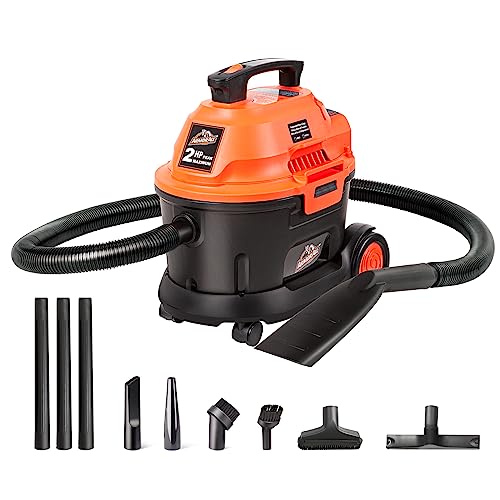
Armor All 2.5 Gallon Wet/Dry Vac
Armor All’s 2.5-gallon vac fits under a car seat or in a hall closet. A 2.0 peak HP motor and 1.25-inch hose suit spot cleanup rather than shop debris. Onboard cord and accessory storage keep the small unit tidy between uses.
Pros
- Small enough to store in a trunk or closet
- Onboard accessory storage keeps parts together
- Light weight makes one-handed carrying easy
Cons
- 2.5-gallon tank fills quickly on anything but light spills
- Underpowered for wood shop or basement flooding cleanup
How they stack up
| # | Model | Capacity | Best for | Score | Price |
|---|---|---|---|---|---|
| 1 | Ridgid NXT 14 Gallon Wet/Dry Vac | 14 gallon | Best overall | 9.4 | Check price |
| 2 | Craftsman 12 Gallon Wet/Dry Vac | 12 gallon | Best value | 9.1 | Check price |
| 3 | DEWALT DXV06P 6 Gallon Wet/Dry Vac | 6 gallon | Best for jobsites | 8.9 | Check price |
| 4 | Vacmaster Professional 8 Gallon Wet/Dry Vac | 8 gallon | Best filtration | 8.6 | Check price |
| 5 | Stanley SL18116P 6 Gallon Wet/Dry Vac | 6 gallon | Best budget | 8.4 | Check price |
| 6 | Shop-Vac 5 Gallon Wet/Dry Vacuum | 5 gallon | Best for garages | 8.2 | Check price |
| 7 | Armor All 2.5 Gallon Wet/Dry Vac | 2.5 gallon | Best compact | 8.0 | Check price |
Common questions
What size shop vac do I need for a garage?
A 5 to 6 gallon tank covers most garage cleanup without becoming hard to store. Step up to 12 gallon or larger only if you run a busy shop that generates debris daily.
Does peak horsepower actually matter on a shop vac?
Peak horsepower is measured under lab conditions a plugged-in vac never sees, so the number rarely predicts real cleaning power. Airflow in cubic feet per minute and sealed suction give a more honest comparison.
Can a shop vac pick up standing water?
Yes, but only wet/dry rated models, and all seven vacs here qualify. Most require removing the dry filter first, since a wet filter can tear or mold.
How do I keep fine dust from clogging the filter?
Switch to a two-stage filter or attach a dedicated fine-dust collection bag for drywall and sanding work. This keeps the primary filter clear and protects the motor from fine grit.
What hose diameter works best for a shop vac?
A 2.5-inch hose moves bulky debris like wood chips and gravel with fewer clogs. Narrower 1.25-inch hoses work fine for household dust and small spills but bog down on chunky material.
Are shop vacs loud enough to need hearing protection?
Most shop vacs run loud enough that extended use calls for ear protection, especially at full suction. Some models, like the Vacmaster Professional, run quieter than average for their power class.
Is a shop vac good for cleaning a car interior?
Yes, a compact 2 to 3 gallon model reaches car interiors better than a full-size shop vac. Small nozzle attachments get into seat gaps and floor mats that a wide hose cannot.
Do shop vacs come with HEPA filters?
True HEPA filters are uncommon on wet/dry shop vacs, though two-stage filters trap similarly fine particles. Check the listing specifications directly if HEPA certification matters for your use.
Ridgid NXT vs Craftsman 12 gallon: which is the better buy?
The Ridgid NXT offers more airflow and a larger 14-gallon tank for heavy daily use. The Craftsman 12-gallon comes close in power at a lower cost, making it the better pick for lighter or occasional shop work.
Final word
Ridgid’s NXT 14-gallon wins this comparison on airflow, tank size, and build quality for daily shop use. Buyers who want most of that performance for less can lean on the Craftsman 12-gallon instead. For cars, closets, and quick spills, the Armor All 2.5-gallon stays the easiest to grab and store.
Jake Monroe
Jake worked as a residential contractor for over a decade before shifting to full-time writing. He evaluates power tools, hand tools and workshop gear through the lens of someone who has actually used them on job sites, not just read the box.


