5 Shelf Brackets Strong Enough for Heavy Loads
Knape & Vogt 182 Series Shelf Bracket leads this comparison for adjustable capacity on a standard track. Wallniture Boston Iron Shelf Brackets suit open kitchen shelving with visible pine or oak boards. Alise Floating Shelf Brackets hide inside the shelf itself, leaving no hardware visible below.
Knape & Vogt 182 Series brackets cover the widest range of jobs, from pantry shelving to workshop storage. Wallniture Boston brackets look right under thick pine in an open kitchen. Alise rod brackets disappear entirely under a floating shelf.
A bracket rated for a hundred pounds only reaches that number when it lands in a stud with the right screws. We compared published capacity per pair, bracket depth against common shelf widths, steel thickness and included fasteners. Owner feedback about pull out failures in drywall anchors shaped where each pick landed.
How to choose
What to look for in a shelf bracket Three numbers matter most: rated load per pair, bracket depth and steel gauge. Published load figures assume anchoring into a stud, so treat that number as a ceiling, not a guarantee. Depth should reach at least two thirds of the shelf width, or the front edge dips once loaded. Steel gauge rarely appears on the listing, so bracket weight works as a rough stand in. Check whether screws come included and whether they suit your wall thickness.
How far apart should shelf brackets sit? Spacing depends more on shelf material than bracket strength. Particle board and MDF start sagging around 24 inches unsupported, so space brackets every 16 inches to match common stud spacing. Solid pine tolerates about 32 inches between supports. Hardwood plywood at 1 inch thickness stretches closer to 36 inches. Runs longer than 48 inches need a third bracket in the middle no matter the material.
Which bracket suits an open kitchen or living room? Visible hardware becomes part of the room once a shelf sits at eye level. Matte black L brackets like the Wallniture Boston pair well with thick pine or oak boards. Concealed rod supports remove hardware from view entirely, though they need a shelf at least 1.5 inches thick to hide the rods. Adjustable track systems look more utilitarian, which suits pantries, closets and garages better than a living room wall.
Best brackets for garages, closets and countertops Storage rooms reward full systems over single brackets. Rubbermaid FastTrack anchors one rail into the studs and lets brackets slide, suiting a garage layout that shifts with the seasons. ClosetMaid ShelfTrack handles the same job for ventilated wire shelving in a wardrobe. Countertops sit in a different category: a granite overhang can exceed 200 pounds, so a rated support like the Federal Brace Hamilton belongs there, anchored into framing.
The best picks, ranked

Knape & Vogt 182 Series Shelf Bracket
Two hooks lock into 82 Series wall standards, so shelf height changes without new holes. Cold rolled steel spreads the load across the standard instead of one point. Depth options span 6 to 16 inches, covering pantry cans through workshop bins.
Pros
- Height adjusts in seconds without redrilling
- Double hook design resists twisting under load
- Depth range fits pantry, closet and workshop shelves
Cons
- Wall standards sold separately, adding to setup
- Visible track reads more utility room than living room

Wallniture Boston Iron Shelf Brackets
Thick L profile matte black iron matches the 2×10 and 2×12 boards common in open kitchens. Four screw holes per plate spread pull out force across more anchors. Multipacks cover a full wall of shelving from one order.
Pros
- Matte black finish disguises scuffs and fingerprints
- Four hole plate lowers stress on each anchor point
- Sized to match standard 2×10 and 2×12 lumber
Cons
- Height stays fixed once mounted
- Included screws run short for thick plaster walls
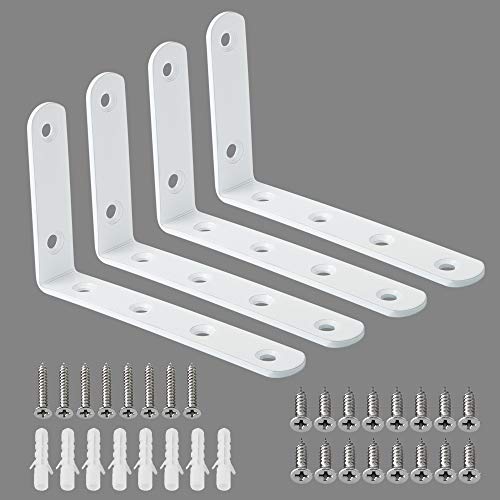
Alise Floating Shelf Brackets
Steel rods slide into holes drilled along the shelf’s back edge, hiding the support inside the wood. Nothing shows below, which is the whole point of a floating shelf. Rod spacing has to match drilled holes within a millimeter or two.
Pros
- No visible bracket under the finished shelf
- Steel rods resist bending better than aluminum rods
- Suits reclaimed timber and butcher block shelving
Cons
- Drilling into the shelf edge demands precision
- Carries less weight than an L bracket of similar size

ClosetMaid ShelfTrack Bracket
Brackets clip into ClosetMaid vertical standards and cradle ventilated wire shelving rather than solid boards. Height moves in one inch steps, useful when hanging space and folded space need rebalancing. Epoxy coating resists humidity common near exterior closet walls.
Pros
- Closet layout changes without drilling new holes
- Wire cradle design stops shelves from sliding forward
- Epoxy finish holds up in humid closets
Cons
- Only fits matching ClosetMaid standards and parts
- Not built for solid wood or plywood shelves

Rubbermaid FastTrack Shelf Bracket
One horizontal rail lags into studs, replacing dozens of individual anchor holes. Brackets lock onto the rail and slide sideways, useful as a garage layout evolves. The same rail also accepts hooks for rakes and hoses.
Pros
- Single rail run replaces many separate wall anchors
- Brackets reposition in seconds along the rail
- Combines shelving and hanging tool storage on one wall
Cons
- Rated load depends on the rail hitting studs
- Whole shelf system relies on one rail component

Federal Brace Hamilton Countertop Support Bracket
Hamilton brackets support granite and quartz overhangs rather than books, and the steel gauge reflects that job. Both legs mount flush so the countertop rests directly on the arm with no gap. Depth choices support a bar overhang while preserving knee clearance.
Pros
- Rated to carry the weight of stone slabs
- Flush arm design stops a slab from rocking
- Depth options preserve seating knee clearance
Cons
- More capacity than most shelving jobs need
- Requires anchoring into framing, not drywall alone

Knape & Vogt 208 Series Heavy Duty Shelf Bracket
208 Series uses thicker steel than the 182 and pairs with matching heavy duty standards. Paint cans, fasteners and power tool cases push past what light duty brackets tolerate. Deeper sizes support a 16 inch board without the front edge dipping under a loaded bin.
Pros
- Thicker steel resists deflection under dense loads
- Handles paint, tools and hardware storage weight
- Still adjusts on the matching wall standard
Cons
- Heavier gauge makes solo alignment more difficult
- Industrial look suits a workshop more than a home
The lineup, side by side
| # | Model | Mounting system | Best for | Score | Price |
|---|---|---|---|---|---|
| 1 | Knape & Vogt 182 Series Shelf Bracket | 82 Series wall standards | Best overall | 9.4 | Check price |
| 2 | Wallniture Boston Iron Shelf Brackets | Powder coated iron | Best for open kitchen shelving | 9.2 | Check price |
| 3 | Alise Floating Shelf Brackets | Blind rod, concealed mount | Best for a hidden, hardware-free look | 9.0 | Check price |
| 4 | ClosetMaid ShelfTrack Bracket | ClosetMaid vertical standards | Best for closet systems | 8.8 | Check price |
| 5 | Rubbermaid FastTrack Shelf Bracket | FastTrack horizontal rail | Best for garage walls | 8.6 | Check price |
| 6 | Federal Brace Hamilton Countertop Support Bracket | Countertop and bar overhang support | Best for countertop overhangs | 8.3 | Check price |
| 7 | Knape & Vogt 208 Series Heavy Duty Shelf Bracket | Heavy gauge cold rolled steel | Best for heavy workshop loads | 8.0 | Check price |
Frequently asked questions
How much weight can a shelf bracket hold?
Household brackets rated for shelving typically hold 40 to 150 pounds per pair when screwed into studs. Drywall anchors alone often cut that figure by half.
Do shelf brackets have to go into wall studs?
For anything beyond light decorative items, yes. Stud wood gives screw threads something solid to grip, while drywall anchors rely on gypsum that crumbles under sustained weight.
What size bracket fits a 12 inch deep shelf?
Choose a bracket close to 10 inches deep. Supporting roughly two thirds to three quarters of the shelf width keeps the front edge from tipping once loaded.
Can shelf brackets mount on a plaster wall?
Yes, once you locate the lath or stud behind the plaster. Plaster crumbles around anchors on its own, so long screws into framing remain the only reliable route.
Are floating shelf brackets as strong as L brackets?
Usually not. Blind rod supports carry less weight for the same footprint, since load transfers through a small drilled area inside the board.
What is the difference between fixed and adjustable shelf brackets?
Fixed brackets screw directly to the wall at one height. Adjustable brackets hook into a vertical standard or horizontal rail, so shelf height can change later without new holes.
Which brackets work with wire closet shelving?
Wire shelving needs a cradle style bracket from a matching system, such as the ClosetMaid ShelfTrack bracket. Flat L brackets do not grip wire shelf edges securely.
Do granite countertops need special brackets?
Yes. Stone overhangs call for a rated countertop support such as the Federal Brace Hamilton, anchored into framing rather than drywall.
How many brackets does a long shelf need?
Most shelves need a bracket every 16 to 32 inches depending on material, plus a middle bracket once the run passes 48 inches.
The verdict
Knape & Vogt 182 Series brackets balance capacity, depth choice and later adjustability better than the rest, which fits most rooms. Pick Wallniture Boston brackets when the shelving stays on display, and Alise rod supports when no hardware should show. Stud mounting still decides whether any rated load number means anything.
Jake Monroe
Jake worked as a residential contractor for over a decade before shifting to full-time writing. He evaluates power tools, hand tools and workshop gear through the lens of someone who has actually used them on job sites, not just read the box.

