Which Sheet Protectors Survive Daily Binder Use
Avery Diamond Clear Heavyweight Sheet Protectors lead for daily binder use, pairing a reinforced binding strip with a low-static face. Amazon Basics Clear Sheet Protectors cost the least per sleeve for bulk filing. Avery Non-Glare Heavyweight suits handouts read under bright office panels. All three use standard letter 3-hole spacing.
Avery Diamond Clear Heavyweight Sheet Protectors suit binders that get opened every day. A reinforced strip absorbs ring stress, and the diamond texture stops pages clinging together when you pull one out. Bulk filing is a different job, and Amazon Basics Clear sleeves handle it for far less per page. Neither belongs around photographs, where thicker archival stock is the safer call.
Listing photos make every sleeve look identical, so the real gaps sit in gauge, hole reinforcement and finish. We compared published specifications, pack counts, hole layouts and stated acid-free status. Recurring owner feedback about tearing at the rings, corner curl and glare under fluorescent panels settled the close calls.
Our top picks

Avery Diamond Clear Heavyweight Sheet Protectors
Diamond texturing breaks up static, so pages separate instead of sticking in a stack. A reinforced binding strip carries the load at the rings, which decides how long a daily-use binder lasts. Top loading keeps documents in place when a binder tips off a desk.
Pros
- Reinforced binding edge resists ring tear-out
- Diamond texture cuts static and page sticking
- Acid-free polypropylene will not react with toner
Cons
- Costs more per sleeve than economy packs
- Textured face still catches some overhead light
Amazon Basics Clear Sheet Protectors
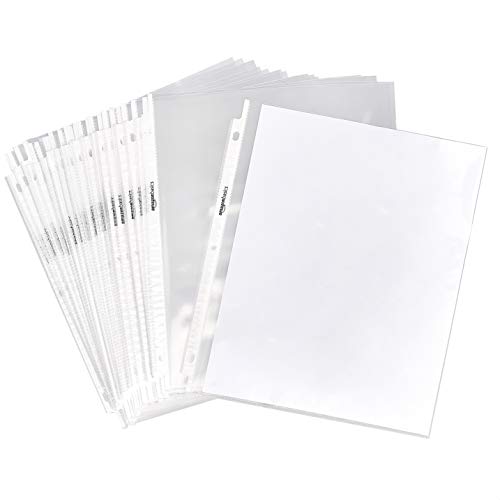
Plain clear polypropylene in large counts makes this the default for paperwork nobody will handle again. Top loading and standard 3-hole spacing fit any letter binder. Owners describe the gauge as lighter than premium sleeves, which is fine in a storage box and noticeable in a training manual.
Pros
- Lowest cost per sleeve among these picks
- Counts of 100 and 200 cover whole-shelf projects
- Untextured face keeps 8 point print legible
Cons
- Lighter gauge creases when pages are flipped hard
- No non-glare version in the same line

Samsill Heavyweight Clear Sheet Protectors
Samsill lands between economy stock and premium Avery, offering a heavier wall without premium pricing per sleeve. Archival-safe polypropylene means no yellowing against toner or inkjet output over years. Reach for it where documents sit in place long term but still get read.
Pros
- Heavier wall than economy sleeves at a modest step up
- Archival-safe stock suits multi-year storage
- Consistent hole spacing seats cleanly on rings
Cons
- Static cling is worse than on textured sleeves
- Glossy clear finish glares under direct downlights

Dunwell Heavyweight Sheet Protectors
Dunwell aims at sleeves that live in service manuals, recipe binders and shop reference folders. Thick walls resist the soft creasing that shows after the same page is flipped hundreds of times. Bulk is the tradeoff, so a full binder of these wants wider rings than usual.
Pros
- Stiff walls stay flat instead of curling at corners
- Survives repeated flipping without soft creases
- Wipes clean after kitchen or garage handling
Cons
- Thicker stock fills a binder faster
- Stiffness slows single-sheet loading slightly

Avery Non-Glare Heavyweight Sheet Protectors
Matte surfacing scatters reflections, keeping text readable under conference room panels and window light. Contrast softens a little, so photographs and fine line art lose some bite. Choose it for slide handouts, rate sheets and training packets rather than image portfolios.
Pros
- Matte face kills overhead light reflections
- Reinforced edge matches the Diamond Clear line
- Easier on the eyes through long reading sessions
Cons
- Softens detail in photos and fine line art
- Costs more per sleeve than clear stock

C-Line Heavyweight Polypropylene Sheet Protectors
C-Line supplies a lot of school and office stock, and this line shows it through reinforced binding strips and repeatable punch alignment. Sleeves seat square on the rings, which keeps a set of 30 student binders uniform. Clarity holds up well, though the surface takes fingerprints quickly.
Pros
- Reinforced strip survives student handling
- Punch alignment stays consistent box to box
- Case quantities available for school orders
Cons
- Surface shows fingerprints quickly
- Fewer finish options than the Avery range

StoreSMART Heavy Duty Sheet Protectors
StoreSMART leans archival, with thick walls built for photographs, certificates and artwork that must never bond to the plastic. Rigidity guards corners while a binder stands upright on a shelf. Pack counts run small, making this a targeted purchase rather than a filing solution.
Pros
- PVC-free stock will not cloud photo emulsion
- Rigid walls protect corners in upright storage
- Clarity holds up for display-style pages
Cons
- Smaller pack counts than mainstream office brands
- Thick walls limit how many fit one binder
How to choose
What to look for in a sheet protector Gauge decides most of it. Heavier polypropylene resists creasing, curls less and survives repeated flipping. Loading edge comes next: top loading holds pages in when a binder tips, while side loading speeds up swapping. Check whether the binding strip is reinforced, since that strip is where sleeves fail first. Acid-free or archival-safe wording tells you the plastic will not react with toner across years of storage. Ignore pack photos, which look identical across every brand here.
Clear, non-glare or textured finish Clear sleeves reproduce photos, charts and small print most faithfully. Non-glare stock trades a little contrast for text that stays readable under fluorescent panels or a bright window. Diamond and matte texturing land in between, and they add a practical benefit: less static, so pages peel apart instead of clinging. Match the finish to the room lighting rather than to the document.
Best sheet protectors for high-traffic binders Service manuals, recipe collections and training packets absorb hundreds of page turns a year. Heavyweight lines such as Dunwell hold their shape long after economy sleeves go soft. Plan for wider rings, because thick sleeves eat binder capacity fast. Budget roughly two-thirds the page count you would fit using light stock in the same binder. Anyone flipping pages with gloves or wet hands should skip textured faces, which trap grime in the pattern.
Photos, certificates and long-term storage Archival storage has one hard rule: no PVC. Vinyl sleeves soften over warm summers and can bond to photo emulsion. Polypropylene lines like StoreSMART avoid that failure entirely. Store binders upright, keep them out of attic heat, and leave adhesive corners outside the sleeve. For anything irreplaceable, accept the smaller pack count and buy archival stock.
The lineup, side by side
| # | Model | Material | Best for | Score | Price |
|---|---|---|---|---|---|
| 1 | Avery Diamond Clear Heavyweight Sheet Protectors | Polypropylene, acid-free | Best overall | 9.4 | Check price |
| 2 | Amazon Basics Clear Sheet Protectors | Polypropylene, acid-free | Best value | 9.2 | Check price |
| 3 | Samsill Heavyweight Clear Sheet Protectors | Archival-safe polypropylene | Best budget heavyweight | 9.0 | Check price |
| 4 | Dunwell Heavyweight Sheet Protectors | Heavyweight polypropylene, acid-free | Best for heavy daily use | 8.8 | Check price |
| 5 | Avery Non-Glare Heavyweight Sheet Protectors | Polypropylene with non-glare finish | Best for presentations | 8.6 | Check price |
| 6 | C-Line Heavyweight Polypropylene Sheet Protectors | Heavyweight polypropylene | Best for classroom sets | 8.3 | Check price |
| 7 | StoreSMART Heavy Duty Sheet Protectors | Archival polypropylene, no PVC | Best for photos and archives | 8.0 | Check price |
Common questions
What are the best sheet protectors for everyday binder use?
Avery Diamond Clear Heavyweight takes the top spot. Reinforced binding strips absorb ring stress, and diamond texturing keeps pages from clinging when you pull one out.
How thick should a heavy duty sheet protector be?
Listings label gauge as economy, standard or heavyweight instead of quoting a number. Binders opened daily want anything marked heavyweight. Economy weight is fine inside a storage box.
Are sheet protectors safe for photographs?
Polypropylene and polyester sleeves are safe. Avoid PVC and vinyl, which soften with age and can stick to photo surfaces. Archival lines such as StoreSMART state PVC-free on the listing.
Top loading vs side loading: which is better?
Top loading keeps pages in place when a binder tips, so it suits reference material. Side loading speeds up frequent swaps, which helps with menus, rate sheets and rotating schedules.
Can sheet protectors hold two pages back to back?
Yes, and most people do exactly that. Two sheets lie flat in a standard sleeve. A third bows the plastic and strains the binding strip at the rings.
Do non-glare sheet protectors reduce print quality?
Apparent contrast drops a little. Body text stays easy to read, while photographs and fine graphics look softer. Keep clear sleeves for image-heavy pages.
Which sheet protectors fit a standard 3-ring binder?
Any letter-size sleeve punched with standard 3-hole spacing. All seven picks here use that spacing at 8.5 by 11 inches, so binder fit is not a differentiator.
Why do sheet protectors stick together?
Static builds between smooth polypropylene faces, worst in dry indoor air. Textured sleeves like Avery Diamond Clear cut it down. Fanning the stack before loading helps too.
What sheet protectors work best for a classroom set?
C-Line Heavyweight, because punch alignment stays consistent across boxes and case quantities are available. Reinforced strips also handle the way students yank pages out.
Is it worth paying more for heavyweight sheet protectors?
Only when pages get handled. Heavyweight stock earns its keep in manuals and recipe binders, and wastes money on paperwork filed once and never opened.
Our take
For a binder that actually gets used, buy Avery Diamond Clear Heavyweight and move on. A reinforced strip and low-static face fix the two failures owners complain about most. Filing a cabinet of paperwork nobody will reopen is a different problem, and Amazon Basics Clear sleeves cover it for a fraction per page. Anyone storing photographs or certificates should skip both lines and choose the PVC-free archival stock from StoreSMART.
Marcus Chen
Marcus covered consumer electronics for enthusiast tech publications for six years before joining ChoiceCrest. He specializes in translating manufacturer spec sheets into plain-language buying advice, with a focus on audio, computing accessories and smart-home gear.