Water stones, oilstones and diamond plates compared
Sharp Pebble Premium Whetstone 1000/6000 tops the ranking, pairing a repair grit with a polishing grit and including the flattening stone most kits omit. King KDS 1000/6000 covers the same range in a longer, slower wearing body. DMT Dia-Sharp D8C cuts hard steels that water stones glaze on.
Sharp Pebble Premium Whetstone 1000/6000 handles nearly every home kitchen job. Its 1000 grit face resets a dull edge, then 6000 refines it for clean slicing. Soft binders like this dish quickly, so plan on flattening every few sessions. Woodworkers grinding hardened chisels should start with a diamond plate instead.
Grit labels alone tell you little, because Japanese, American and European scales do not line up. We compared abrasive type, stated grit, stone dimensions, binder hardness and soaking requirements from current Amazon listings. Owner reports on dishing, glazing and base stability broke the ties.
What we recommend

Sharp Pebble Premium Whetstone 1000/6000
One block carries 1000 grit for reshaping and 6000 grit for finishing, covering a home cook’s entire routine. A bamboo base with a silicone cradle keeps the stone steady on a wet counter. Flattening stone and angle guide arrive in the box, so nothing else is needed on day one.
Pros
- Repair and polish grits in a single purchase
- Silicone cradle holds firm on wet countertops
- Flattening stone included rather than sold separately
Cons
- Soft binder dishes faster than premium stones
- Wants a five to ten minute soak before each use
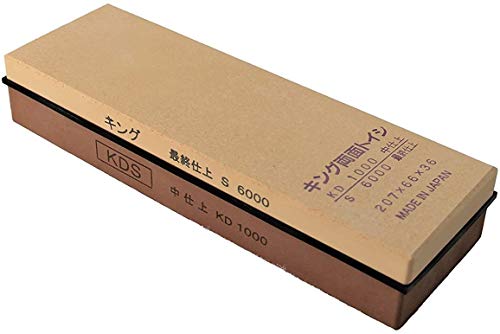
King KDS 1000/6000 Combination Whetstone
King has produced this grit pairing for decades, and it stays a default recommendation in Japanese knife circles. Its 1000 side cuts predictably without gouging, while 6000 leaves a bright working polish. At 207mm long, a chef knife crosses the face in one stroke.
Pros
- Long face suits full length chef knife strokes
- Predictable feedback that beginners read quickly
- 34mm body allows years of flattening
Cons
- Needs a full soak of around ten minutes
- Supplied plastic holder slides on smooth counters
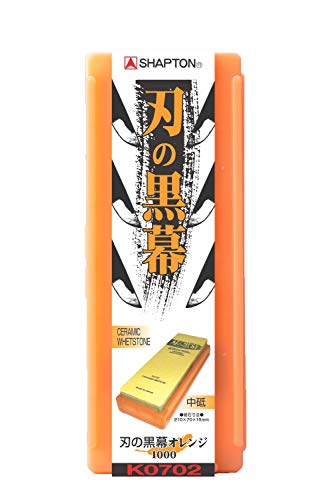
Shapton Kuromaku Professional 1000 Ceramic Stone
Ceramic binder bites into stainless quickly and needs only a splash of water rather than a soak. That makes a mid prep touch up practical instead of a chore. Its moulded case doubles as a raised holder, lifting knuckles clear of the counter.
Pros
- Cuts hard stainless faster than soft water stones
- Ready to work within seconds
- Storage case works as a stable stand
Cons
- Single grit, so a finishing stone is still needed
- Thinner body than a soaking stone

DMT Dia-Sharp D8C 8-Inch Diamond Stone
Monocrystalline diamond bonded to a steel plate cuts powder metallurgy and high vanadium blades that clog water stones. Flatness holds for the life of the plate, so it laps your other stones as well. Coarse 45 micron abrasive strips metal fast, which calls for a light hand on thin kitchen knives.
Pros
- Stays flat with no maintenance at all
- Cuts steels that glaze softer abrasives
- Doubles as a lapping plate for water stones
Cons
- Too aggressive for finishing work on its own
- Cutting rate drops once the break in period ends

Norton IB8 India Combination Oilstone
Aluminium oxide in an oil filled binder suits carbon steel woodworking tools, where slow controlled cutting beats speed. Coarse and fine faces carry a chisel through the full bevel process. Honing oil floats swarf clear of the surface, which holds off the glazing that spoils dry use.
Pros
- Holds flatness longer than soft water stones
- Bevel control suits chisels and plane irons
- No soaking or drying time between uses
Cons
- Oil makes it messier than a water stone
- Poor fit for a food prep counter

Smith’s TRI-6 Arkansas TriHone Sharpening System
A rotating triangular block holds coarse and fine synthetic stones plus a natural Arkansas finishing stone. Changing grit takes a flip rather than a second setup and rinse. Stone length runs 152mm, short for a chef knife but well matched to pocket and hunting blades.
Pros
- Three grits without buying three separate stones
- Moulded base keeps stones off the bench
- Bundled angle guide helps newcomers hold a bevel
Cons
- 152mm faces are short for long kitchen knives
- Natural Arkansas stone cuts slowly on modern stainless
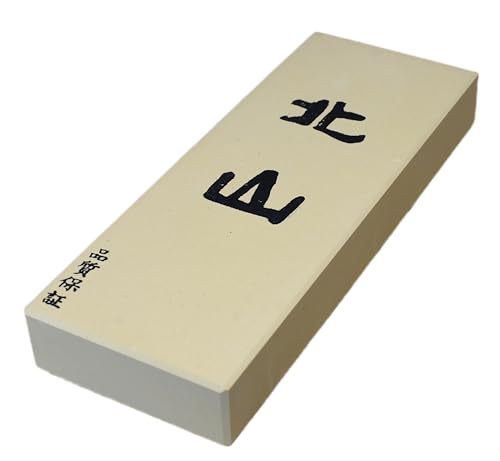
Kitayama 8000 Grit Super Polishing Whetstone
Fine 8000 grit refines an edge that a 1000 grit stone has already shaped. Polishing at this level removes micro serrations that snag on tomato skin. Slurry builds fast and does much of the cutting, so keep the face wet and let the stone work.
Pros
- Produces a clean push cutting edge on carbon steel
- 75mm width fits broad blades and cleavers
- Wooden stand lifts the stone for knuckle clearance
Cons
- Pointless without a coarser stone first
- Soft face needs frequent flattening
How they compare
| # | Model | Grits | Best for | Score | Price |
|---|---|---|---|---|---|
| 1 | Sharp Pebble Premium Whetstone 1000/6000 | 1000 and 6000 | Best overall | 9.4 | Check price |
| 2 | King KDS 1000/6000 Combination Whetstone | 1000 and 6000 | Best value | 9.2 | Check price |
| 3 | Shapton Kuromaku Professional 1000 Ceramic Stone | 1000 | Best for fast edge repair | 9.0 | Check price |
| 4 | DMT Dia-Sharp D8C 8-Inch Diamond Stone | Coarse, 45 micron | Best for hard steels | 8.8 | Check price |
| 5 | Norton IB8 India Combination Oilstone | Coarse and fine sides | Best for chisels and plane irons | 8.6 | Check price |
| 6 | Smith’s TRI-6 Arkansas TriHone Sharpening System | Coarse, fine, natural Arkansas | Best budget | 8.3 | Check price |
| 7 | Kitayama 8000 Grit Super Polishing Whetstone | 8000 | Best for mirror finishing | 8.0 | Check price |
Before you buy
How grit numbers translate to real work Think in three jobs rather than four digit numbers. Anything from 200 to 600 reshapes a chipped or badly rounded edge. Grits between 800 and 1500 set the working bevel, and 1000 covers that for nearly every kitchen knife. Above 3000 you are polishing, which improves slicing feel but adds no cutting power. Two grits do the job for most people, not five.
Water stones, oilstones and diamond plates Water stones cut fast because fresh abrasive keeps breaking free, and dishing is the price. Oilstones such as the Norton IB8 wear slowly and pair naturally with carbon steel woodworking tools. Diamond plates like the DMT Dia-Sharp D8C never leave flat and bite into vanadium rich alloys that glaze other abrasives. Ceramic stones sit between those camps, cutting hard steel while needing only a splash of water.
Kitchen knives vs chisels and plane irons German stainless and Japanese carbon blades both respond to a 1000 and 6000 pairing, which explains why the Sharp Pebble and King KDS appear so often. Look for a face at least 180mm long so a chef knife crosses it in one pass. Woodworking runs the other way: coarse and fine oilstone faces give the slow control a chisel bevel needs. Flatten the back of a chisel before touching the bevel, since an edge is only as sharp as the flat behind it.
Flattening, soaking and stone care Soft water stones hollow in the middle within a few sessions, and a dished face rounds your bevel. Draw a pencil grid on the surface, lap it with a flattening plate or coarse diamond stone, then stop once every line has gone. Soaking stones want five to fifteen minutes in water, while splash and go ceramics need none. Dry stones fully before storage, because trapped water can crack a stone in a cold garage.
Good to know
What grit sharpening stone should a beginner start with?
A 1000 and 6000 combination covers almost everything a home cook meets. The 1000 face restores a dull edge in a few minutes, then 6000 refines it. Add a 400 grit stone only when you have chipped blades to repair.
Do sharpening stones need to be soaked in water?
Traditional water stones such as the King KDS want five to fifteen minutes of soaking. Splash and go ceramics like the Shapton Kuromaku need only a surface sprinkle. Diamond plates work dry or with a little water.
Which is better, a whetstone or a diamond plate?
Whetstones give finer control and cheaper polishing grits. Diamond plates cut harder steels and never need flattening. Plenty of owners keep both, using the DMT Dia-Sharp D8C to lap their water stones between sharpening sessions.
How often should you flatten a sharpening stone?
Check every two or three sessions. Pencil grid, lap, stop when the lines vanish. Soft water stones hollow quickly, while ceramic and diamond surfaces stay flat far longer.
Can you use oil on a water stone?
No. Oil clogs the porous binder and stops the stone releasing fresh abrasive. Oilstones such as the Norton IB8 are built for it, and the two types should never share a block.
Is 8000 grit worth it for kitchen knives?
It pays off if you slice soft produce or push cut herbs, since polishing removes the micro teeth that snag. General chopping does fine on a 1000 grit finish, which also holds its bite longer between touch ups.
What angle should you hold a knife on a sharpening stone?
Roughly 15 degrees per side for Japanese blades and 20 degrees for German stainless. A guide like the one bundled with the Smith’s TRI-6 helps until muscle memory forms. Consistency beats hitting an exact number.
How do you sharpen chisels and plane irons on a stone?
Work the coarse oilstone face first, then the fine face, and finish on a polishing stone. Lap the back of the tool flat before touching the bevel. A honing guide keeps the angle repeatable across sessions.
Can a sharpening stone fix a chipped knife?
Yes, though it takes patience. Grind the chip out on a coarse stone or a diamond plate, then rebuild the bevel at 1000 grit. Deep chips near the heel may be quicker to remove on a belt grinder.
What size sharpening stone do you need for a chef knife?
At least 180mm of length, and 200mm is more comfortable. Shorter faces such as the 152mm stones on the Smith’s TRI-6 force a sawing motion that ruins bevel consistency. Width of 60mm or more helps with tall blades.
Final word
Sharp Pebble Premium Whetstone 1000/6000 remains the sensible first buy, since it handles repair and polish and ships with the flattening stone most kits leave out. Pick the DMT Dia-Sharp D8C instead if your knives use high vanadium powder steel or you want a plate that stays flat for good. Woodworkers sharpening chisels should skip both and start with the Norton IB8 oilstone.
Jake Monroe
Jake worked as a residential contractor for over a decade before shifting to full-time writing. He evaluates power tools, hand tools and workshop gear through the lens of someone who has actually used them on job sites, not just read the box.


