Self-Emptying Robot Vacuums Worth the Upgrade
The iRobot Roomba Combo j9+ is the top pick for most homes, pairing a washable mop with camera navigation that avoids real obstacles. The Roborock Q Revo MaxV comes closest on value thanks to its self-washing dock, and the Shark AI Ultra 2-in-1 costs less while still skipping weeks of manual bin emptying.
The iRobot Roomba Combo j9+ leads this list by combining a washable, retractable mop with camera-based navigation built to recognize real obstacles, not just furniture. It costs more than most rivals and its replacement bags add an ongoing expense, but it is the only model here that empties dust and manages mopping from one dock. Shoppers on a tighter budget should look at the Shark AI Ultra 2-in-1 instead.
We compared official dock capacity, mop type, navigation technology, and battery runtime across current listings, then weighed those specs against patterns in owner feedback for pet hair and small-space performance.
The best picks, ranked

iRobot Roomba Combo j9+
The Combo j9+ pairs a retractable mop with the same camera-based navigation iRobot built for the j7 line. Its Clean Base holds weeks of debris, so emptying becomes a once-a-month chore instead of a daily one. Owners who want one dock for both mopping and vacuuming tend to rate this model highest among iRobot’s self-emptying lineup.
Pros
- Retractable mop lifts automatically on carpet
- Camera-based navigation avoids cords and pet waste
- Clean Base dock handles weeks of debris without a bag change
Cons
- Clean Base and replacement bags cost more than basic docks
- Mop pad needs manual rinsing after heavy use

Roborock Q Revo MaxV
Roborock built the Q Revo MaxV around a dock that washes and dries its own mop pad, not just the dust bin. Dual cameras work with LiDAR to spot small obstacles like charging cables before the robot runs them over. According to the listing, battery life stretches to roughly three hours on a single charge.
Pros
- Dock washes and hot-air-dries the mop pad between runs
- Dual-camera system spots small obstacles like cables and shoes
- Long runtime covers larger homes in one cycle
Cons
- Dock footprint is larger than basic charging stations
- App setup takes longer due to the number of settings

Shark AI Ultra 2-in-1 with Self-Empty Base
This model gets buyers into self-emptying cleaning without the premium price of iRobot or Roborock flagships. Shark’s AI Laser Vision maps each room and remembers multiple floors for homes with more than one level. A mopping pad attaches to the base for light touch-ups, though it is not a true retractable mop system.
Pros
- Lower cost of entry into self-emptying vacuums
- Mapping stores multiple floor plans for multi-level homes
- Base doubles as a charging and storage dock
Cons
- Mopping pad is an attachment, not a built-in retractable mop
- Replacement bags are a recurring cost

Eufy by Anker RoboVac X10 Pro Omni
Eufy’s Omni Station handles emptying, mop washing, and hot-air drying from a single base, which keeps the mop from smelling musty between runs. LiDAR navigation maps rooms quickly and the mop head lifts automatically when it detects carpet. Anker’s backing means firmware updates have been fairly consistent since launch.
Pros
- Omni Station handles emptying, mop washing, and hot-air drying in one base
- LiDAR mapping is fast and accurate on first run
- Auto-lift keeps carpets dry during mixed-floor cleaning
Cons
- Base is bulky and needs clearance on two sides
- Eufy app account creation is required for full features

Ecovacs Deebot X2 Omni
The X2 Omni swaps the usual single rectangular mop pad for two rotating pads that scrub along baseboards and into corners. A dToF LiDAR sensor paired with a 3D camera keeps the robot from getting confused by dark rugs or black furniture legs. Owners managing larger single-level homes often cite the long runtime as the reason they chose this model.
Pros
- Rotating mop pads apply extra scrubbing pressure along edges and corners
- Long runtime suits larger single-level homes
- TrueDetect 3D camera reduces false stops on dark objects
Cons
- Round mop pads cannot reach tight square corners as well as square pads
- Dock software has had slower update cycles than rivals

iRobot Roomba j7+
The j7+ skips mopping entirely and focuses on vacuum-only cleaning with camera navigation tuned to spot pet waste and loose cords. It shares the same Clean Base dock as the Combo j9+, so bin capacity is identical. Buyers who already own a separate mop, or do not want one, get iRobot’s avoidance tech for less.
Pros
- Camera-based avoidance is tuned specifically for pet waste and cords
- Clean Base matches the Combo line for bin capacity
- Lighter and smaller than the Combo j9+ without the mop hardware
Cons
- No mopping function at all, so a separate mop is still needed
- Shorter runtime than newer Roborock and Eufy models
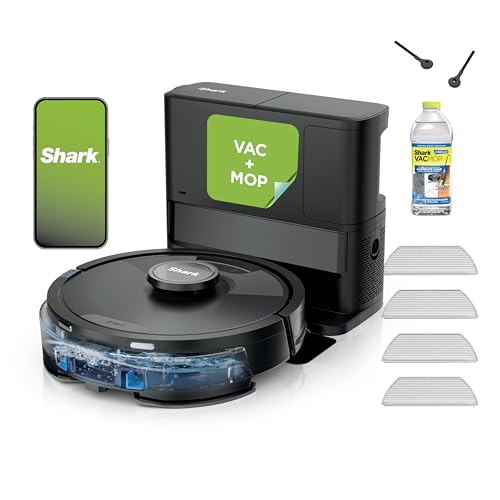
Shark Matrix Plus Self-Empty Robot Vacuum
Shark’s Matrix Clean system drives the robot in overlapping rows rather than a random bounce pattern, which shows up as fewer missed strips on large open floor plans. It is vacuum-only, so hard floors still need a separate mop pass. The self-empty base runs quieter during its empty cycle than some competing docks.
Pros
- Matrix Clean pattern reduces missed strips on large open floors
- Large onboard dust cup needs fewer empties even before the dock kicks in
- Self-empty base is quieter than some rivals during the empty cycle
Cons
- No mopping, so hard floors still need a separate pass
- Larger footprint than compact self-empty docks
How they compare
| # | Model | Self-Empty Dock | Best for | Score | Price |
|---|---|---|---|---|---|
| 1 | iRobot Roomba Combo j9+ | Up to 60 days | Best Overall | 9.4 | Check price |
| 2 | Roborock Q Revo MaxV | Auto-empty + mop wash + hot air dry | Best Value | 9.2 | Check price |
| 3 | Shark AI Ultra 2-in-1 with Self-Empty Base | Up to 60 days | Best Budget | 8.8 | Check price |
| 4 | Eufy by Anker RoboVac X10 Pro Omni | Omni Station: empty, wash, dry | Best for Small Apartments | 8.9 | Check price |
| 5 | Ecovacs Deebot X2 Omni | OZMO Pro wash + self-empty + dry | Best for Mopping | 8.7 | Check price |
| 6 | iRobot Roomba j7+ | Clean Base, up to 60 days | Best for Pet Owners | 8.4 | Check price |
| 7 | Shark Matrix Plus Self-Empty Robot Vacuum | Up to 60 days | Best for Large Homes | 8.2 | Check price |
What matters most
What a self-emptying dock actually does A self-emptying dock lifts debris straight from the robot’s bin into a larger container inside the base after each run. Most docks hold six to eight weeks of dust and hair before that container needs a bag change. Weekly runs on a 1,500 square foot home might stretch a bag out even longer. Separately, some docks now wash and dry a mop pad too, which is a different job from simply emptying dust.
Self-empty versus self-empty-and-wash Basic self-empty docks like the one on the Roomba j7+ only handle dry debris. Combo mopping docks, such as the ones on the Q Revo MaxV and Deebot X2 Omni, also rinse and dry the mop pad between cleaning cycles. That extra step matters most in kitchens, where a dirty mop pad left sitting can smell within a day. Buyers who only have hard floors in one or two rooms may not need the washing step at all.
Best for small apartments and tight hallways Compact docks matter more in apartments than suction power does. The Shark AI Ultra’s base is narrower than Roborock’s or Eufy’s Omni Station, which helps in a hallway closet. Smaller apartments also finish faster, so battery life becomes less important than dock footprint. A model with strong mapping, like AI Laser Vision or LiDAR, still helps avoid repeat passes in a cluttered studio layout.
Is a self-emptying vacuum worth it for pet hair? Pet hair clogs standard robot bins faster than household dust does, which is where a bigger dock container pays off fastest. Models with camera-based avoidance, including the j7+ and Combo j9+, are built specifically to steer around pet waste accidents rather than smear them across a floor. Owners of shedding breeds often report emptying the robot’s small onboard bin daily without a dock, versus monthly with one. Mopping docks add less value here, since pet hair is a dry-debris problem rather than a mess that needs washing.
Common questions
How often do I need to empty a self-emptying robot vacuum?
Most self-empty docks hold six to eight weeks of debris for an average home, though homes with pets or thick carpet may need a bag change closer to the four-week mark.
Do self-emptying robot vacuums also mop?
Only the combo models do. The Roomba Combo j9+, Roborock Q Revo MaxV, Eufy X10 Pro Omni, and Ecovacs Deebot X2 Omni all include a mop pad, while the Roomba j7+ and Shark Matrix Plus are vacuum-only.
What is the difference between a self-empty dock and a self-wash dock?
A self-empty dock only moves dry debris into a bag inside the base. A self-wash dock goes further by rinsing and drying the mop pad between cycles, which matters most for households that mop daily.
Are self-emptying robot vacuums good for pet hair?
Yes. Pet hair fills a robot’s small onboard bin quickly, so a dock that holds weeks of debris cuts down on manual emptying for shedding breeds specifically.
Can a self-emptying robot vacuum map multiple floors?
Most current models, including the Shark AI Ultra and the Roomba series, store several floor maps and switch automatically when the robot is carried to a different level.
Do I still need to buy replacement bags for the dock?
Yes, for dust-only docks. Bagless Omni-style docks like Eufy’s and Ecovacs’ still need periodic maintenance, but they skip the recurring bag purchase.
Which self-emptying robot vacuum has the longest battery life?
The Ecovacs Deebot X2 Omni and Roborock Q Revo MaxV both list runtimes well past two hours, which covers most homes in a single cycle.
Is a self-emptying robot vacuum worth it for a small apartment?
It helps less with runtime and more with dock footprint. A compact base like Shark’s self-empty station fits tighter closets than larger Omni-style docks.
Do self-emptying vacuums avoid pet waste automatically?
iRobot’s j7+ and Combo j9+ use camera-based navigation specifically tuned to recognize and steer around pet waste, a feature not every brand includes.
How loud is the self-empty cycle?
Dock emptying is louder than normal vacuuming for a few seconds, though owners of Shark’s Matrix Plus report a quieter empty cycle than some Roborock and Ecovacs docks.
Our take
The Roomba Combo j9+ is the strongest pick for most households, combining a washable mop with camera navigation that steers around real messes, not just furniture legs. Buyers who want a cheaper way into self-emptying cleaning should start with the Shark AI Ultra 2-in-1 instead, accepting a smaller dock and attachment-style mop in exchange for a lower cost of entry. Homes with only hard floors and no interest in mopping fit better with the Roomba j7+ or Shark Matrix Plus.
Marcus Chen
Marcus covered consumer electronics for enthusiast tech publications for six years before joining ChoiceCrest. He specializes in translating manufacturer spec sheets into plain-language buying advice, with a focus on audio, computing accessories and smart-home gear.


