Running Watches That Fit Beginners Through Ultra Training
The Garmin Forerunner 265 is the strongest overall pick, pairing a bright AMOLED display with detailed training metrics for regular runners. The Garmin Forerunner 55 suits beginners who want core GPS tracking without extra complexity, while the Coros Pace 3 fits runners who prioritize multi-day battery life over a premium screen.
The Garmin Forerunner 265 leads this list for combining a bright AMOLED touchscreen with deep training load and recovery metrics most runners actually use. Its battery life trails Coros devices built specifically around longer run times between charges. Beginners and ultra-distance runners chasing longer battery life should look at the alternatives further down this list.
We compared battery life, GPS accuracy, training metrics and smartwatch features like notifications and payments across seven running watches rather than ranking by screen size alone.
What to look for
What actually matters when choosing a running watch Battery life decides how often a watch needs charging, which matters more for ultra-distance runners than casual training. GPS accuracy, especially multi-band or dual-frequency tracking, affects pace and distance readings in urban areas or under tree cover. Training metrics like readiness scores or training load help runners decide when to push and when to rest. Display type trades brightness and detail against battery efficiency.
Entry-level watches versus training-focused models Garmin’s Forerunner 55 keeps the interface simple for runners who just want pace, distance and heart rate without extra complexity. The Forerunner 265 and Polar Pacer Pro add deeper training load and recovery metrics that newer runners may not need yet. Starting simple and upgrading once structured training begins often serves beginners better than buying a premium watch immediately.
Battery life for ultra-distance training Coros’s Pace 3 and Garmin’s Instinct 2 both prioritize long battery life, covering multi-day training trips or ultra-distance races without a mid-activity charge. The Garmin Forerunner 265 and Apple Watch Ultra 2 trade some of that battery life for brighter AMOLED displays and deeper smartwatch features. Runners training for ultras should weigh battery life above screen quality when choosing.
Smartwatch features beyond running metrics Apple Watch Ultra 2 offers the deepest smartwatch integration here, including contactless payments and full iPhone notifications, though it requires an iPhone to use. Garmin’s Forerunner 965 and 265 add notifications and music storage without needing a specific phone brand. Runners who want a dedicated running tool with minimal smartwatch distraction may prefer Coros’s Pace 3 or Polar’s Pacer Pro instead.
What we recommend

Garmin Forerunner 265
A bright AMOLED touchscreen displays more detail than the simpler screens on entry-level running watches. A training readiness score combines sleep, recovery and recent training load into one daily number. Multi-band GPS improves location accuracy in dense urban areas with tall buildings.
Pros
- AMOLED display shows more detail than basic LCD screens
- Training readiness score simplifies daily training decisions
- Multi-band GPS improves accuracy in dense urban areas
Cons
- Shorter battery life than Coros watches built for ultras
- Higher cost than entry-level GPS running watches

Garmin Forerunner 55
A simplified interface focuses on pace, distance and heart rate without the deeper training load metrics of pricier models. Daily suggested workouts adjust based on recent training, useful for runners new to structured training. A lighter body feels less noticeable on the wrist than larger multisport watches.
Pros
- Simple interface suits runners new to GPS watches
- Longer battery life than premium AMOLED models
- Lighter and less bulky on the wrist
Cons
- Lacks the deeper training load and recovery metrics of pricier watches
- Basic LCD screen shows less detail than AMOLED displays

Coros Pace 3
Up to 38 hours of continuous GPS tracking covers an ultra-distance race without needing a mid-run charge. A lightweight silicone band and compact case keep it comfortable through long training blocks. Training metrics include running power, a feature many competitors reserve for premium multisport watches.
Pros
- Exceptionally long GPS battery life for ultra-distance runs
- Lightweight build stays comfortable over long training blocks
- Running power metric rivals pricier multisport watches
Cons
- Smaller app ecosystem than Garmin’s Connect platform
- Screen is smaller than Garmin’s AMOLED models

Apple Watch Ultra 2
Deep iPhone integration covers notifications, calls and contactless payments alongside running metrics. Third-party running apps add training plans and pace alerts beyond Apple’s native Workout app. A bright always-on display stays readable in direct sunlight during outdoor runs.
Pros
- Full smartwatch functionality beyond running metrics
- Always-on display stays readable in bright sunlight
- Deep iPhone integration for calls and notifications
Cons
- Requires an iPhone, unlike Android-compatible running watches
- Shorter battery life than dedicated running watches like the Coros Pace 3
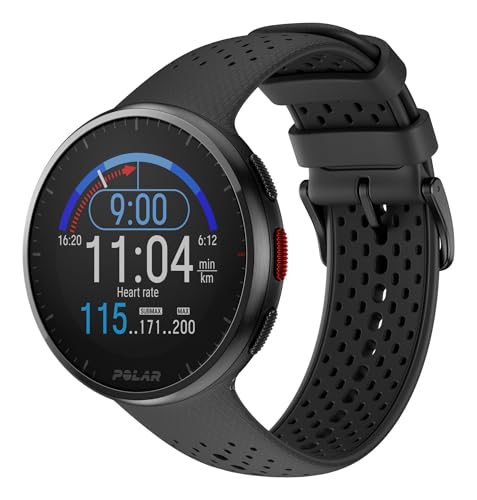
Polar Pacer Pro
Training Load Pro separates cardio and muscle load into two distinct scores rather than one combined number. Recovery Pro analysis factors in an orthostatic heart rate test for a more detailed readiness read. A lightweight polymer case keeps weight down for long runs.
Pros
- Training Load Pro splits cardio and muscle load separately
- Recovery Pro adds a more detailed readiness analysis
- Lightweight case suits long-distance comfort
Cons
- Shorter battery life than Coros or Garmin’s longer-life modes
- Smaller screen than Garmin’s AMOLED Forerunner models

Garmin Forerunner 965
A larger AMOLED display shows more data fields at once than the standard Forerunner 265 screen. A titanium bezel adds durability without the bulk of a full multisport watch case. Garmin’s full training metric suite, including training readiness, carries over from the 265 at a larger screen size.
Pros
- Larger AMOLED screen shows more data at a glance
- Titanium bezel adds durability over standard aluminum
- Full training metric suite matches Garmin’s top running watches
Cons
- Highest cost of any watch on this list
- Larger case feels bulkier on smaller wrists

Garmin Instinct 2
A MIL-STD-810 rating certifies this watch against shock, water and temperature extremes beyond standard running watch testing. An optional solar charging lens extends battery life between charges on sunny training days. A simpler monochrome display trades detail for extreme battery efficiency.
Pros
- Military-standard durability rating exceeds typical running watches
- Optional solar charging extends time between charges
- Long battery life suits multi-day training trips
Cons
- Monochrome display shows less detail than AMOLED screens
- Fewer advanced training metrics than Garmin’s Forerunner line
Compared at a glance
| # | Model | Display | Best for | Score | Price |
|---|---|---|---|---|---|
| 1 | Garmin Forerunner 265 | AMOLED touchscreen | Best Overall | 9.2 | Check price |
| 2 | Garmin Forerunner 55 | Standard LCD | Best for Beginners | 8.6 | Check price |
| 3 | Coros Pace 3 | Up to 38 hours GPS mode | Best Battery Life | 8.8 | Check price |
| 4 | Apple Watch Ultra 2 | watchOS, iPhone required | Best for iPhone Integration | 8.7 | Check price |
| 5 | Polar Pacer Pro | Training Load Pro, Recovery Pro | Best for Training Load Analytics | 8.5 | Check price |
| 6 | Garmin Forerunner 965 | Large AMOLED touchscreen | Best Premium Display | 9.0 | Check price |
| 7 | Garmin Instinct 2 | MIL-STD-810 rated | Best Rugged Durability | 8.4 | Check price |
Frequently asked questions
How long does a running watch battery last?
Battery life varies widely, from about 7 days on the Polar Pacer Pro to up to 38 hours of continuous GPS tracking on the Coros Pace 3, or up to 28 days in smartwatch mode on the Garmin Instinct 2.
What is training load on a running watch?
Training load estimates how much stress recent workouts have placed on the body. The Polar Pacer Pro’s Training Load Pro splits this into cardio and muscle load separately, while Garmin’s Forerunner 265 combines it into a readiness score.
Do I need an iPhone for the Apple Watch Ultra 2?
Yes. The Apple Watch Ultra 2 requires an iPhone for setup and full functionality, unlike Garmin, Coros or Polar watches that pair with both iOS and Android.
What is multi-band or dual-frequency GPS?
Multi-band GPS, found on the Garmin Forerunner 265 and Coros Pace 3, uses more satellite signal types to improve accuracy in urban areas or under tree cover compared to standard single-band GPS.
Is an AMOLED display worth it for a running watch?
AMOLED displays, like those on the Garmin Forerunner 265 and 965, show brighter colors and more detail than standard LCD screens, though they typically use more battery.
What running watch is best for a beginner?
The Garmin Forerunner 55 keeps the interface simple and focuses on core metrics like pace and heart rate, which suits runners new to GPS watches.
Can a running watch survive extreme temperatures or drops?
The Garmin Instinct 2 carries a MIL-STD-810 durability rating, which tests for shock, water and temperature extremes beyond typical running watch standards.
What is solar charging on a running watch?
Solar charging, available on the Garmin Instinct 2, uses a lens built into the display to add charge from sunlight, extending the time between manual charges.
Do premium running watches track recovery, not just workouts?
Yes. Watches like the Garmin Forerunner 265 and Polar Pacer Pro include recovery-focused metrics, such as readiness scores or recovery time estimates, alongside standard workout tracking.
The bottom line
For most runners who want detailed training metrics on a bright, modern display, the Garmin Forerunner 265 is the strongest overall pick. Beginners who want simple GPS tracking without extra complexity should choose the Garmin Forerunner 55 instead, and ultra-distance runners who need battery life above all else should go with the Coros Pace 3.
Derek Holt
Derek has a background coaching recreational and amateur athletes and has worked the sales floor at specialty fitness retailers. He focuses on equipment durability, ergonomics and realistic use cases rather than marketing claims.