Picking a Running Light for Early Morning Runs
BioLite HeadLamp 425 leads the pack with a flat front profile that resists bounce. Petzl BINDI is the ultralight pick for road runners who mainly need visibility. Noxgear Tracer2 vest makes you visible from every angle in traffic, covering a gap no headlamp fills alone.
Seeing the path and being seen by traffic are different jobs, and few lights do both well. BioLite HeadLamp 425 leads this list because its flat housing sits flush against the forehead and resists the nodding beam that plagues most headlamps. Petzl BINDI stays almost weightless for runners who mainly need to be noticed.
A bright forward beam does little for a driver approaching from a side junction, which is why this category splits into two separate problems. We compared beam patterns and output claims, strap design and bounce, weight, battery runtimes, and rear or side visibility, then weighed those against owner reports on comfort and how fast output fades as batteries drain.
How to pick the right one
Seeing the trail vs being seen by traffic A headlamp throws light forward so you can place your feet, but a driver crossing from the side sees almost none of it. Reflective strips only work once headlights already aim at you. Runners near traffic should pair a forward beam with something that shines rearward and sideways, whether that is a vest, a clip on strobe, or a rear red light.
Why headlamps bounce and how to stop it The most common complaint about headlamps is a beam that nods with every stride. That happens when weight sits forward of the forehead on a stretchy strap. Flat profile lamps and rear battery packs fix it by shifting mass backward, and a crown strap helps further on heavier units.
How much runtime do you actually get? Runtime figures are usually quoted at the lowest brightness setting, so full power often lasts a fraction as long. Many lamps also step down automatically as the battery drains, dimming the beam before it dies. For a one hour dark run, check that the stated runtime at your chosen brightness comfortably exceeds the session.
Does beam shape matter more than lumens? A narrow, high output spot lights a distant tree while leaving the rock beside your foot in shadow, the wrong priority for running. A wide flood pattern covering both sides of your stride reads uneven terrain far better. On streets with lighting already, a modest flood plus strong rear visibility beats raw lumens every time.
Our top picks

BioLite HeadLamp 425
A flat front housing sits close against the forehead, so the beam does not nod with each stride. Moving the battery to the back balances the load and stops the strap from creeping. A rear red light adds visibility to traffic approaching from behind.
Pros
- Flat profile eliminates most beam bounce
- Rear battery balances weight on the head
- Rear red light covers traffic from behind
Cons
- Runtime at full output is short
- Built in battery cannot be swapped mid run

Petzl BINDI Headlamp
At roughly 35 grams, this headlamp disappears once you put it on. A thin cord headband adjusts quickly and folds into a pocket after the run. Output and runtime at full power trail larger, trail focused units.
Pros
- Light enough to forget you are wearing it
- Packs down into a pocket easily
- Adjusts fast with a secure cord headband
Cons
- Not bright enough for technical trails
- Runtime drops fast at maximum output

Black Diamond Sprinter 500 Headlamp
A wide flood beam lights the ground on both sides of your feet, not just what is straight ahead. The rear battery pack carries a red strobe for cars approaching from behind. Extra weight shows up on longer runs, and the connecting cable can snag a cap.
Pros
- Wide beam suits uneven trail footing
- Rear strobe adds visibility to traffic
- Balances weight between front and rear
Cons
- Heavier than minimalist running lamps
- Cable between units can catch on headwear
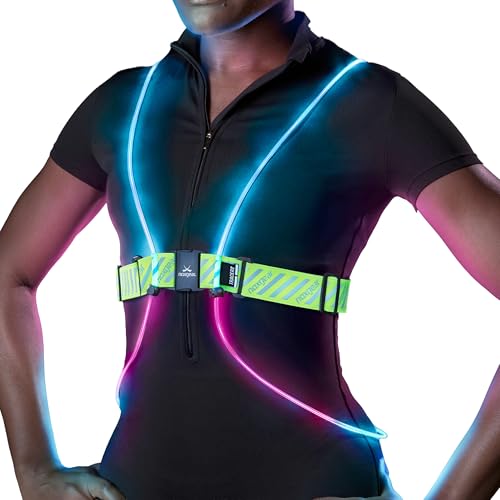
Noxgear Tracer2 Visibility Vest
This is a light up vest, not a headlamp, solving a problem beams cannot: visibility from the side. Illuminated fiber optic tubes read as a person rather than a point of light. A separate headlamp still covers genuinely dark terrain underfoot.
Pros
- Visible from every angle, including the side
- Reads as a human shape to drivers
- Fits over most running layers
Cons
- Provides no ground illumination at all
- Charges separately from a headlamp

Petzl ACTIK CORE Headlamp
Either a rechargeable core or standard AAA batteries power this headlamp, useful on multi day trips or after a missed charge. Beam and output suit mixed road and trail running, and a red mode preserves night vision. Faster efforts reveal more bounce than dedicated running lamps allow.
Pros
- Runs on a rechargeable core or spare AAA cells
- Bright enough for trail and road use
- Red mode preserves night vision
Cons
- Bounces more than dedicated running lamps
- Single front unit means less balanced weight

Knuckle Lights Advanced
Held in each hand, these lights swing with your arms and light the ground from two angles. Shadows that hide uneven pavement flatten out as a result. Nothing sits on your head, so bounce and strap pressure disappear entirely.
Pros
- Two angles reveal trip hazards clearly
- Nothing on your head, so no bounce
- Arm movement sweeps light across the path
Cons
- Occupies both hands during the run
- Takes a few runs to aim well

Nathan HyperBrite RX Strobe Light
A small clip on strobe adds rear or side visibility to gear you already own. It attaches to a waistband, pack strap, or cap and runs long in flashing mode. No beam means it works only as an addition to a headlamp, not a replacement.
Pros
- Cheap way to add rear visibility
- Clips to almost any kit you already own
- Runs a long time in flashing mode
Cons
- Provides no useful ground illumination
- Small clip can work loose on rough terrain
Side by side
| # | Model | Output | Best for | Score | Price |
|---|---|---|---|---|---|
| 1 | BioLite HeadLamp 425 | Up to 425 lumens | Best overall | 9.4 | Check price |
| 2 | Petzl BINDI Headlamp | Up to 200 lumens | Best ultralight | 9.2 | Check price |
| 3 | Black Diamond Sprinter 500 Headlamp | Up to 500 lumens | Best for trails | 9.0 | Check price |
| 4 | Noxgear Tracer2 Visibility Vest | Illuminated visibility vest | Best for being seen | 8.8 | Check price |
| 5 | Petzl ACTIK CORE Headlamp | Up to 600 lumens | Best battery flexibility | 8.6 | Check price |
| 6 | Knuckle Lights Advanced | Handheld running lights, pair | Best for even footing | 8.3 | Check price |
| 7 | Nathan HyperBrite RX Strobe Light | Clip on strobe light | Best budget visibility | 8.0 | Check price |
Common questions
How many lumens do I need for running?
Lit roads need only 100 to 200 lumens, since the job is mostly being seen. Unlit paths call for 200 to 400, and technical trails at speed benefit from 400 or more, though beam shape still matters more than the number.
Head torch or chest light, which is better for running?
Headlamps point wherever you look, which helps at junctions and on technical ground. Chest and waist lights sit lower and cast longer shadows that reveal trip hazards better. Many trail runners combine both on rough terrain.
How do I stop a head torch from bouncing?
Pick a flat front lamp or one with a rear battery pack. Tighten the strap snug without pressure, and use a crown strap if the lamp includes one. A thin cap or headband underneath adds friction and stops slipping.
Are running lights waterproof?
Most are water resistant rather than fully waterproof, so rain is fine but submersion is not. Check the stated rating before running in heavy weather, and dry the charging port before plugging in a wet lamp.
Do reflective clothes replace a running light?
No, reflective material only returns light already aimed at it. A driver who has not turned toward you yet sees nothing. Active lighting gets you noticed early enough for a driver to react.
Should I use flashing or steady mode?
Flashing draws attention and works best facing traffic, while steady light helps judge your own distance and speed. Many runners keep steady light forward and flashing light rearward.
How long do rechargeable running lights last?
Battery life per charge depends on the mode selected, and the cells themselves typically hold useful capacity for a few hundred charge cycles. Storing a lamp fully drained for months shortens that life, so top it up occasionally.
Can I run with a headlamp in cold weather?
Yes, though lithium cells lose capacity in the cold, so expect shorter runtime on freezing mornings. Keeping the lamp inside a jacket until you set off helps, and swappable battery lamps let you carry a warm spare.
Running vest or headlamp, do I need both?
A headlamp lights the ground so you can place your feet on dark trails. A visibility vest solves the separate problem of being seen from the side in traffic. Runners near roads often need both.
Final word
BioLite HeadLamp 425 is the best all round choice, staying steady on the head while covering both seeing and being seen. Road runners who want the least weight should reach for the featherweight Petzl BINDI. Add the Noxgear Tracer2 vest if your route runs near traffic, since side visibility is a gap no forward beam fills.
Derek Holt
Derek has a background coaching recreational and amateur athletes and has worked the sales floor at specialty fitness retailers. He focuses on equipment durability, ergonomics and realistic use cases rather than marketing claims.


